Métis Cree Frock Coat, ca. 1840
GUEST: The coat was in my father's possession. And he passed away a few years ago. So I inherited it. And I have not actually ever taken it out of the box before.
APPRAISER: What do you--
GUEST: I've looked at it and seen how beautiful it was and didn't want to hurt it or disturb it. So it's been in a box.
APPRAISER: This is from Canada. And the folks who made this are called the Red River Cree, the Métis Cree. This was tailored by a Indigenous woman, a First Nation woman of Canada, but in a western style. It's in the style of a frock coat. In, uh, the 1600s, Canada was called Rupert's Land, and it was being settled and exploited for beaver pelts, the beaver trade. The Hudson Bay Company was extremely active in Canada. They ruled Canada in a certain fashion. Many of the Hudson’s Bay factors were Scottish. Thomas Douglas in 1811, founded a colony, and it became known as the Red River Colony. So we have two cultures here. We have frontiersmen harvesting beaver pelts and sending them back to Europe. And we had, uh, the Native Cree ladies who were living in the area, and they intermarried with these men, and they became called Métis Cree. So this is made by a First Nation woman of Cree heritage for probably her husband, who was perhaps a factor in the Hudson’s Bay Company, or at the very least, he was working in the fur trade, and he was someone of some significance because it's a pretty fancy coat. Your average individual would not have had a coat of such splendor. I would say that this is made perhaps somewhere between 1830 and 1850. The coat is made out of deer hide. It's Native-tanned. The ornamentation is porcupine quill. The ladies would harvest quills. They'd flatten them with their teeth. They dip them in different pigments to dye them, and then they would embroider this quill work in traditional patterns. So you have floral elements and then stars, celestial orbs, sun devices, moon devices-- extremely important to Native people. They would derive power from these celestial entities. These ladies are very attuned to the natural world. And then the whole device may also be seen as a tree of life. Ancestors are exceedingly important to Native people. The glass beads, made in Venice, Italy. The dye pigments are traded, probably from either France or England. The blue silk, undoubtedly from France. It does have some wear-- some of the porcupine quill is missing. There's a little bit of soiling. On a retail basis, I would say this is worth $30,000.
GUEST: (exhales) Wow. Wow.
APPRAISER: It's just fabulous.
GUEST: It's beautiful, it really is. I love to see the back-- I hadn't seen it before. (laughs)
APPRAISER: Maybe $35,000, $40,000 for insurance purposes.

$30,000 Retail
$40,000 Insurance
Featured In

episode
Maryland Zoo, Hour 2
ROADSHOW finds rare treasures at Maryland Zoo including one worth $180,000!
19th Century

appraisal
1876 John Alexander Stoneware Cooler

appraisal
Braided Rawhide Lariat, ca. 1850
appraisal
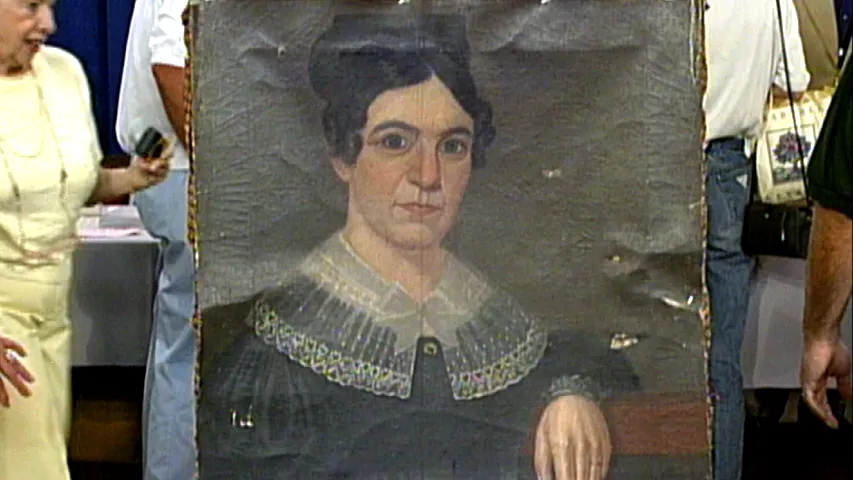
American School Portrait, ca. 1820

appraisal
Eskimo Hunting Helmet, ca. 1820
Understanding Our Appraisals
Executive producer Marsha Bemko shares her tips for getting the most out of ANTIQUES ROADSHOW.
Value can change: The value of an item is dependent upon many things, including the condition of the object itself, trends in the market for that kind of object, and the location where the item will be sold. These are just some of the reasons why the answer to the question "What's it worth?" is so often "It depends."
Note the date: Take note of the date the appraisal was recorded. This information appears in the upper left corner of the page, with the label "Appraised On." Values change over time according to market forces, so the current value of the item could be higher, lower, or the same as when our expert first appraised it.
Context is key: Listen carefully. Most of our experts will give appraisal values in context. For example, you'll often hear them say what an item is worth "at auction," or "retail," or "for insurance purposes" (replacement value). Retail prices are different from wholesale prices. Often an auctioneer will talk about what she knows best: the auction market. A shop owner will usually talk about what he knows best: the retail price he'd place on the object in his shop. And though there are no hard and fast rules, an object's auction price can often be half its retail value; yet for other objects, an auction price could be higher than retail. As a rule, however, retail and insurance/replacement values are about the same.
Verbal approximations: The values given by the experts on ANTIQUES ROADSHOW are considered "verbal approximations of value." Technically, an "appraisal" is a legal document, generally for insurance purposes, written by a qualified expert and paid for by the owner of the item. An appraisal usually involves an extensive amount of research to establish authenticity, provenance, composition, method of construction, and other important attributes of a particular object.
Opinion of value: As with all appraisals, the verbal approximations of value given at ROADSHOW events are our experts' opinions formed from their knowledge of antiques and collectibles, market trends, and other factors. Although our valuations are based on research and experience, opinions can, and sometimes do, vary among experts.
Appraiser affiliations: Finally, the affiliation of the appraiser may have changed since the appraisal was recorded. To see current contact information for an appraiser in the ROADSHOW Archive, click on the link below the appraiser's picture. Our Appraiser Index also contains a complete list of active ROADSHOW appraisers and their contact details and biographies.


