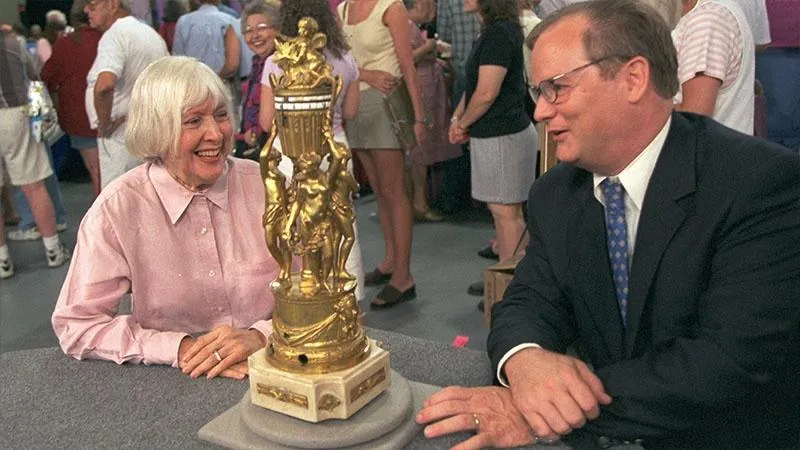
APPRAISER: It's exciting to me as an American furniture… appraiser and as an appraiser of – of other antiques to see something like this. This is the first piece of French furniture that we've seen from this period. And your ancestor owned it, right?
GUEST: Yeah.
APPRAISER: Yeah. He was a pretty dapper guy, this guy here. He was a diplomat, right?
GUEST: Yes.
APPRAISER: And went to Paris a lot.
GUEST: Yes.
APPRAISER: Went to France.
GUEST: He was born in Maryland and went to… Europe at about age nine or ten…
APPRAISER: Okay.
GUEST: …and wandered around-- that got him I guess the qualifications to be a diplomat. We don't know exactly when he would have gotten it, but we think it was either when he was ambassador to Paris in about 1905, ’07 area…
APPRAISER: Okay.
GUEST: …or else before that.
APPRAISER: In the 1880s or '90s.
GUEST: 1880s, '90s…
APPRAISER: Well that’s—
GUEST: Until about 1900 somewhere.
APPRAISER: Well, he has very good taste, because what he purchased then is a piece that in the 1880s or '90s would have been about 100 years old. And what you've brought in is a piece in the Louis XVI style. French period-- not a copy made in the 19th century, but actually a period piece. In France, you had the Louis XIV and XV style, which are a bit more rococo and a bit more curvy. This piece typifies the Louis XVI style. It has Neoclassical elements, really. This brass gallery with the swag and the tassel, these... feel that. Don't you love the crispness of those?
GUEST: Oh, yeah, they're sharp.
APPRAISER: These are cast gilt mounts, which are wonderfully chased, wonderful quality. You have this satinwood, called citronnier, and then down here, the cracks in the panels are okay because there was shrinkage. It shows that it's a period piece. The panels have shrunk and they've cracked. So that doesn't bother you, right?
GUEST: Okay, no.
APPRAISER: Okay.
GUEST: That part, you know, is just life, you know.
APPRAISER: Part of it's... right. So, the wonderful thing about Louis XVI furniture is that Louis XVI was fascinated with all things mechanical-- mechanical devices and hidden compartments. And he and Marie Antoinette, really, especially Marie Antoinette, ordered lots of major furniture from Paris Ébénistes, furniture makers and this is one of the pieces, fairly high style. They get more elaborate, but this is fairly high style. You said there are five hidden compartments in this piece?
GUEST: Yes, there's one under the drawer here…
APPRAISER: Okay, let's look at that one.
GUEST: …that you take the drawer out, isn't terribly hard to find.
APPRAISER: Is this where you hide all your money?
GUEST: Well only… not anymore since it's on TV. I took it out.
APPRAISER: You took it out, okay, you took it out.
GUEST: Yeah.
APPRAISER: I was hoping to find a lot of money. There's a hidden compartment underneath this panel hidden away. And there are four others, right?
GUEST: Yes. Well we have one under here, but I…
APPRAISER: Okay.
GUEST: …it's hard to get at.
APPRAISER: Okay. So, and then there are three more down below. So let - let me say here quickly, what's typical of the French. We have these wonderful oak secondary woods. The dovetail construction is wonderfully fine, and as we're looking at this, look at this mechanism.
GUEST: Yes.
APPRAISER: These are little...
GUEST: Locks, yeah.
APPRAISER: Locks that go into these locks…
GUEST: Mm-hmm.
APPRAISER: To hold these drawers locked shut. So it's this fascination with quality and with detail, and… I'll tell – I’ll you, it's very exciting for you to have brought this French secrétaire à abattant.
GUEST: Mm-hmm.
APPRAISER: As you know, that's the term for it in the 18th century.
GUEST: I guess it means just "standing up" or something like that.
APPRAISER: A standing-up, ah… desk. We see a lot of copies on the Roadshow of Louis XVI furniture and Louis XV furniture, but this is an original 1780s piece. Have you had it appraised? You said you had somebody that gave you…
GUEST: Well…
APPRAISER: …an idea.
GUEST: While I was having the legs glued, the… my French restorer said…
APPRAISER: Yeah.
GUEST: "Well, a dealer offered me $20,000 for it."
APPRAISER: Yes.
GUEST: And I don't know if that's low, high…
APPRAISER: Right.
GUEST: …or indifferent, but...
APPRAISER: The value of this piece would be in the range of $20,000 to $25,000.
GUEST: Wow. Well, it's…
APPRAISER: As an…
GUEST: …nice to know it's real.
APPRAISER: And if we could find... if we could attribute it to a certain Paris cabinetmaker, it would be even more.
GUEST: Uh-uh.
APPRAISER: We haven't found any marks yet, but I'm gonna keep looking.
GUEST: Yeah.
APPRAISER: We'll look together afterwards.
GUEST: All right.