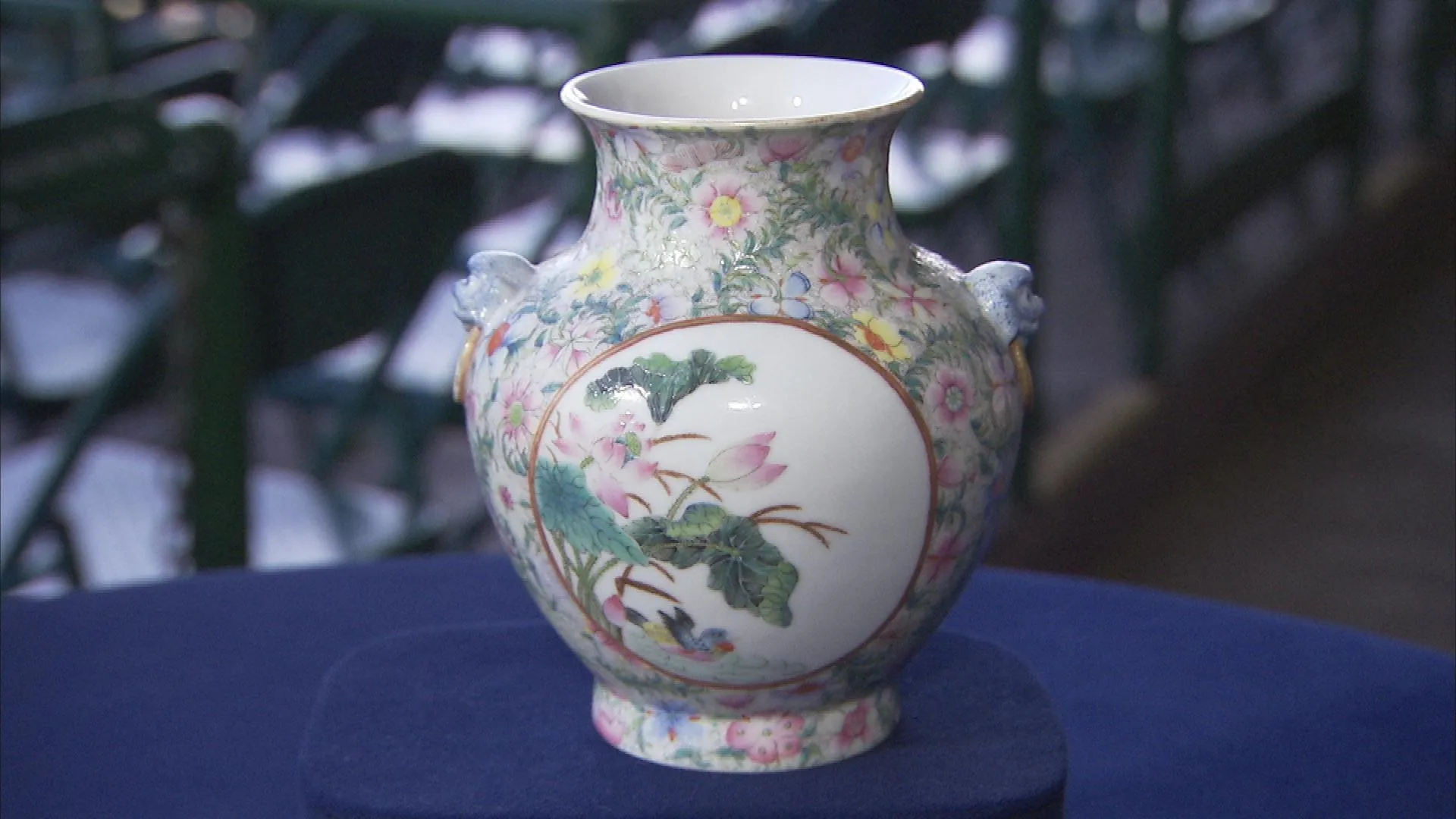
GUEST: I've brought this vase.
It says it's made
by Cloisonné,
and it belonged to my
great-grandmother.
APPRAISER: Do you happen to know where
she might have gotten it?
GUEST: I don't really know.
APPRAISER: What we have here is a very
interesting interpretation
of somebody else's artwork.
And on the bottom
it does say here...
it says Cloisonné.
And then to the left of that
is the name Longwy.
And then these other
two represent probably
production marks.
The person who, say,
molded the piece,
and then the person
who enameled the piece.
So it's sort of a form of
19th-century quality control.
Now, Longwy is actually
the name of the factory.
It's spelled l-o-n-g-w-y.
It's in the northeast corner
of France.
And they specialized in making
pottery and porcelain.
And the word cloisonné, it's a French term that denotes
Chinese enamel or Asian enamel.
And it actually
means "fencing."
So, in real cloisonné, what you would do is you would take a metal body and put a series of metal fences around it and fill it with enamel. Well, the way that the people
at Longwy accomplished that
was really very interesting.
Rather than use the little
metal wirework,
what they did was use
little black ink borders,
and that's what holds
the enamel in place.
So you have the French
interpretation of cloisonné. The factory didn't put that under there. That was probably just some helpful uncle to say, “Oh, this is cloisonné here."
GUEST: Right.
APPRAISER: And this is pottery, not porcelain. That's why you get all of this crackle glazing here.
It probably dates
to about the 1880s.
GUEST: Okay.
APPRAISER: It's a bride's basket.
So you've got a nice
rope twist top
and a beautiful shaped
body like this.
This shows an incredible
amount of effort
for something that is
a very simple gift
from this time period.
This would have been a bride's
pride and joy in the 1880s.
So I would say,
at auction,
you would be looking at a price
of around $1,000 to $1,500.
It's really a beautiful piece
of pottery.
Thanks for
bringing it down.
GUEST: Wow. Thank you.