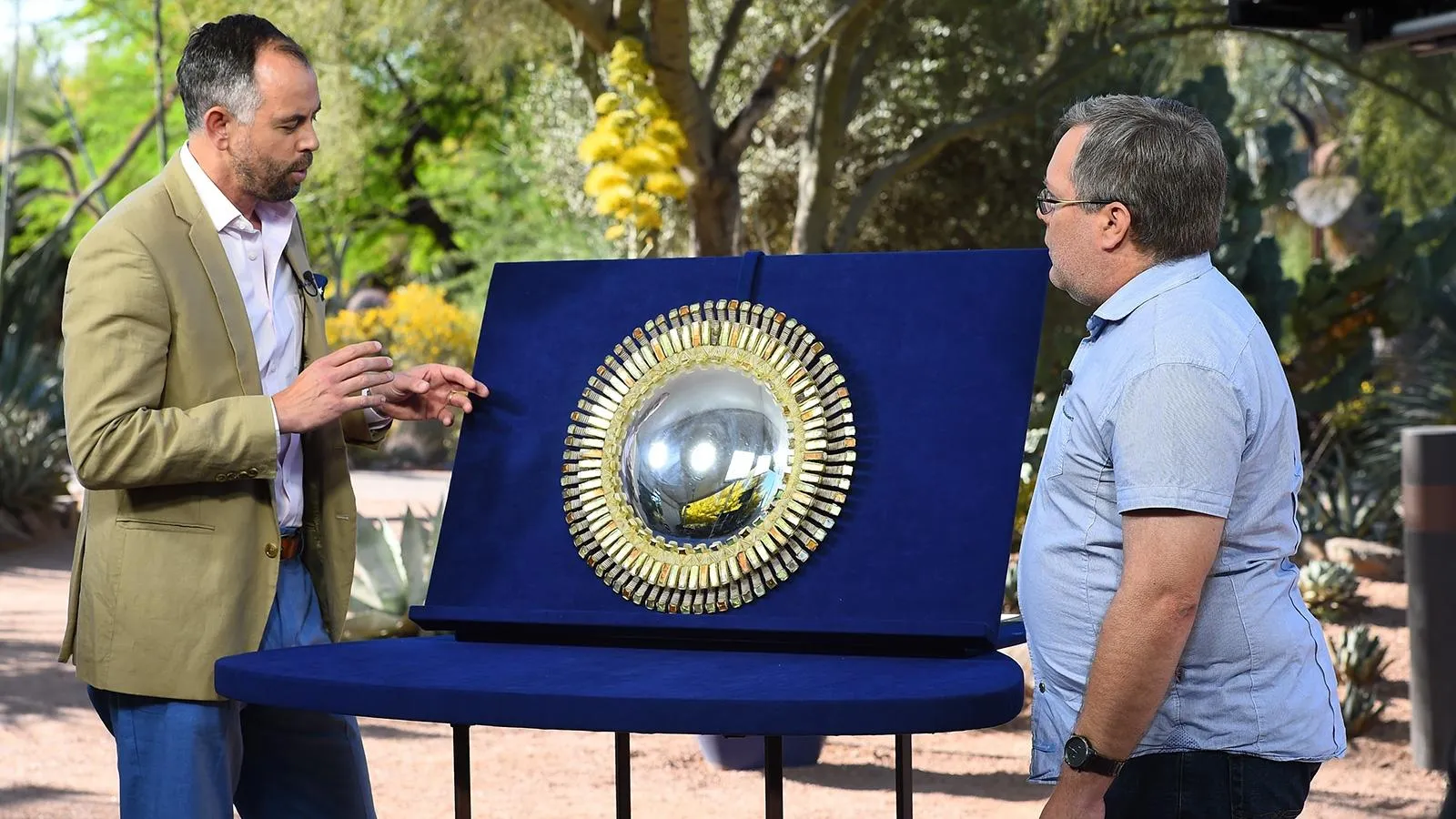
Line Vautrin Talosel Mirror, ca. 1960
GUEST: My maternal grandparents in Liège, Belgium, they owned a shop that sold home furnishings. Every now and then, they would go down to Paris and go to... I... they just... What my mom called the market, where they'd look at, you know, people selling different things. There was, I guess, a lady who sold jewelry and mirrors and stuff. They liked the mirrors, so they put an order in. When they received the order, this one, it had, like, a little piece that had been broken off, so they didn't think they could sell it. So they just kept it at home because they kind of liked the style. Apparently, they said they sold like hotcakes, and, um, they tried to order some a few months later, but they could never really get in touch with the person again. So they had one left in the store. So they took that one, as well. My parents have that one at their house. And when my maternal grandmother moved into long-term care, my parents gave this one that was in their house to me.
APPRAISER: And do you know who made it?
GUEST: I'm told somebody named Line Vautrin. I don't know if I'm pronouncing that right.
APPRAISER: So you are, you're doing a great job with the pronunciation. Her name was Line Vautrin. And she was a French jewelry maker at first. She was born in 1913 in Paris into a family of jewelers and metal workers. And then in 1937, right between the wars, she had an exhibition at the Paris Exposition, offering jewelry. And she did so well that she got enough money to open up a store in Paris at a slightly more high-end district. But you have to realize that during this timeframe, you know, then beginning with World War II, precious metals were just not available. So what she did-- and this is what's so fantastic about this-- is that she turned to other different methods and experimentation of ways to make jewelry and her other real thing that she loved, and her passion was mirrors. And this is a absolutely magnificent example. As we can see, it's made of a composite resin, and you can only imagine how difficult it would be, especially with this size, to build up each layer of resin. They're incredibly fragile, and then to have all these wonderful little mirrored panels around the outside, and then, obviously, this central convex mirror, which is mercury glass. Do you happen to know when it came into the family, when they acquired it?
GUEST: Um, she said that they think she got this one they got in the early '60s, like, '61 to '63.
APPRAISER: Okay, and it's most likely that the mirror was actually produced or manufactured right around that time period, shortly before it was then sold. This wasn't an old thing that was sold. It could have been Line herself would have been selling this as a new piece at the time, so made around circa 1960. She was a relative unknown until 1986, when a dealer recognized the importance of her work. And "Vogue" magazine referred to her as the poetess of metalwork at one point, because she was so magnificent in her jewelry and metalwork, but also this other form, which was this composition that she was using. Do you have any idea how much they paid for the mirror?
GUEST: I have no idea.
APPRAISER: Any sense of the value?
GUEST: My mom sent me a picture. It was hanging above my dog bowl at home, and she sent me a picture of one that was, like, on some website, and they were asking a ridiculous amount for it, like, $30,000 or something. So I did a little research. I've seen some, there's, like, $2,000, and then some seemed to be worth more, but I don't know what makes them worth... I don't know what the difference is between them. There seems to be a really big range.
APPRAISER: Well, the big difference is, is that the cheap ones are fakes.
GUEST: Oh, okay.
APPRAISER: So I am gonna very delicately remove this from the hanging and just turn it around. And, as you can see, it is actually signed Line Vautrin. But then, beyond that, what's really great to see is, you can see this really smoky buildup. Possibly your grandparents were smokers? I mean...
GUEST: Yes, my grandfather smoked cigars. (laughs)
APPRAISER: Who wasn't, right? At some point. The cigar smoke over the years just adhered and sunken into the resin. And this really reassures us this is in fact a mirror by Line, and not a reproduction. In 2016, a similar example sold for $27,500. Since then, there's been considerable interest in her work. Um, and another example, smaller, sold for $40,000. So, in getting together with my colleagues, we feel a reasonable auction estimate for this mirror, as a beautiful mirror, would be $40,000 to $60,000.
GUEST: Oh, wow. That is... that's crazy. (laughing) I probably shouldn't keep it above the dog bowl anymore.
APPRAISER: Probably not. (laughing) There was one which had more, like, Sputnik-type mirrors. That one sold within the last couple of years for over $400,000.
GUEST: Oh, wow.

$40,000 - $60,000 Auction
Featured In
episode
Desert Botanical Garden, Hour 3
Phoenix treasures heat up at the Desert Botanical Garden, including a $75,000 appraisal!
Decorative Objects
appraisal
appraisal
Understanding Our Appraisals
Placeholder