GUEST: This piece was bought by my great-grandmother, and it was given, I think, to my mother, and she didn't do anything with it for a while. For some reason, she gave it to me when I was in my first apartment. And when I saw it, I didn't know if I really liked it back then, and it looked awfully delicate to me, so I kind of rolled it up and put it away for a while. And eventually it made its way back to my mother, and she put it in a Lucite box and kept it... hung it on a wall.
APPRAISER: Okay.
GUEST: For about 30 years, I'd say, something like that.
APPRAISER: Any ideas on what kind of rug it might be?
GUEST: Well, I was told it was a Russian silk rug. And they said it was pretty valuable, but at that time, that really didn't mean too much to me, you know.
APPRAISER: They didn't give you a value?
GUEST: No, no, never had it appraised or anything.
APPRAISER: Okay. Well, it's actually a Persian silk rug.
GUEST: Oh, okay.
APPRAISER: So it's not far from Russia. It's woven in Azerbaijan. It's a Tabriz silk rug.
GUEST: Tabriz, okay.
APPRAISER: Woven in the late 19th century. So it's about 120 years old. So your great-grandmother might have bought it, you think, around 1900, or...?
GUEST: Probably, maybe even a little earlier, perhaps. She traveled all over the world, I know, at that time.
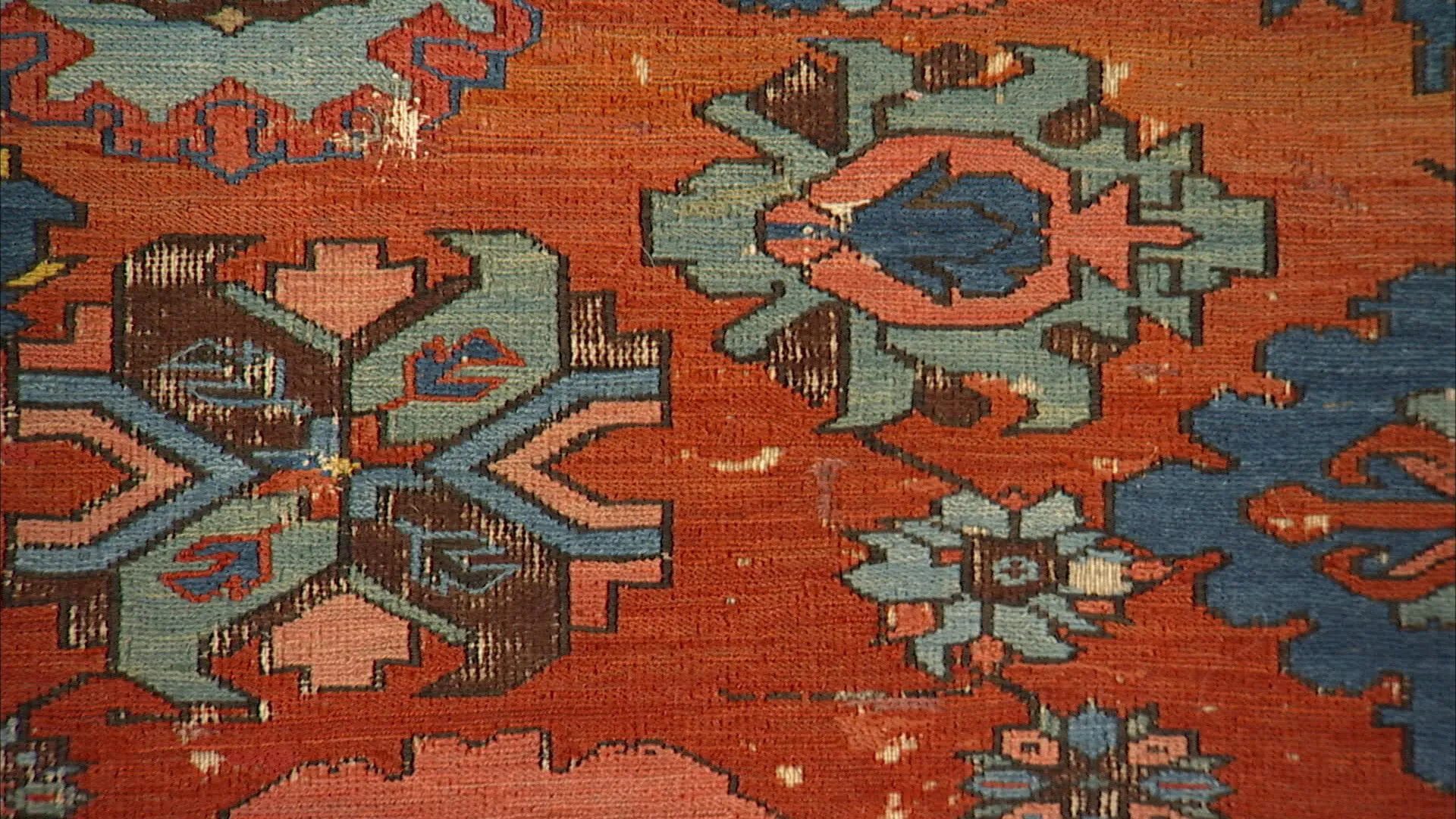
APPRAISER: Well, this is an extremely fine rug. It has about 400 knots per square inch.
GUEST: Wow. I always thought the back was a little more interesting.
APPRAISER: Well, it's extremely fine. The colors have faded a little bit, especially the red. These were extremely popular in the late 19th century. There was a revival that took place in the 19th century of rug weaving in Iran. And it was for the European market primarily, and then later for the American market. And these silk rugs were really a status piece, and they were a symbol of wealth. And they were drawing their design influences from the classical carpets that came before them in the 16th and 17th century.
GUEST: Wow.
APPRAISER: So it's a wonderful revival. We see a lot of these rugs in a varying degree of condition, and this piece does have some condition issues.
GUEST: Right, I could see that myself.
APPRAISER: There is the little tear up here.
GUEST: Was there any, like, fringe at all, or was it pretty much...?
APPRAISER: It probably had a fringe at one point, which has worn off. But the important thing is that it maintains its border at the end. And you'll notice that there is a narrow red guard border that still remains. Overall, the piece is a little bit stiff because I don't think it's been cleaned in a very long time.
GUEST: I don't think it has, either.
APPRAISER: And so it needs to be thoroughly washed and soaked so that it can soften up, so that that place can get fixed.
GUEST: Oh, okay. Now, would the colors come out more, then, if you wash it?
APPRAISER: No. No, but it will definitely... it already has the brilliance of the silk and the way the silk reflects the light, but the important thing about the cleaning is that it's going to get supple again.
GUEST: Yeah.
APPRAISER: I think the cleaning process and the TLC that it needs might cost as much as a thousand dollars.
GUEST: Okay.
APPRAISER: It's worth about $5,000 now.
GUEST: Oh, really? Wow.
APPRAISER: And if you were to put that thousand dollars into it, it would have a value closer to $10,000.
GUEST: Really?
APPRAISER: On a retail level. When we find them in mint condition, a rug like this would be worth close to $30,000.
GUEST: Really?