GUEST: My grandfather went to Germany for the reconstruction after World War II, and he was with the American Occupation movement. He was there for several years and he picked up different various things, and these are two of the prints that he picked up and brought back to us. He was there for about, I guess, several years.
APPRAISER: Your grandfather and your grandmother?
GUEST: Yes, both of them were there.
APPRAISER: They were together?
GUEST: And my grandmother, especially, was moved by the struggle in Germany. They said the destruction was amazing, and that the people were... A lot of suffering was going on. And so this really reflected what she thought she had seen.
APPRAISER: And she was seeing this after the Second World War.
GUEST: Yes.
APPRAISER: Presumably in the 1950s?
GUEST: Late '40s and early '50s, yes.
APPRAISER: Late '40s and early '50s. And do you know who they're by?
GUEST: I know that it's a Kollwitz?
APPRAISER: Yes.
GUEST: But I don't know anything else about them.
APPRAISER: Her full name is Käthe Kollwitz. She is undoubtedly the most important female artist in Germany in the 20th century. Her father was a Social Democrat and sort of a union man. And he noticed that she had a proclivity for drawing early on, and she would basically, as a teenager, draw the workers that came by to his meeting house. He was a home builder, and sort of a union boss, if you will. So early on, she was introduced to the plight of the working person. She was drawn to these figures, particularly a figure like this working woman, because of their beauty initially.
GUEST: Wow.
APPRAISER: And not because she was trying to triumph the working class and the plight of them.
GUEST: Yeah.
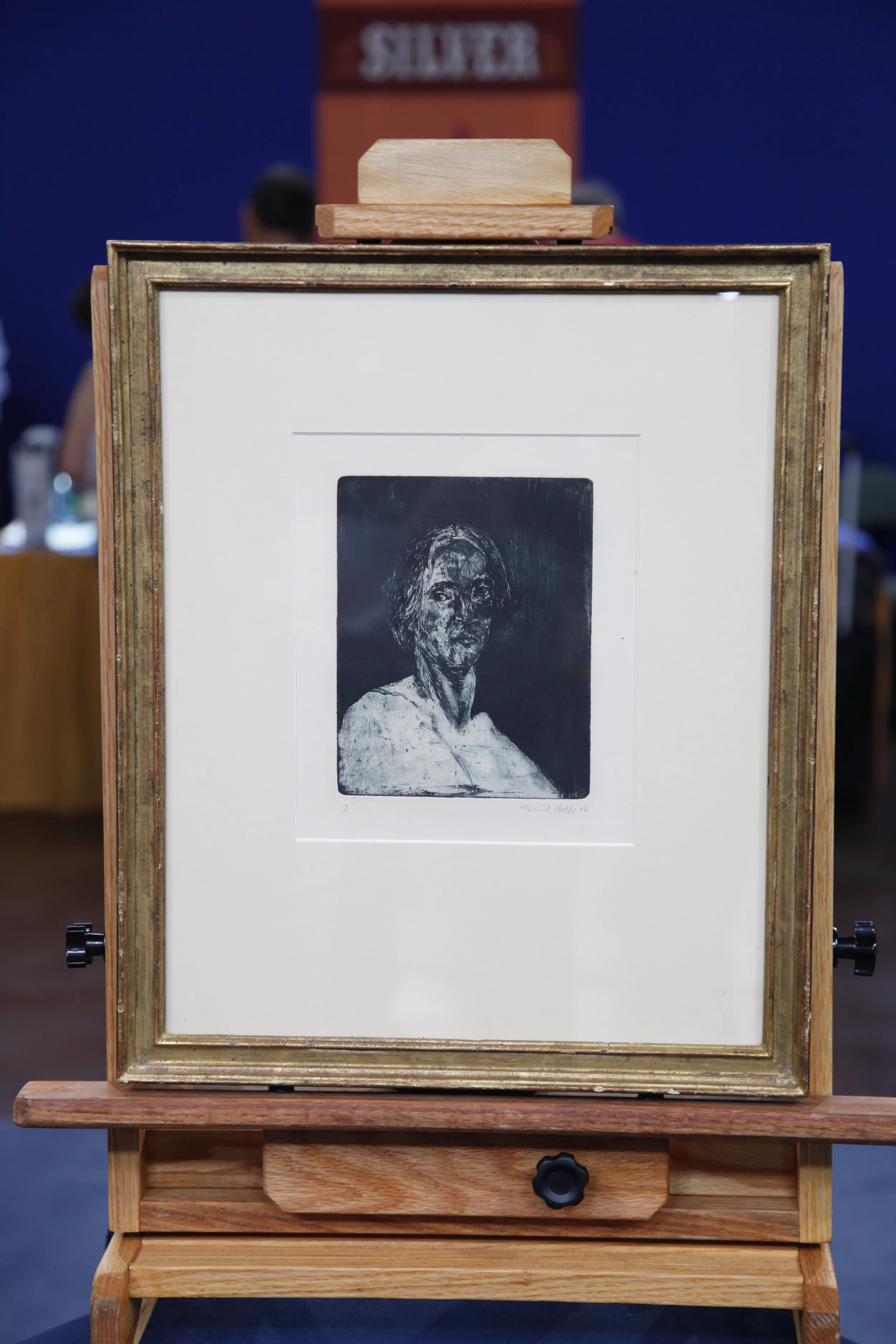
APPRAISER: And this is just called "A Working Woman in Profile to the Left."
GUEST: Okay.
APPRAISER: And it's this very humble, beautiful, haunting image.
GUEST: Yeah, it is.
APPRAISER: A woman lit from underneath and just very... Very singular and quiet. Sort of a heroic image of a working person.
GUEST: It does, it does.
APPRAISER: And you like this one a lot, you were saying.
GUEST: I love that one a lot, yeah.
APPRAISER: And this is great for showing the... I mean, she has these farmers hooked up to a plow.
GUEST: Yeah, yeah.
APPRAISER: And just the plight of the worker, and the toil, and the hardship.
GUEST: Yeah, right.
APPRAISER: That really encapsulates all that. You've got an etching by Kollwitz closest to you, and a lithograph. And they're both from the early part of the 1900s. You can see it's signed down here in pencil. As is this one.
GUEST: Yes.
APPRAISER: And then on this, you can see the publisher... Right there.
GUEST: Okay.
APPRAISER: And the little text right here? Just saying that it's etched by Kollwitz. This print here made around 1906. When it was finally ready for publication, that didn't occur until 1921. And at that point, the publisher's name, Emil Richter-- who was actually based in Dresden while she was making this in Berlin...
GUEST: I see.
APPRAISER: Published the etching. And this one here from around 1903.
GUEST: Wow, okay.
APPRAISER: So from over a hundred years ago, surviving through the two wars... Her work was actually confiscated and burned during the Second World War, and she was investigated by the Nazis. By that point, she had already become such a national figure that she escaped any harm. This was made in an edition of about 150.
GUEST: Okay.
APPRAISER: And this is a much more scarce lithograph.
GUEST: I see, oh, okay.
APPRAISER: Closest to me. Have you ever had them valued? What would your guess be?
GUEST: Oh, I don't know, since I'm on the ANTIQUES ROADSHOW, I guess it's maybe $1,000, $2,000, or...
APPRAISER: $1,000 for each?
GUEST: Yeah, let's throw that one, yeah.
APPRAISER: Well, the one closest to you, the etching of the men pulling the plow, I'd put a replacement value on that of around $4,000.
GUEST: Oh, wow, okay. Great!
APPRAISER: And on this beautiful lithograph...
GUEST: Yeah.
APPRAISER: I would put a replacement value of around $6,000. So combined, about $10,000.
GUEST: Wow! Whoa! That's really good.
APPRAISER: Yeah.
GUEST: And I love them, on top of it all.