GUEST: This was actually a wedding gift that was given to us, so I know nothing about it basically, except that the man who owned it was a business partner of my husband in Japan. The story goes that my husband, in 1960, went to his home and saw this, marveled at it, and when we got married two years later, it arrived as a wedding gift. And another friend of ours, a businessman from Japan, said the tradition was that if you really admire something in a person's home, they have to give it to you.
APPRAISER: I've heard that to be true.
GUEST: Have you heard that?
APPRAISER: Yes, I have.
GUEST: I thought it was just a folklore thing or something. My, so yeah.
APPRAISER: And the two came in this...
GUEST: As a piece, yes.
APPRAISER: And this as an ensemble.
GUEST: Yes.
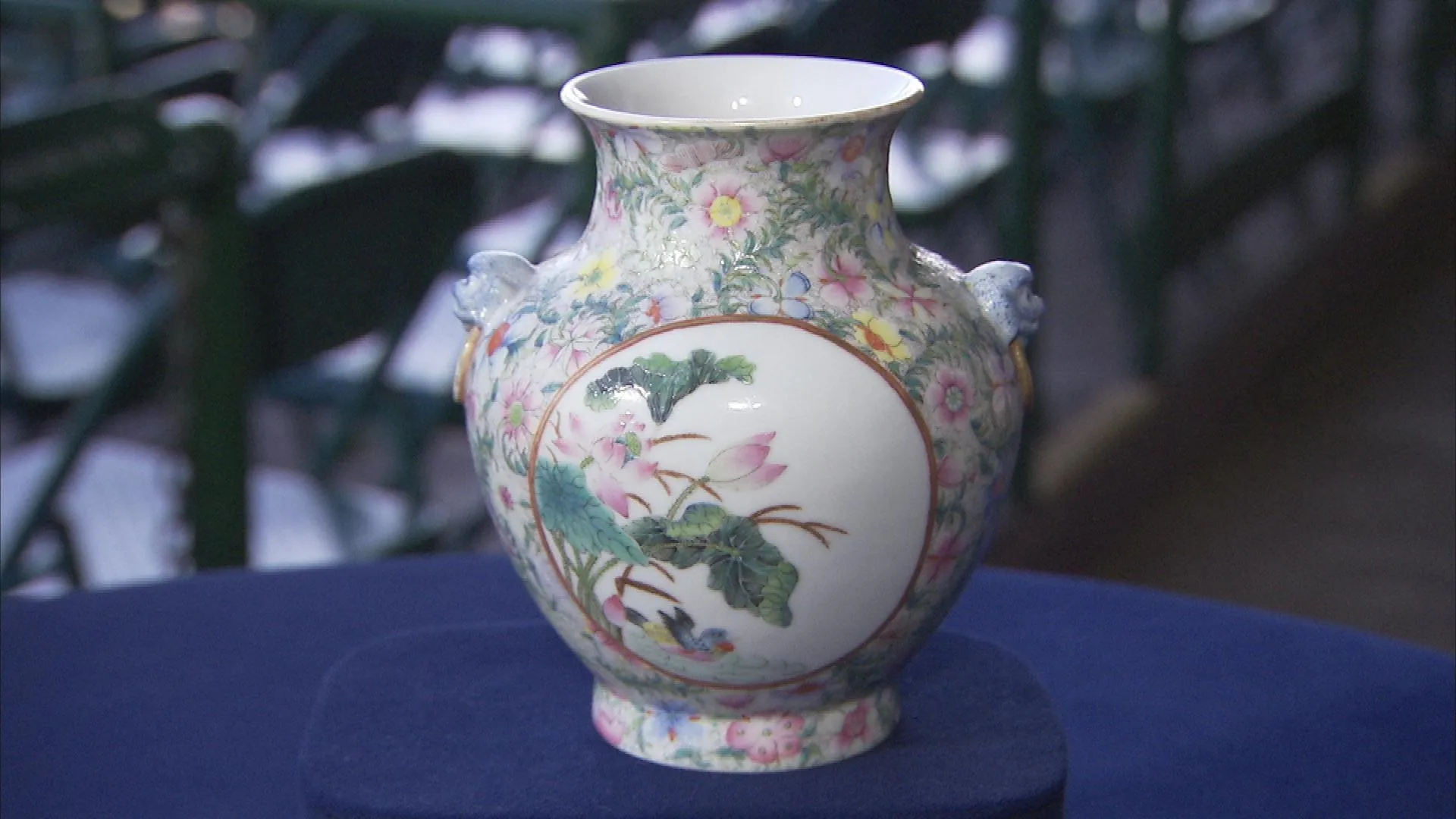
APPRAISER: What have you thought about this vase, or has it been suggested to you that there was some great age or significance to the design?
GUEST: Well, it was said that it was 400 years old. But I don't... I mean I have nothing. And why wouldn't they give me papers on it if it was?
APPRAISER: To look at the patination of this bronze, to see this very rich and red color throughout, one would think it could be antique to such a degree that... quite that old. It's Japanese, that much is true, not a surprise there. It's made in the archaic Chinese style, though, interestingly. So it's a Chinese-style vase. It's not quite 400 years old. This dates to around 1900. Turn-of-the-century vase. The stand was made not long before the vase itself, perhaps at the same time. I wanted to talk about the relationship, though, between this vase and the stand that... that it's on. If I can put this aside and... The stand itself, which has this wonderful root wood kind of configuration, all of which is carved. This is an illusion of a... of a natural...
GUEST: Oh, no!
APPRAISER: ...root kind of structure. To turn it to the side, you can see this is a full section of a... some variety of rosewood tree. And if we had the time, and of course we don't, we could literally count the rings to kind of find out a little more about this tree.
GUEST: Oh, I see, yeah.
APPRAISER: Now, this is what's very interesting. The stand is Chinese.
GUEST: Oh, for pity sakes.
APPRAISER: What you have is a pairing of a Chinese stand made very much in a Japanese style, or at least appealing to a Japanese aesthetic, and a Japanese vase...
GUEST: In the Chinese...
APPRAISER: That's made very much in the Chinese style. This is a variety of rosewood grown on the island of Hainan, perhaps, or somewhere in southern China. This is not of the restricted variety. We see a lot of furniture and we sell a lot that is made of this material. I think the vase, were it come up to auction, would be between $800 to $1,200.
GUEST: Nice.
APPRAISER: The stand, by itself, if it were to come up to auction, would be between $2,000 and $4,000.
GUEST: Really lovely.
APPRAISER: I think the stand...
GUEST: Whoa.
APPRAISER: ...is the real treasure.
GUEST: No kidding, how wonderful. (chuckling) That's great.
APPRAISER: Thank you for coming to ROADSHOW.
GUEST: Thank you so much, Richard, this is great.