Japanese Russet Iron Namban Helmet, ca. 1800
GUEST: It's been in the family since World War II. And, uh, my father, when he was 14 here in Arkansas, ran away from home because his father was in Europe fighting. And my dad wanted to join the army, too. But at 14, the Marines said no, the Army said no. So he thought he would head toward Canada and join the Canadian forces and deploy from there. Well, he didn't make it to Canada because his uncle found him before he crossed the border. But he did... his uncle did take him to a military store, a large one, Bannerman's in New York, where he saw this helmet and bought it.
APPRAISER: Do you know how much he paid for it?
GUEST: Well, I think probably a 14-year-old boy from Arkansas in 1943 probably didn't have a lot of money, and, uh, so I'm sure it was just a matter of pennies or a few dollars back then.
APPRAISER: This is a Japanese russet iron helmet, a kabuto, called a southern barbarian helmet or Namban helmet.
GUEST: Mm-hmm.
APPRAISER: Made in Japan in the late 18th or early 19th century. It's actually fashioned on a Portuguese...
GUEST: Mm.
APPRAISER: ...or a Spanish late 16th century helmet. There would have been a multi-tiered, what they call shikoro...
GUEST: Mm-hmm.
APPRAISER:....or neck guard. And the inside would have been fitted with a leather interior for comfort and also to position it properly on the wearer's head. This is actually the Buddha of Infinite Light...
GUEST: Mm.
APPRAISER: ...who represents the Pure Land sect of Mahayana Buddhism. And he is standing on a cloud here.
GUEST: Mm-hmm.
APPRAISER: And he is actually in what they call the position of Amida raigo. And the symbolism is the Buddha descending to welcome the believer into the western paradise. This would have been worn...
GUEST: Mm-hmm.
APPRAISER: ...in battle by a samurai warrior.
GUEST: Wow.
APPRAISER: This would have been a battle helmet, and it is actually etched and embellished with gold and silver in the decoration of the clouds and the Buddha. It's a wonderful piece. Do you have any idea what you think it's worth?
GUEST: Oh, absolutely no idea. I'd say just guessing between $2,000 and $3,000, I would probably say.
APPRAISER: Well, at auction, you're a little conservative. I would say at the auction block, somewhere between $6,000 and $10,000.
GUEST: Oh, wow, I won't put it on my head then. Never have. (laughs)

$6,000 - $10,000 Auction
Featured In

episode
Crystal Bridges Museum of American Art, Hour 3
Head to bustling Bentonville for ROADSHOW finds at Crystal Bridges Museum of American Art!
19th Century

appraisal
1876 John Alexander Stoneware Cooler

appraisal
Braided Rawhide Lariat, ca. 1850
appraisal
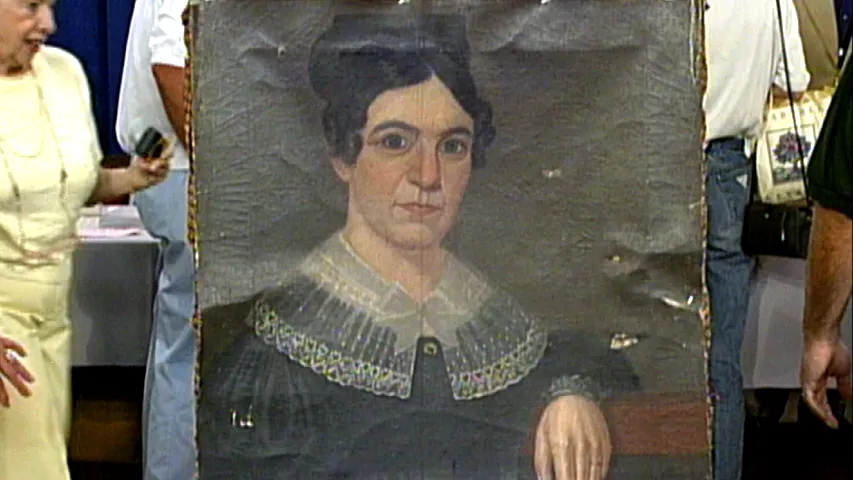
American School Portrait, ca. 1820

appraisal
Eskimo Hunting Helmet, ca. 1820
Understanding Our Appraisals
Executive producer Marsha Bemko shares her tips for getting the most out of ANTIQUES ROADSHOW.
Value can change: The value of an item is dependent upon many things, including the condition of the object itself, trends in the market for that kind of object, and the location where the item will be sold. These are just some of the reasons why the answer to the question "What's it worth?" is so often "It depends."
Note the date: Take note of the date the appraisal was recorded. This information appears in the upper left corner of the page, with the label "Appraised On." Values change over time according to market forces, so the current value of the item could be higher, lower, or the same as when our expert first appraised it.
Context is key: Listen carefully. Most of our experts will give appraisal values in context. For example, you'll often hear them say what an item is worth "at auction," or "retail," or "for insurance purposes" (replacement value). Retail prices are different from wholesale prices. Often an auctioneer will talk about what she knows best: the auction market. A shop owner will usually talk about what he knows best: the retail price he'd place on the object in his shop. And though there are no hard and fast rules, an object's auction price can often be half its retail value; yet for other objects, an auction price could be higher than retail. As a rule, however, retail and insurance/replacement values are about the same.
Verbal approximations: The values given by the experts on ANTIQUES ROADSHOW are considered "verbal approximations of value." Technically, an "appraisal" is a legal document, generally for insurance purposes, written by a qualified expert and paid for by the owner of the item. An appraisal usually involves an extensive amount of research to establish authenticity, provenance, composition, method of construction, and other important attributes of a particular object.
Opinion of value: As with all appraisals, the verbal approximations of value given at ROADSHOW events are our experts' opinions formed from their knowledge of antiques and collectibles, market trends, and other factors. Although our valuations are based on research and experience, opinions can, and sometimes do, vary among experts.
Appraiser affiliations: Finally, the affiliation of the appraiser may have changed since the appraisal was recorded. To see current contact information for an appraiser in the ROADSHOW Archive, click on the link below the appraiser's picture. Our Appraiser Index also contains a complete list of active ROADSHOW appraisers and their contact details and biographies.


