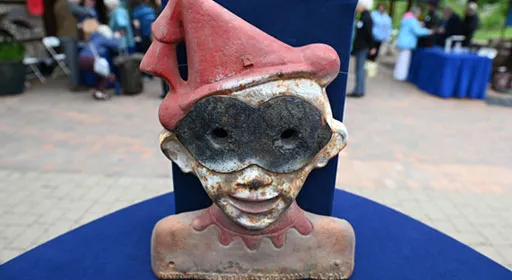
J. T. Dickman Clown Shooting Gallery Target, ca. 1915
GUEST: I think it was probably about ten years ago, when I went to a garage sale, while my husband was going through the barn, pulling out things that he was interested in, and asking how much, and the young man said, "Well, just make a pile." This fella was just propped up on the porch, kind of up against a stair. And because of my age, I know that he's a shooting gallery target. So I said, "Well, would this be for sale?" He said, "Yeah, just add it to the pile." We said, uh, "Okay, what do we owe you?" He said, "How about $100?"
APPRAISER: You see that it's dated 1911. And you see the name on it in Los Angeles, California. So Dickman was born in Wisconsin in 1876.
GUEST: Okay.
APPRAISER: And then as a young man, he finds himself in Los Angeles, and comes upon these shooting gallery, they called them rigs. I used to go to Coney Island as a kid, and actually played with one of these things. And a rig was cast iron. Some of them were mobile, and they moved around...
GUEST: Oh, right. …
APPRAISER: for fairs and country fairs.
GUEST: Yeah, I remember. Yeah.
APPRAISER: And others were stationary, and they were all operated by chains, a metal chain.
GUEST: Mm-hmm.
APPRAISER: So there was noise; they would clatter. And then the sound of the bullets hitting the metal targets. And it was a racket. It was just so much fun. So Dickman buys a rig in Los Angeles, and within two or three years, he has three rigs. And these rigs need constant repair. They need replacement parts. And all of the makers of the shooting gallery rigs were east of the Mississippi. So he's out in Los Angeles, on the West Coast, alone, and there is the story of the entrepreneur. He decides to go into business. And this was patented in 1911. And this was his most famous target, so...
GUEST: Oh, okay!
APPRAISER: His rigs had hundreds of targets. This one would have been the principal target. And his system was called the bright eye system. One of these eyes was lit with a gas flame.
GUEST: I didn't know that!
APPRAISER: When you shot the bullet through the eye, you extinguished the gas flame. But immediately, the other eye would light up.
GUEST: (laughs)
APPRAISER: So it was going back and forth. Boom, boom, boom, boom. It would light, go out, light, go out. How cool is that?
GUEST: I had no idea.
APPRAISER: Yeah, and you can see the wear where all the little bullet dings...
GUEST: Oh, that's why it's textured.
APPRAISER: And this is a result of thousands of bullets. Most of the paint on it is original. It's a beautiful natural patina. So Dickman made rigs up and down the West Coast. He went out of business in 1934. Other manufacturers started to copy this clown, except they're not signed Dickman. And eventually, especially when we went off to war, the Depression comes along, a lot of the rigs were taken apart and melted down as scrap metal. Because it's patented in 1911, we know it was made shortly after that. So this was probably made in the teens, early '20s. These targets are very highly desirable.
GUEST: Oh, good.
APPRAISER: Uh, there's a book on shooting gallery targets. This is on the cover of the book.
GUEST: Oh, wow.
APPRAISER: It's considered, really, the, the pinnacle of shooting gallery technology, as well as, the imagery is like a piece of Pop Art. Retail, we're going to place a value of $20,000 to $22,000...
GUEST: Oh, wow.
APPRAISER: ...on this clown.
GUEST: (chuckles)And you're not joking.
APPRAISER: And I'm not clowning around with you.
GUEST: You're not clowning around. (both laugh)

$20,000 - $22,000 Retail
Featured In
episode
Idaho Botanical Garden, Hour 1
Gem State treasures sparkle at Idaho Botanical Garden including a discovery up to $80,000!
20th Century
appraisal
Comic Wind-up Toys, ca. 1930
appraisal
Barbie Accessories & Case, ca. 1960
appraisal
William Moorcroft Pottery, ca. 1910
appraisal
Understanding Our Appraisals
Executive producer Marsha Bemko shares her tips for getting the most out of ANTIQUES ROADSHOW.
Value can change: The value of an item is dependent upon many things, including the condition of the object itself, trends in the market for that kind of object, and the location where the item will be sold. These are just some of the reasons why the answer to the question "What's it worth?" is so often "It depends."
Note the date: Take note of the date the appraisal was recorded. This information appears in the upper left corner of the page, with the label "Appraised On." Values change over time according to market forces, so the current value of the item could be higher, lower, or the same as when our expert first appraised it.
Context is key: Listen carefully. Most of our experts will give appraisal values in context. For example, you'll often hear them say what an item is worth "at auction," or "retail," or "for insurance purposes" (replacement value). Retail prices are different from wholesale prices. Often an auctioneer will talk about what she knows best: the auction market. A shop owner will usually talk about what he knows best: the retail price he'd place on the object in his shop. And though there are no hard and fast rules, an object's auction price can often be half its retail value; yet for other objects, an auction price could be higher than retail. As a rule, however, retail and insurance/replacement values are about the same.
Verbal approximations: The values given by the experts on ANTIQUES ROADSHOW are considered "verbal approximations of value." Technically, an "appraisal" is a legal document, generally for insurance purposes, written by a qualified expert and paid for by the owner of the item. An appraisal usually involves an extensive amount of research to establish authenticity, provenance, composition, method of construction, and other important attributes of a particular object.
Opinion of value: As with all appraisals, the verbal approximations of value given at ROADSHOW events are our experts' opinions formed from their knowledge of antiques and collectibles, market trends, and other factors. Although our valuations are based on research and experience, opinions can, and sometimes do, vary among experts.
Appraiser affiliations: Finally, the affiliation of the appraiser may have changed since the appraisal was recorded. To see current contact information for an appraiser in the ROADSHOW Archive, click on the link below the appraiser's picture. Our Appraiser Index also contains a complete list of active ROADSHOW appraisers and their contact details and biographies.


