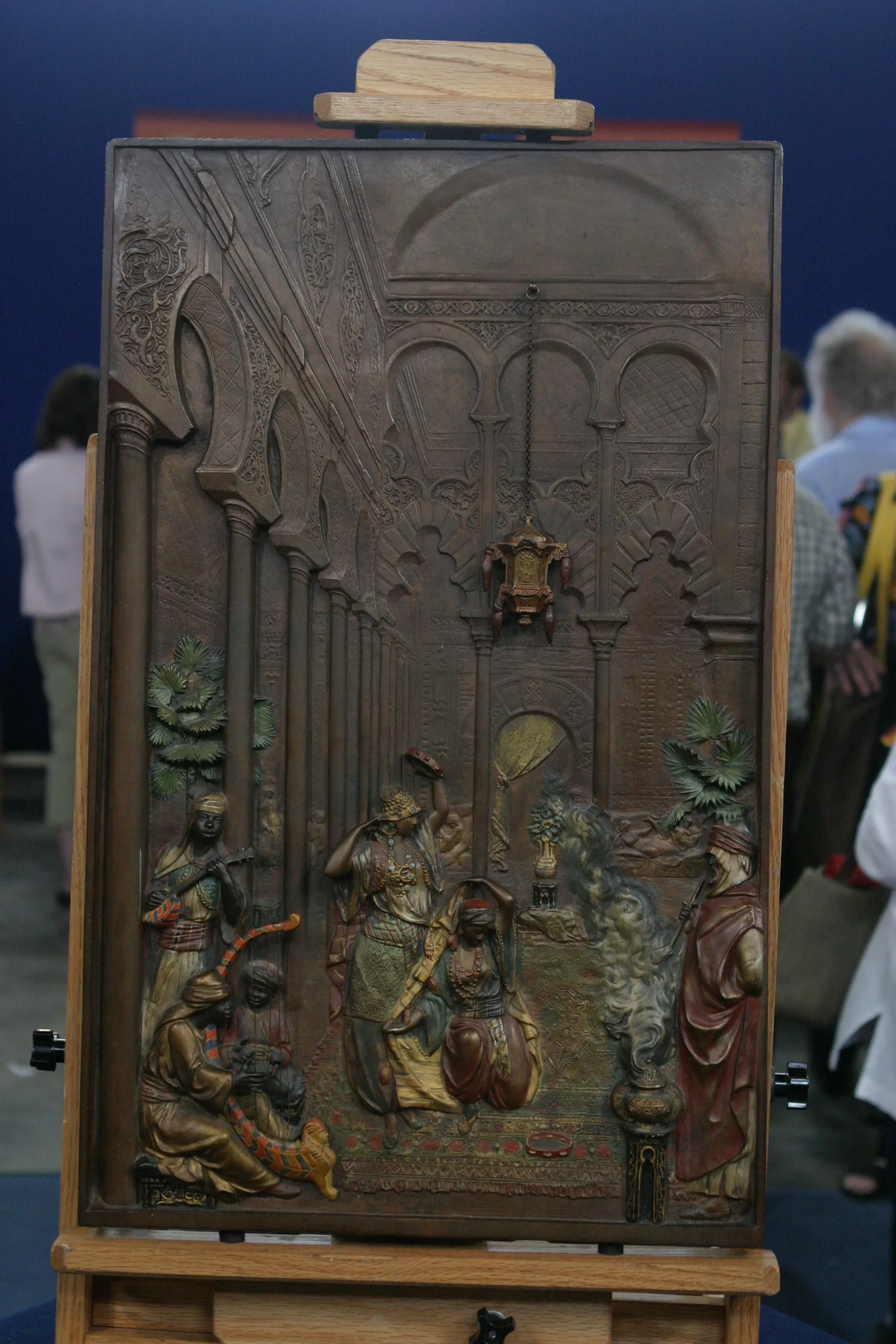
APPRAISER: You've brought in this carved panel here. And in all my years in the Antiques Roadshow, 18 years, I've never seen anything quite as remarkable as this.
GUEST: Oh, my.
APPRAISER: I'm pretty amazed.
GUEST: Wow.
APPRAISER: My heart's beating right now.
GUEST: Oh wow.
APPRAISER: I'll tell you. Please tell me, where did you find this?
GUEST: I bought this two days ago at an estate sale in Meridian, Idaho.
APPRAISER: Are you an antiquer? Do you like to go antiquing?
GUEST: I am an antique dealer, and I get around a lot. And so I just thought it was amazing.
APPRAISER: Okay, and what drew you to this panel?
GUEST: It's just... the detail is just absolutely gorgeous.
APPRAISER: What was the price on the piece?
GUEST: I paid $500.
APPRAISER: $500?
GUEST: Yes.
APPRAISER: You paid $500 for this?
GUEST: Yes.
APPRAISER: And then you brought this?
GUEST: And this came along with it because it has the picture in this picture.
APPRAISER: So right here we see this hanging in this elegant parlor. It looks like a photo from the late 19th century. What you've brought in here is a pair of door panels. And there's a line that runs right down the center here. And these were originally on a cabinet that would have sat on a stand.
GUEST: Oh, wow.
APPRAISER: And do you know how old this is, actually?
GUEST: No.
APPRAISER: Okay, well, these panels here, the pair of panels date to the mid-16th century.
GUEST: Oh, my word.
APPRAISER: So these are about 1550, 1560.
GUEST: Wow.
APPRAISER: One of the earliest pieces of inlay or carving I've ever seen on the Antiques Roadshow.
GUEST: Oh, my goodness.
APPRAISER: And the process that made these Italian panels-- these are Italian, mid-16th century-- the process is called intarsia. And intarsia is a technique that's been around since Egyptian times. And it's inlaying woods of different types and coloring the woods to create three-dimensional effect just like a painter would with his paintbrush.
GUEST: Oh, my.
APPRAISER: And what we have here, of course, is a battle scene. We have here a tent in the front, and clearly here is the leader of the battle, the general, and they're making plans to attack the fortress, which is in the background. Here this soldier... and this is amazing. The soldier's on the horse and it's foreshortened. Here's the back of the horse and his head is turned. Look at that detail.
GUEST: I know.
APPRAISER: Look at that carving. I mean this is mid-16th century. We have here in the foreground the cannons, which are being lit. And there's probably literally 15 different woods inlaid in here. I've never seen more of a variety of woods in anything in my life. I mean this could be in a major museum.
GUEST: Wow.
APPRAISER: Exhibited with security guards protecting it.
GUEST: Oh, wow.
APPRAISER: Do you have any idea of the value of this?
GUEST: No, not a clue. I have no idea.
APPRAISER: No idea? So you paid $500 for this, no idea of the value.
GUEST: No idea.
APPRAISER: I would put an auction estimate on this pair of carved panels at $20,000...
GUEST: Oh, my stars.
APPRAISER: To $30,000.
GUEST: Wow. Wow. (chuckling): That's exciting.