Ioan Nemtoi Studio Art Glass Vase, ca. 2005
GUEST: I have a red vase, uh, that I purchased, uh, at a thrift shop for $50.
APPRAISER: And, is that recently?
GUEST: Uh, it was about three years ago.
APPRAISER: Okay. And, uh, what drew you to this vase?
GUEST: Uh, it's the... the patterns, uh, the shape, the colors. Uh, it's in the, uh, china cabinet that's lit from the top, so it, when the light shines through, it's like a red glow.
APPRAISER: Oh, that's great. Well, as you can see, I like these colors too...
GUEST: Mm-hmm.
APPRAISER:...by what I'm wearing.
(both chuckle)
APPRAISER: Uh, so, this piece was actually made by a Romanian glass artist, whose name is Ioan Nemtoi.
GUEST: Okay.
APPRAISER: I meant no disrespect if I've mispronounced it, but I don't speak Romanian.
GUEST: Right. (chuckles)
(chuckling):
APPRAISER: So... He has an interesting story, because, uh, he grew up in northeast Romania, and when he was in the fifth grade, he showed an aptitude
for art. So he got channeled into more art classes...
GUEST: Mm-hmm.
APPRAISER:...and ended up studying, uh, going to college in Bucharest, and he got a degree there in ceramics and art...
GUEST: Mm-hmm.
APPRAISER:...and glass.
GUEST: Okay.
APPRAISER: And went on to start opening his own studio back in his hometown, 'cause he liked the sand there.
GUEST: Okay.
APPRAISER: And sand is what you use when you make glass.
GUEST: Okay.
APPRAISER: That's what glass is made of...
GUEST: Right.
APPRAISER:...that's one of the many things. He went back there in 1995...
GUEST: Mm-hmm.
APPRAISER:...and then he started making these great pieces, and a couple pieces were donated to the Vatican and to the UNICEF headquarters.
GUEST: Okay... (chuckles)
APPRAISER: And, um... he's represented in museums, and he's had shows.
GUEST: Okay.
APPRAISER: And this particular piece, uh, which is a, a large piece for him. Um, sometimes his glass had-- w-would be cased, and it would be shine-- the surface would be more of a shiny surface.
GUEST: Mm-hmm.
APPRAISER: This one is a matte finish. Uh, but this, in a, in a retail venue, could sell for between $1,500 and $2,500.
GUEST: Wow. Okay. (laughs) It's nice. (laughs)
APPRAISER: Good shopping.
GUEST: Yeah.

$1,500 - $2,500 Retail
Featured In

episode
Living History Farms, Hour 1
ROADSHOW visits Living History Farms for treasures and a top $75,000 to $125,000 find.
Glass
appraisal
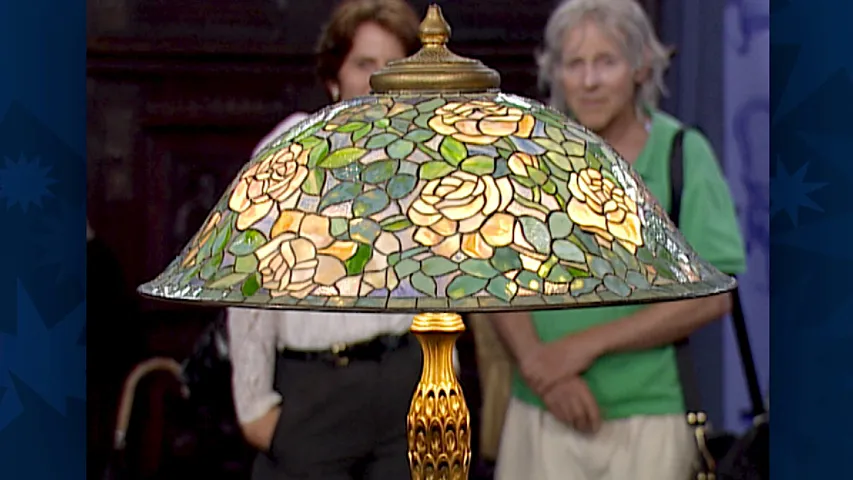
Tiffany Studios Rose Helmet Lamp, ca. 1905

appraisal
Venetian Glass Vase, ca. 1935

appraisal
Tiffany Glass Candy Dish, ca. 1927

appraisal
Gustav Stickley Oak Bookcase, ca. 1915
Understanding Our Appraisals
Executive producer Marsha Bemko shares her tips for getting the most out of ANTIQUES ROADSHOW.
Value can change: The value of an item is dependent upon many things, including the condition of the object itself, trends in the market for that kind of object, and the location where the item will be sold. These are just some of the reasons why the answer to the question "What's it worth?" is so often "It depends."
Note the date: Take note of the date the appraisal was recorded. This information appears in the upper left corner of the page, with the label "Appraised On." Values change over time according to market forces, so the current value of the item could be higher, lower, or the same as when our expert first appraised it.
Context is key: Listen carefully. Most of our experts will give appraisal values in context. For example, you'll often hear them say what an item is worth "at auction," or "retail," or "for insurance purposes" (replacement value). Retail prices are different from wholesale prices. Often an auctioneer will talk about what she knows best: the auction market. A shop owner will usually talk about what he knows best: the retail price he'd place on the object in his shop. And though there are no hard and fast rules, an object's auction price can often be half its retail value; yet for other objects, an auction price could be higher than retail. As a rule, however, retail and insurance/replacement values are about the same.
Verbal approximations: The values given by the experts on ANTIQUES ROADSHOW are considered "verbal approximations of value." Technically, an "appraisal" is a legal document, generally for insurance purposes, written by a qualified expert and paid for by the owner of the item. An appraisal usually involves an extensive amount of research to establish authenticity, provenance, composition, method of construction, and other important attributes of a particular object.
Opinion of value: As with all appraisals, the verbal approximations of value given at ROADSHOW events are our experts' opinions formed from their knowledge of antiques and collectibles, market trends, and other factors. Although our valuations are based on research and experience, opinions can, and sometimes do, vary among experts.
Appraiser affiliations: Finally, the affiliation of the appraiser may have changed since the appraisal was recorded. To see current contact information for an appraiser in the ROADSHOW Archive, click on the link below the appraiser's picture. Our Appraiser Index also contains a complete list of active ROADSHOW appraisers and their contact details and biographies.


