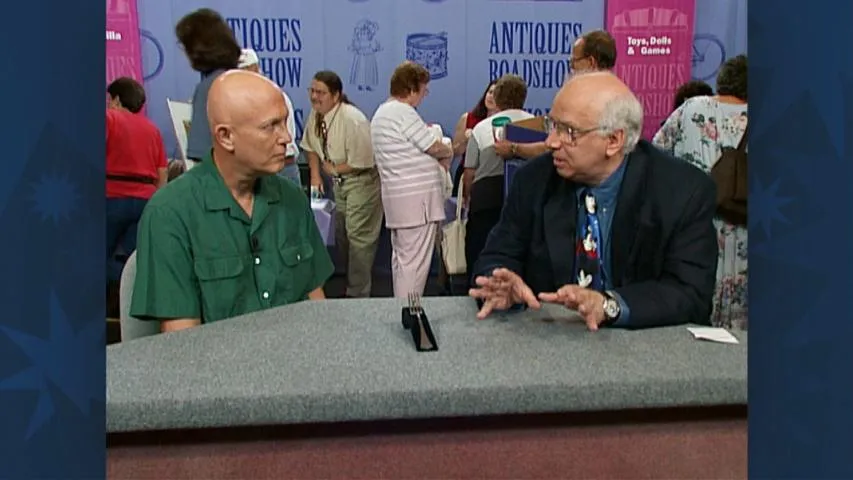
GUEST: The fork is from the Hindenburg the night that it exploded at Lakehurst, New Jersey. My mother and father were stationed there. He was an engineer with the Coast Guard and happened to go out to see the zeppelin arrive because they were interested in that kind of thing. And as it exploded, this fell to his feet. He later was part of the crew that testified because as an engineer, they thought he might have something to say.
APPRAISER: The event occurred on May 6, 1937. There were about 97 people onboard. 36 of them perished.
GUEST: Only 36? I would have thought all.
APPRAISER: The fork itself is rather interesting because it has the "L.Z." on it-- the "Luft Zeppelin" symbol. Most of the material from the Hindenburg was not marked "Hindenburg" per se. The line, as with the ocean liners, put just the name of the entire service on it.
GUEST: Mm-hmm.
APPRAISER: These bits of metal are actual pieces of the Hindenburg that obviously adhered to the fork when it fell to your father's feet. There are some other artifacts from the Hindenburg that have survived-- pieces of the canopy-- and they surface at auction with great regularity. It's interesting because it was covered by... one of the first disasters covered by the media. There was newsreel there because it was such an event-- the landing at Lakehurst.
GUEST: And there was a very profound radio broadcast.
APPRAISER: Yes, that's where that line came from-- "Oh, the humanity"-- where the announcer got completely shocked by what he saw, of course. There's very few comparables. I would say if it came up to auction, it would sell in the range of $8,000 to $10,000.
GUEST: That's what I had hoped, and thank you for confirming it.