Henry George Embossed Tin Cigar Sign, ca. 1895
GUEST: My wife and I went to a little consignment shop and I saw this, and I went, "Whoa, this thing, that can't be real," I didn't think, 'cause the colors were so beautiful. So I asked the lady, I said, uh, "How much is it?" And she says, "Well, that depends. 'Cause the old gentleman that's consigning it wants somebody to love and treasure it, 'cause it's got a lot of sentimental value to it." He was a gentleman in late 80s or early 90s. He was pretty old-- he was born in that town. When he was in his teens, he had an uncle that owned an antique shop down in Los Angeles. And he said he'd come across a print, and, uh, he said he didn't like the frame on it. So he asked if he could send the frame up, and could the kid build him a new frame for it? And then within a week or two after he got it, his uncle passed away unexpectedly, at a young age. So he kind of just put it, this print, into the garage. And for the next 70-some-odd years, through multiple marriages and divorces, he always carried this with him, because it reminded him of his uncle. And he decided to disassemble it. When he did, this was the backing.
APPRAISER: I would have loved to be there for, for his reaction. (chuckles) When you're peeling back the print that's been there that you think nothing of.
GUEST: Right.
APPRAISER: And you go to get something out of a frame, and lo and behold, this is hiding behind it.
GUEST: Yeah.
APPRAISER: What did you have to pay, if you don't mind me asking, for this one?
GUEST: $450 for it.
APPRAISER: So this is a late-19th-century cigar advertising sign depicting Henry George, uh, made for the Hirschhorn, Mack, and Company, uh, makers based out of New York. Now, Henry George was an economist, he was a social activist, he was a journalist. He was regarded at one point as one of the most popular individuals in the United States. Wow. Um, known for a book entitled "Progress and Poverty." He spoke to your common man, he spoke to your laborer, he spoke to your working Joe that was going through the Industrial Revolution.
GUEST: Right— okay.
APPRAISER: And we can date it pretty concretely to about 1895 to 1900. And if you look down here at the very, very bottom, the Tuscarora Advertising Company. They were established in mid-1880s, and they originally started off by selling burlap bags with logos...
GUEST: Okay.
APPRAISER:…on them.
GUEST: Sure.
APPRAISER: And they quickly progressed, as technology advanced, to doing signs, to doing anything and everything in advertising. These were the people that were doing Coca-Cola signs, that were taking orders from all around the country...
GUEST: Okay.
APPRAISER: …for advertising signs. So this sign is a single-sided tin sign with embossing that has lithography on it.
GUEST: Okay.
APPRAISER: Now, they took it a step further, um, and really pioneered offset lithography. Now, that added an additional step where, once that original plate was made, they would transfer the image to a sheet of rubber, and then roll the rubber containing the image through a press that would then press it onto metal without destroying the original plate.
GUEST: Right.
APPRAISER: So they could do a lot more volume, um, they could be a lot more detailed, and the rubber was more forgiving. As you're rolling over a hard metal surface, imagine if you're trying to press that into a stone.
GUEST: Right.
APPRAISER: It’s not gonna go so great. So you've got great subject matter with an important American figure.
GUEST: Right.
APPRAISER: You’ve got cigars, which appeals to tobacciana collectors... (laughs) ...and, quite frankly, most people with a man cave, right?
GUEST: Right, there you go.
APPRAISER: It’s an attractive subject with a prominent American individual. If this sign came up to auction today, I would put a conservative auction estimate on it of $4,000 to $6,000.
GUEST: Wow— wow. Okay, that's, uh, pretty cool.

$4,000 - $6,000 Auction
Featured In

episode
Red Butte Garden & Arboretum, Hour 1
Premiered Mon, Jan 5, 2026 — ROADSHOW celebrates an all-new Season 30, kicking off with a stop in Salt Lake City, Utah!
19th Century

appraisal
1876 John Alexander Stoneware Cooler

appraisal
Braided Rawhide Lariat, ca. 1850
appraisal
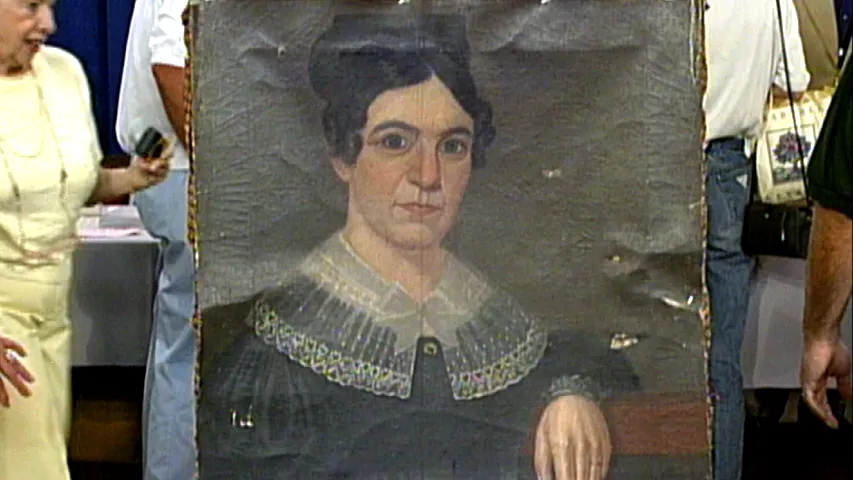
American School Portrait, ca. 1820

appraisal
Eskimo Hunting Helmet, ca. 1820
Understanding Our Appraisals
Executive producer Marsha Bemko shares her tips for getting the most out of ANTIQUES ROADSHOW.
Value can change: The value of an item is dependent upon many things, including the condition of the object itself, trends in the market for that kind of object, and the location where the item will be sold. These are just some of the reasons why the answer to the question "What's it worth?" is so often "It depends."
Note the date: Take note of the date the appraisal was recorded. This information appears in the upper left corner of the page, with the label "Appraised On." Values change over time according to market forces, so the current value of the item could be higher, lower, or the same as when our expert first appraised it.
Context is key: Listen carefully. Most of our experts will give appraisal values in context. For example, you'll often hear them say what an item is worth "at auction," or "retail," or "for insurance purposes" (replacement value). Retail prices are different from wholesale prices. Often an auctioneer will talk about what she knows best: the auction market. A shop owner will usually talk about what he knows best: the retail price he'd place on the object in his shop. And though there are no hard and fast rules, an object's auction price can often be half its retail value; yet for other objects, an auction price could be higher than retail. As a rule, however, retail and insurance/replacement values are about the same.
Verbal approximations: The values given by the experts on ANTIQUES ROADSHOW are considered "verbal approximations of value." Technically, an "appraisal" is a legal document, generally for insurance purposes, written by a qualified expert and paid for by the owner of the item. An appraisal usually involves an extensive amount of research to establish authenticity, provenance, composition, method of construction, and other important attributes of a particular object.
Opinion of value: As with all appraisals, the verbal approximations of value given at ROADSHOW events are our experts' opinions formed from their knowledge of antiques and collectibles, market trends, and other factors. Although our valuations are based on research and experience, opinions can, and sometimes do, vary among experts.
Appraiser affiliations: Finally, the affiliation of the appraiser may have changed since the appraisal was recorded. To see current contact information for an appraiser in the ROADSHOW Archive, click on the link below the appraiser's picture. Our Appraiser Index also contains a complete list of active ROADSHOW appraisers and their contact details and biographies.


