Hand Appliqué Quilt Top, ca. 1860
GUEST: So I brought this quilt top that I bought back in the early 2000s from an auction in Albia, Iowa. I bought it from the... nun's home that was part of the Catholic Church there. And I know I paid... probably less than $20 for it.
APPRAISER: Wow...
GUEST: I... am a quilter myself.
APPRAISER: Okay.
GUEST: And... part of it was just making sure that I saved it.
APPRAISER: So I would date it, approximately 1860s. And I'm able to determine that because of the dyes that were used in the fabrics. So you have, um, this, this overdyed green. We didn't have a single process green until a little bit later in the 19th century. So it was dyed yellow and then blue, or then blue, and then yellow. So we're seeing some of the yellow come out in the front. A little piece in the back where they-- the blue is actually poking out... ...in the stem. You wouldn't make blue stems. It was green. So that's your double process. You're also using Turkey red, and then this beautiful, beautiful chromium yellow. The pattern is unique. I think it's an original design. It's like nothing I've ever seen before. We see a lot of coxcomb designs. We see a lot of these wheel designs with the flowers. We see a lot of grape leaves and grapes, but we never see them all put together. It is all hand done. It's hand appliquéd, and it's hand pieced. It is just a quilt top. It isn't finished yet. I want to open it up. So this is a four block design. Not that everything that was four block came out of Pennsylvania, but they typically were from Pennsylvania.
GUEST: Okay.
APPRAISER: Because it's so graphic, and because it's an original design, I think even as a quilt top, this piece would sell at auction between $400 and $600.
GUEST: Okay.
APPRAISER: What do you think you're going to do with it?
GUEST: I will keep it.
APPRAISER: I agree, I wouldn't, I wouldn't try to finish it. I know you're a quilter...
GUEST: No.
APPRAISER: ...I know as a quilter, too, your hands get itchy for that needle. I would leave it just as it is.
GUEST: Yeah. Yeah.

$400 - $600 Auction
Featured In

episode
Living History Farms, Hour 1
ROADSHOW visits Living History Farms for treasures and a top $75,000 to $125,000 find.
19th Century

appraisal
1876 John Alexander Stoneware Cooler

appraisal
Braided Rawhide Lariat, ca. 1850
appraisal
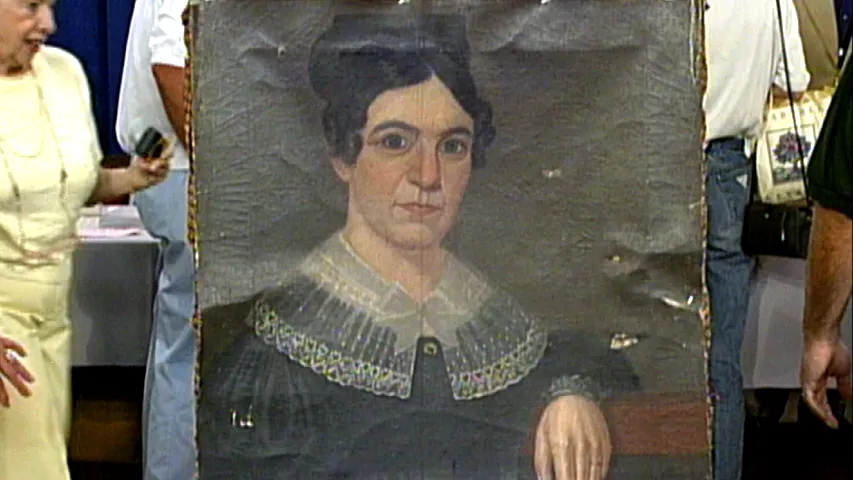
American School Portrait, ca. 1820

appraisal
Eskimo Hunting Helmet, ca. 1820
Understanding Our Appraisals
Executive producer Marsha Bemko shares her tips for getting the most out of ANTIQUES ROADSHOW.
Value can change: The value of an item is dependent upon many things, including the condition of the object itself, trends in the market for that kind of object, and the location where the item will be sold. These are just some of the reasons why the answer to the question "What's it worth?" is so often "It depends."
Note the date: Take note of the date the appraisal was recorded. This information appears in the upper left corner of the page, with the label "Appraised On." Values change over time according to market forces, so the current value of the item could be higher, lower, or the same as when our expert first appraised it.
Context is key: Listen carefully. Most of our experts will give appraisal values in context. For example, you'll often hear them say what an item is worth "at auction," or "retail," or "for insurance purposes" (replacement value). Retail prices are different from wholesale prices. Often an auctioneer will talk about what she knows best: the auction market. A shop owner will usually talk about what he knows best: the retail price he'd place on the object in his shop. And though there are no hard and fast rules, an object's auction price can often be half its retail value; yet for other objects, an auction price could be higher than retail. As a rule, however, retail and insurance/replacement values are about the same.
Verbal approximations: The values given by the experts on ANTIQUES ROADSHOW are considered "verbal approximations of value." Technically, an "appraisal" is a legal document, generally for insurance purposes, written by a qualified expert and paid for by the owner of the item. An appraisal usually involves an extensive amount of research to establish authenticity, provenance, composition, method of construction, and other important attributes of a particular object.
Opinion of value: As with all appraisals, the verbal approximations of value given at ROADSHOW events are our experts' opinions formed from their knowledge of antiques and collectibles, market trends, and other factors. Although our valuations are based on research and experience, opinions can, and sometimes do, vary among experts.
Appraiser affiliations: Finally, the affiliation of the appraiser may have changed since the appraisal was recorded. To see current contact information for an appraiser in the ROADSHOW Archive, click on the link below the appraiser's picture. Our Appraiser Index also contains a complete list of active ROADSHOW appraisers and their contact details and biographies.


