George Washington's Inaugural Ball Silk Sash, ca. 1789
GUEST: My mother said this was a scarf worn at George Washington's inauguration. He did not wear it. The men got these and the women got the earrings.
APPRAISER: You have some distinguished ancestry, I should put it, right?
GUEST: I do.
APPRAISER: Entirely possible that you would have some family member that went to that ball, right?
GUEST: Yes.
APPRAISER: But you don't know exactly which one, right?
GUEST: No.
APPRAISER: Okay, you know, looking at this, now framed and, and folded, a silk banner that probably was seven feet long if you extend it, and it's all folded under itself right here. It's really long.
GUEST: I did not realize that.
APPRAISER: When this showed up, I was so excited because, first of all, I love American folk art.
GUEST: Uh-huh.
APPRAISER: I also love American history.
GUEST: Right.
APPRAISER: This piece combines a great folk design...
GUEST: Right.
APPRAISER: With great history. So as you know, President Washington was inaugurated on April 30, 1789. A week later, they held a big ball down near Wall Street, in New York, for the president. All the ladies wore their finest. It was just, something like this certainly would not be unusual at that. We have this American eagle, painted eagle on the silk, and it's a classic stance with the laurel branch in one claw symbolizing the peace, and in the other claw, the arrows symbolizing strength. And the eagle's banner here says, "E Pluribus," written out in gold. There are 13 stars above that in yellow with blue outline, and up here it looks like an abstract design. Somebody else actually pointed out-- I can't take credit-- this is G, and this is a W.
GUEST: Oh, my heart.
APPRAISER: For George Washington.
GUEST: That's fabulous.
APPRAISER: Isn't that great? You've never...?
GUEST: No, it is better than fabulous!
APPRAISER: It's better than fabulous because the G, if you look sideways...
GUEST: I see the G.
APPRAISER: And then the W for George Washington. They're probably silver little spangles with glass beads.
GUEST: Yeah, right.
APPRAISER: Each one is carefully sewn over the star for G.W. and the 13...
GUEST: Oh, that's, that is so exciting.
APPRAISER: Isn't that neat?
GUEST: Oh, yeah.
APPRAISER: And above it, the French...like a fleur-de-lis!
GUEST: The fleur-de-lis!
APPRAISER: Now, a week after the major ball...
GUEST: Yeah.
APPRAISER: had another ball-- the French count.
GUEST: De Moustier.
APPRAISER: For Washington-- de Moustier. Now, we don't know, we certainly can't prove it, because these relics are so rare. But to my knowledge, no other of, of these banners exist. But it's very possible that a banner like this would have been at that ball a week later. And I've checked with several experts here. The silk, the fine silk, is of the period. The spangles, it's all right. I got good news and bad news. Which one, which one do you want first?
GUEST (laughs): I think I'll take the good news today.
APPRAISER: You want the good news first? Okay, I think that's a good way to do it. The value, on a, on a bad day, would be $3,000 to $6,000, and this is a kind of object, that, in the right situation...
GUEST: Right.
APPRAISER: Could bring $10,000, $15,000 at an auction setting. Now I'm gonna give you the bad news. These are costume jewelry from around, from after 1900.
GUEST: So they aren't...
APPRAISER: They didn't...
GUEST: Mother lied to me.
APPRAISER: They didn't make clips like this...
GUEST: Okay.
APPRAISER: This ear clip until after 1900. So, you know...
GUEST: Okay, oh, that's interesting.
APPRAISER: Yeah, and also the metal's not gold, and it's not even enamel. So they're nice, decorative ear clips, but... So these weren't made for the...
GUEST: So I can wear them without feeling like I'm... All right.
APPRAISER: You can wear them without worrying about losing them as much, you know?
GUEST: Yeah, yeah, yeah, yeah, yeah.
APPRAISER: But this you want to, you want to really preserve, as you've always done.
GUEST: I'm excited, really, Leigh. I just love it.

$5,000 - $8,000 Auction
$3,000 - $6,000 Auction
Featured In
episode
San Diego, Hour 2
ROADSHOW learns about 19th-century American naval cutlasses at the USS Midway Museum.
episode
Election Collection
Watch political items across history from both sides, plus a $600K-$800K find!

episode
250 Years of Americana
This special edition of ROADSHOW features discoveries reflecting 250 years of American history. — Mon, April 20, 2026
Topics
topic
Revolutionary War
Browse ANTIQUES ROADSHOW's collection of content related to the artifacts and major figures of America's Revolutionary War.
topic
Presidential Collectibles
Explore ANTIQUES ROADSHOW's large collection of presidential memorabilia.
Silk
appraisal
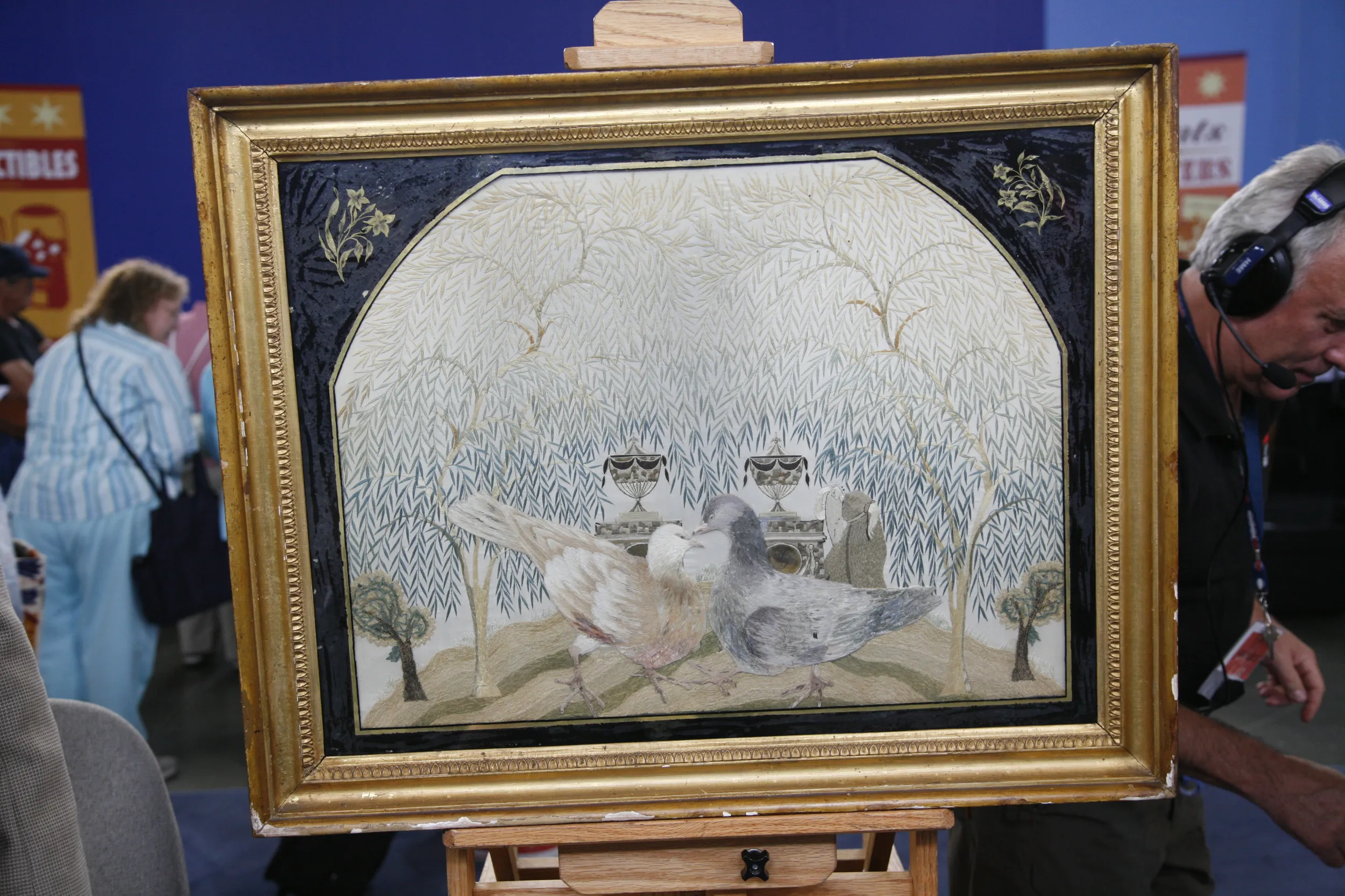
Mary Balch School Mourning Picture, ca. 1805
appraisal
appraisal
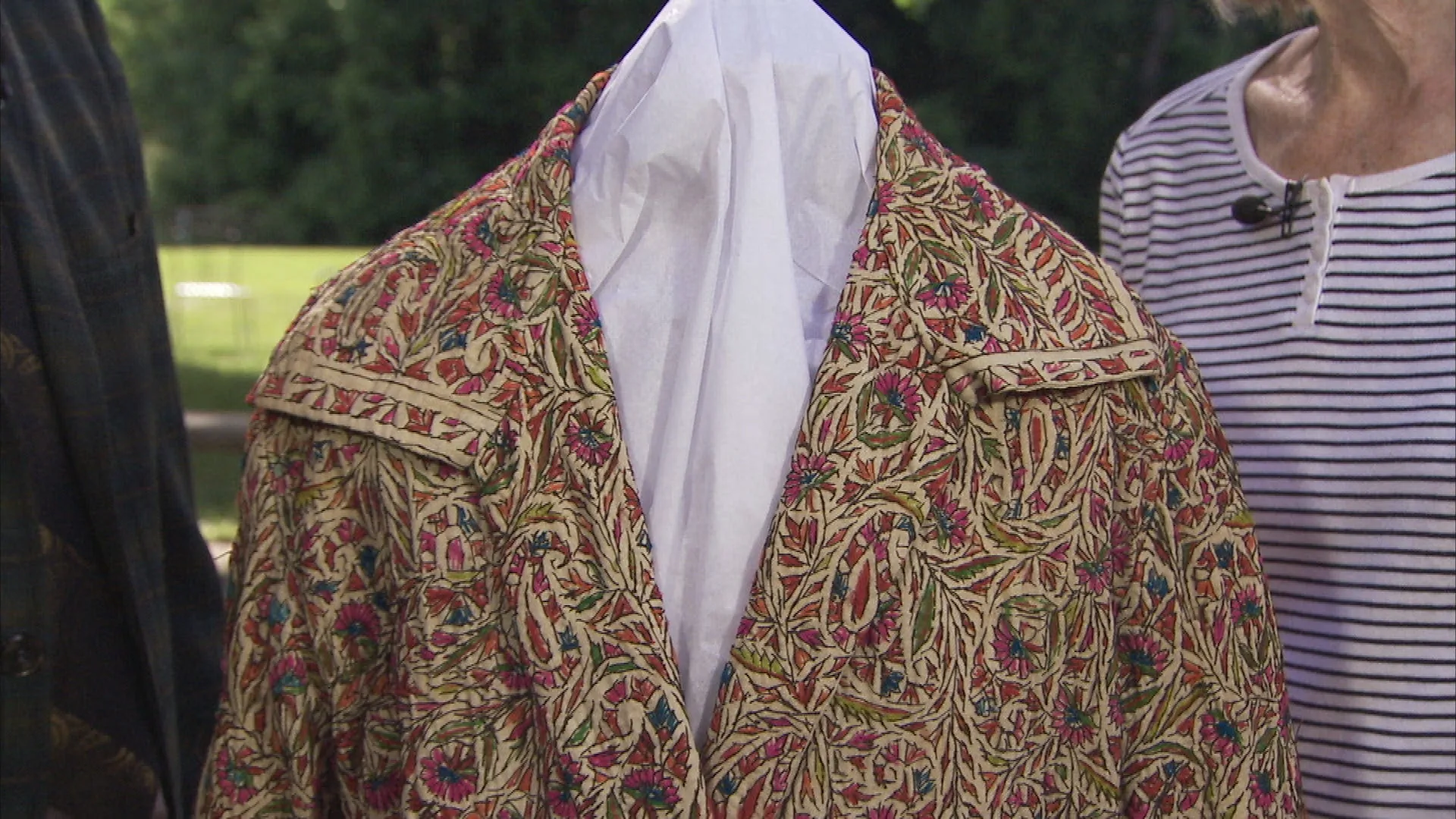
Egyptian Needlework Jacket, ca. 1925
appraisal
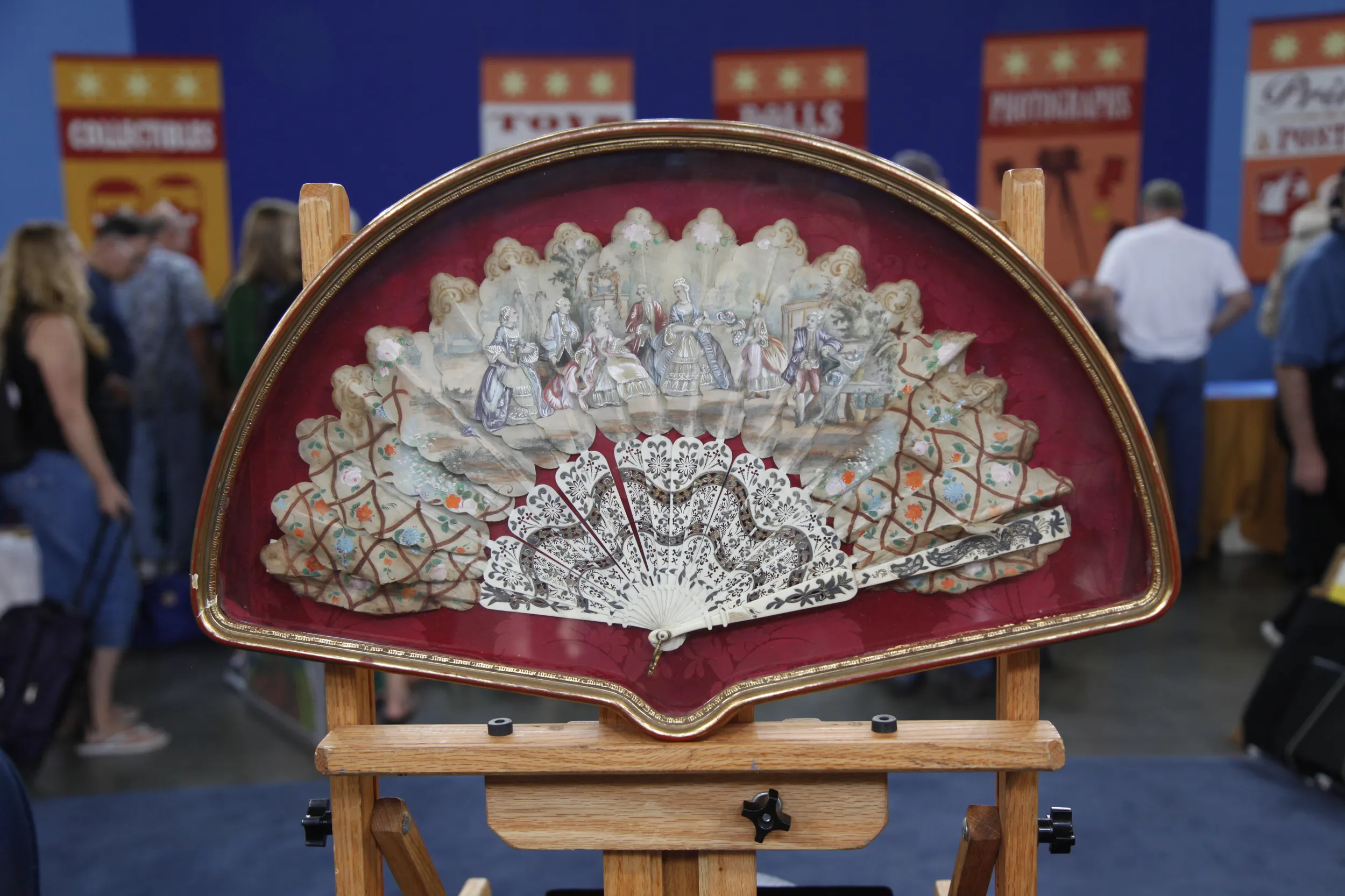
French Silk and Bone Fan, ca. 1800
Understanding Our Appraisals
Executive producer Marsha Bemko shares her tips for getting the most out of ANTIQUES ROADSHOW.
Value can change: The value of an item is dependent upon many things, including the condition of the object itself, trends in the market for that kind of object, and the location where the item will be sold. These are just some of the reasons why the answer to the question "What's it worth?" is so often "It depends."
Note the date: Take note of the date the appraisal was recorded. This information appears in the upper left corner of the page, with the label "Appraised On." Values change over time according to market forces, so the current value of the item could be higher, lower, or the same as when our expert first appraised it.
Context is key: Listen carefully. Most of our experts will give appraisal values in context. For example, you'll often hear them say what an item is worth "at auction," or "retail," or "for insurance purposes" (replacement value). Retail prices are different from wholesale prices. Often an auctioneer will talk about what she knows best: the auction market. A shop owner will usually talk about what he knows best: the retail price he'd place on the object in his shop. And though there are no hard and fast rules, an object's auction price can often be half its retail value; yet for other objects, an auction price could be higher than retail. As a rule, however, retail and insurance/replacement values are about the same.
Verbal approximations: The values given by the experts on ANTIQUES ROADSHOW are considered "verbal approximations of value." Technically, an "appraisal" is a legal document, generally for insurance purposes, written by a qualified expert and paid for by the owner of the item. An appraisal usually involves an extensive amount of research to establish authenticity, provenance, composition, method of construction, and other important attributes of a particular object.
Opinion of value: As with all appraisals, the verbal approximations of value given at ROADSHOW events are our experts' opinions formed from their knowledge of antiques and collectibles, market trends, and other factors. Although our valuations are based on research and experience, opinions can, and sometimes do, vary among experts.
Appraiser affiliations: Finally, the affiliation of the appraiser may have changed since the appraisal was recorded. To see current contact information for an appraiser in the ROADSHOW Archive, click on the link below the appraiser's picture. Our Appraiser Index also contains a complete list of active ROADSHOW appraisers and their contact details and biographies.


