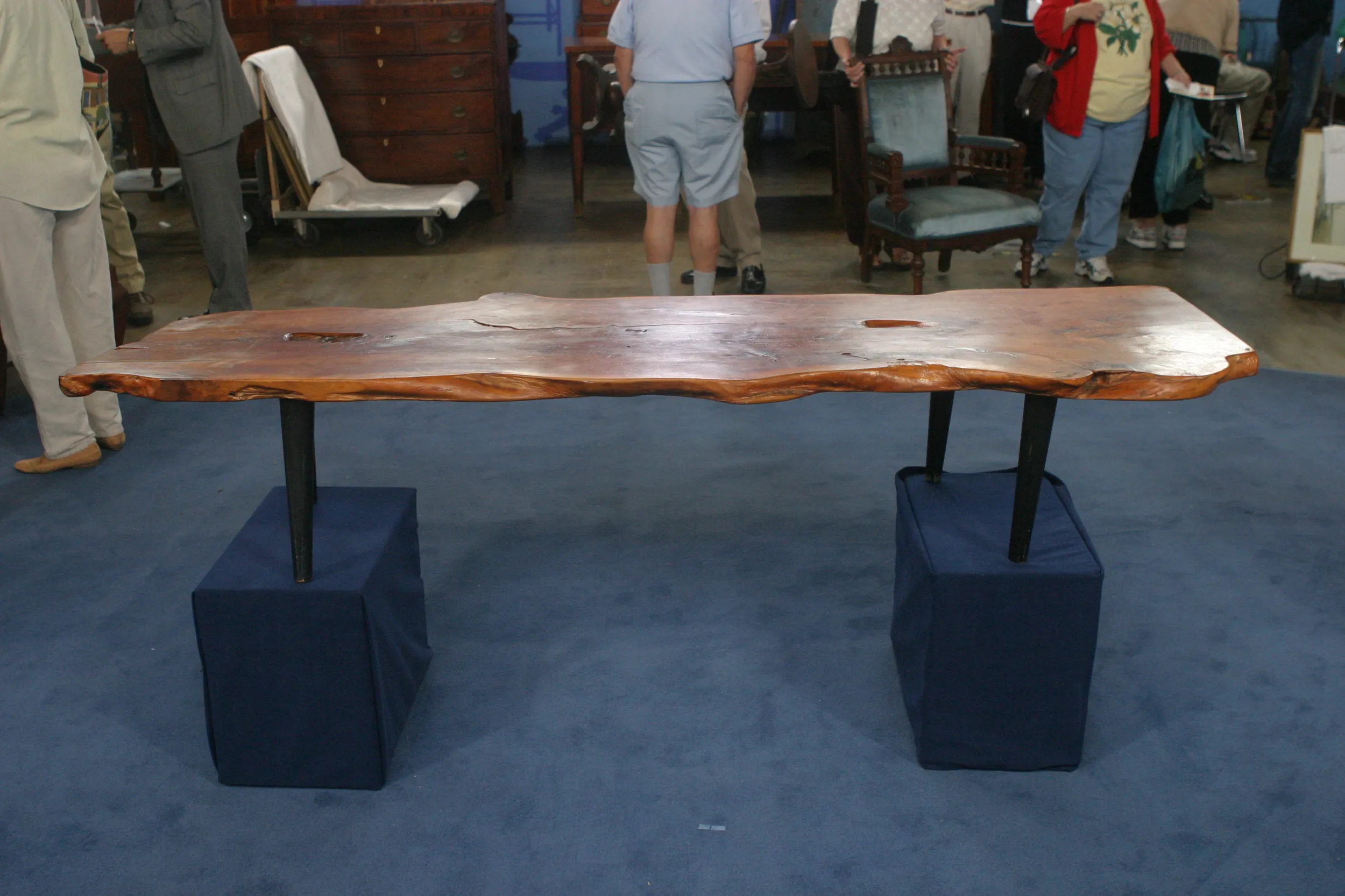
George Nakashima Walnut Trestle Table & Sketch, ca. 1955
GUEST: My parents lived in Bucks County. That's where I was born and raised. And they were interested in George Nakashima's work. So they went and visited him at his workshop in New Hope, Pennsylvania and talked about commissioning him to make a table. And they wanted a nice, long table...
APPRAISER: Right.
GUEST: ...to fit a lot of people.
APPRAISER: Right.
GUEST: And so this is what George Nakashima...
APPRAISER: Made for them.
GUEST: ...uh, came up with, yes.
APPRAISER: In 1956.
GUEST: '55 or '56. We ate every meal...
APPRAISER: Okay.
GUEST: We had no kitchen table.
APPRAISER: Every mark, every scratch is a record of your family's interaction with it, right?
GUEST: Absolutely.
APPRAISER: George Nakashima, 1905 he was born.
GUEST: Yes.
APPRAISER: And he passed away in 1990.
GUEST: Right.
APPRAISER: His daughter still--Mira, right?
GUEST: Mira.
APPRAISER: Still makes beautiful things.
GUEST: Yeah.
APPRAISER: One of the things that he believed in is that a piece of wood should be used...
GUEST: Used.
APPRAISER: ...and scratched: "Let a piece record the life around it." So that's what you've done. The wonderful thing is this drawing. It shows the two slabs up on top,
and in the center of the picture it says "Sap" in small letters. And you only have four butterfly joints in the picture. Now, he put a total of six, uh, rosewood butterfly joints. And that's really rare in a table.
GUEST: Is it?
APPRAISER: Yes. And he didn't put the sapwood on the inside. He put the sapwood on the outside. So he took these two book-matched boards, flipped them, and on the edge, this is a sapwood, the area just under the bark. That's that beautiful natural, light-colored wood.
GUEST: When my father went into the workshops or the sheds where Nakashima kept his wood...
APPRAISER: Right.
GUEST: ...he asked my father to pick the wood out...
APPRAISER: Oh, isn't that great?
GUEST: ...for this table. He went, and he said, "How about that piece of wood?" And George said, "No, not that one."
APPRAISER: Not that one.
GUEST: "Let's keep looking." So my dad picked another one out, and he said...
APPRAISER: "Not that one."
GUEST: "No, not that one." So my dad finally said, "George, why don't you just pick out a piece of wood."
APPRAISER: You just pick... (laughs) Now, when this table was made, in 1956 or so...
GUEST: Right, that's what we figure.
APPRAISER: ...they were using a lot of hand tools in the shop.
GUEST: Sure.
APPRAISER: And towards the '70s and '80s, when the shop got bigger, they had to use more machine tools, big planers. But this is, it's nice that this is so early. Now, what happened in the Nakashima market is that in the 19 early-'90s things were going for very little, a few thousand per item. And then-- you probably watched
this-- in the late '90s, started going up.
GUEST: Yes.
APPRAISER: And that peaked in about 2006.
GUEST: Okay.
APPRAISER: So it means the market is flooded right now.
GUEST: Yes, okay.
APPRAISER: And this type of table, we would put an estimate, today, of about $25,000 to $30,000 at auction.
GUEST: Okay.
APPRAISER: Now, I could have said, easily, two years ago, a year and a half ago,
$50,000 to $70,000, $50,000 to $60,000.
GUEST: Okay. It's in the family for good.
APPRAISER: He rarely gave the sketches away to a client.
GUEST: Is that right?
APPRAISER: That adds, potentially, a good $5,000 to $6,000, at least, to the table.

$30,000 - $36,000 Auction
$30,000 - $36,000 Auction
Featured In
episode
Madison, Hour 2
Roadshow investigates a shocking heist from the Wisconsin Historical Society.
episode

episode
Vintage Madison 2024, Hour 2
Roadshow revisits one-of-a-kind Wisconsin wonders including one worth $77,000 to $123,000!
Topics
topic
Nakashima
Our selection of Nakashima appraisals is ready to be explored for ANTIQUES ROADSHOW viewers drawn to George Nakashima's wood craftsmanship.
Walnut
appraisal
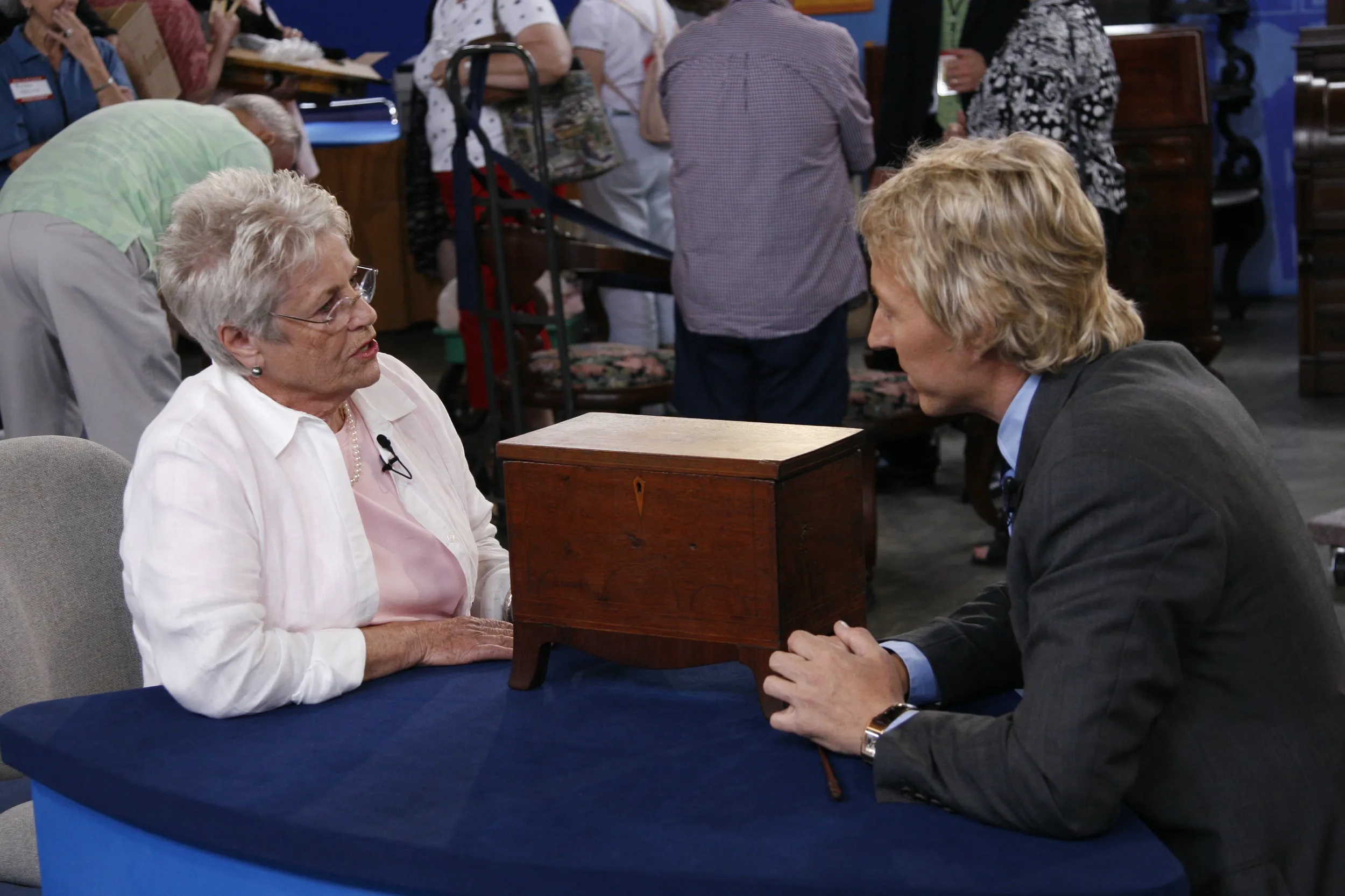
Federal Walnut Document Box, ca. 1800
appraisal
Chinese Carved Walnut Shells, ca. 1910

appraisal
Frank Rohloff Table, ca. 1968
appraisal
English Regency Hall Tree, ca. 1840
Understanding Our Appraisals
Executive producer Marsha Bemko shares her tips for getting the most out of ANTIQUES ROADSHOW.
Value can change: The value of an item is dependent upon many things, including the condition of the object itself, trends in the market for that kind of object, and the location where the item will be sold. These are just some of the reasons why the answer to the question "What's it worth?" is so often "It depends."
Note the date: Take note of the date the appraisal was recorded. This information appears in the upper left corner of the page, with the label "Appraised On." Values change over time according to market forces, so the current value of the item could be higher, lower, or the same as when our expert first appraised it.
Context is key: Listen carefully. Most of our experts will give appraisal values in context. For example, you'll often hear them say what an item is worth "at auction," or "retail," or "for insurance purposes" (replacement value). Retail prices are different from wholesale prices. Often an auctioneer will talk about what she knows best: the auction market. A shop owner will usually talk about what he knows best: the retail price he'd place on the object in his shop. And though there are no hard and fast rules, an object's auction price can often be half its retail value; yet for other objects, an auction price could be higher than retail. As a rule, however, retail and insurance/replacement values are about the same.
Verbal approximations: The values given by the experts on ANTIQUES ROADSHOW are considered "verbal approximations of value." Technically, an "appraisal" is a legal document, generally for insurance purposes, written by a qualified expert and paid for by the owner of the item. An appraisal usually involves an extensive amount of research to establish authenticity, provenance, composition, method of construction, and other important attributes of a particular object.
Opinion of value: As with all appraisals, the verbal approximations of value given at ROADSHOW events are our experts' opinions formed from their knowledge of antiques and collectibles, market trends, and other factors. Although our valuations are based on research and experience, opinions can, and sometimes do, vary among experts.
Appraiser affiliations: Finally, the affiliation of the appraiser may have changed since the appraisal was recorded. To see current contact information for an appraiser in the ROADSHOW Archive, click on the link below the appraiser's picture. Our Appraiser Index also contains a complete list of active ROADSHOW appraisers and their contact details and biographies.


