French Three Graces Clock, ca. 1890
GUEST: My mother picked it up in-in probably the late '40s at an antique store.
APPRAISER: It’s called an annular clock and it's French. And instead of a traditional clock with two hands, a minute hand and an hour hand telling the time, this enameled band spins with the arrow being the indicator in the front. This is the Three Graces clock. These are Zeus's daughters and they represent all the positive aspects of life in society. They're a bronze figure that have been patinated with a chemical that makes them this black color. It has these three tapered feet that are brass and they're really wonderfully done. I love all these ormolu open fret bronze castings that are gilded just over the top. You have this beaded border on this triangular marble base and you have these wonderful garlands. It just presents itself really well. You come to the top, you have the spear and then you have these wonderful ormolu mounts and then the putti at the top sitting on a cloud. When do you think this clock was made?
GUEST: I think inside it says 1807.
APPRAISER: That has a serial number, 1807 on it.
GUEST: Oh. (chuckles)
APPRAISER: It's actually later than that. It's, uh, it's a clock that was made circa 1890. This top comes off, but as you know, it was pretty hard to take off. And inside is a beautiful eight-day French movement. It's also stamped on the top plate "J. Lefebvre Fils" which is sons, excuse my pronunciation of the French language. It's the best I can do-- and it was made in Paris. So this is a clock copied from the original that was produced by François Vion circa 1765-- but this is a later copy. These were a very popular clock. A lot of Parisians made the cases and a lot of French clock makers would put their movements inside of these cases. And you can see the bottom half of the sphere has a little deterioration. This is the original paint at the bottom. And this has been highlighted at some time. And it's also missing a torch, but honestly, really not a big deal at all. In this as-is condition, in a retail setting, this clock would sell for around $15,000.
GUEST: Wow. (chuckles) That's amazing to me. (chuckles)

$15,000 Retail
Featured In

episode
Red Butte Garden & Arboretum, Hour 3
Premiered Mon, Jan 19, 2026 — See a bounty of Utah treasures from ROADSHOW’s visit to Red Butte Garden & Arboretum!
Enamel
appraisal
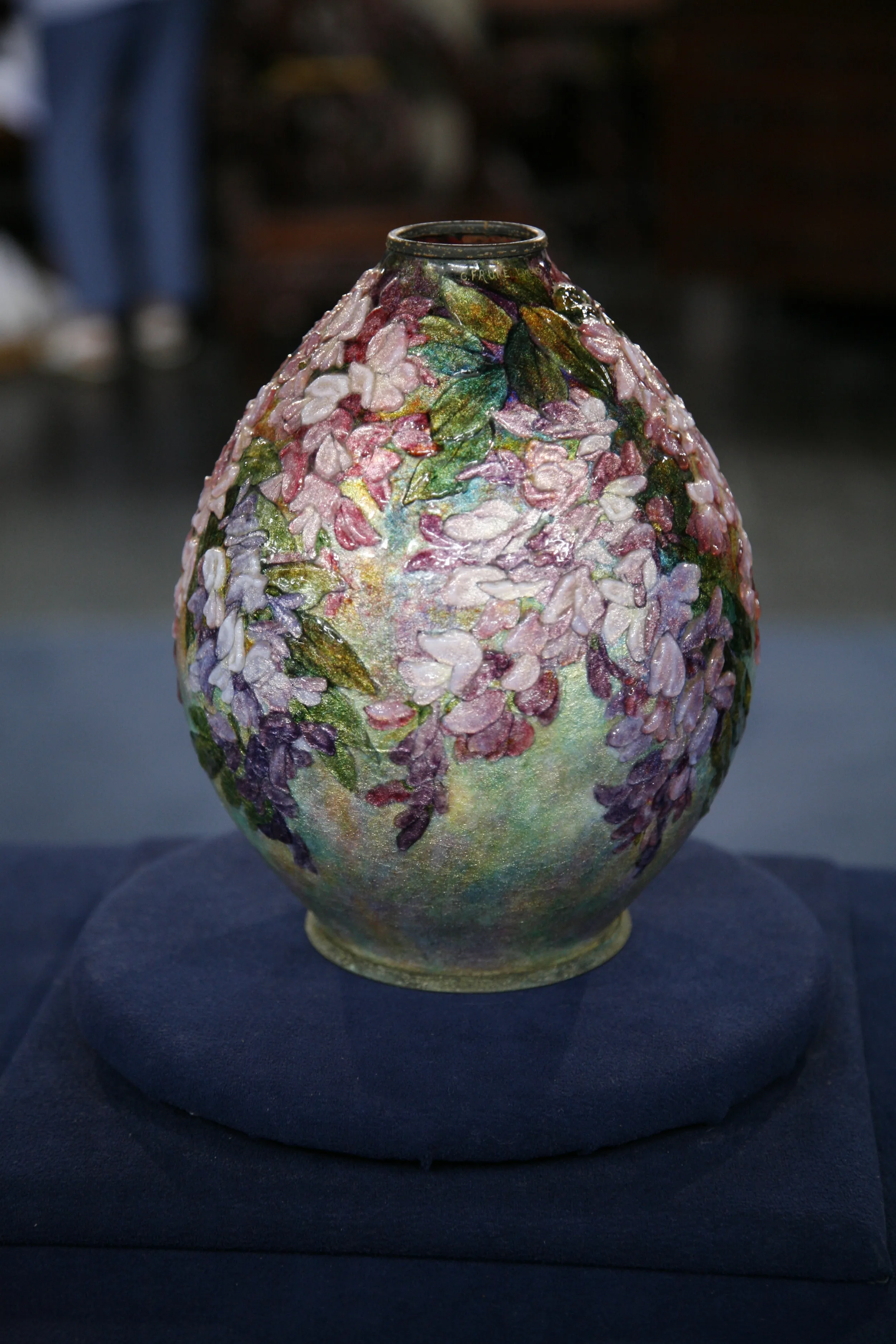
Camille Fauré Enameled Vase, ca. 1925

appraisal

appraisal
J. & L. Lobmeyr Vase, ca. 1885

appraisal
English Memorial Jewelry Collection
Understanding Our Appraisals
Executive producer Marsha Bemko shares her tips for getting the most out of ANTIQUES ROADSHOW.
Value can change: The value of an item is dependent upon many things, including the condition of the object itself, trends in the market for that kind of object, and the location where the item will be sold. These are just some of the reasons why the answer to the question "What's it worth?" is so often "It depends."
Note the date: Take note of the date the appraisal was recorded. This information appears in the upper left corner of the page, with the label "Appraised On." Values change over time according to market forces, so the current value of the item could be higher, lower, or the same as when our expert first appraised it.
Context is key: Listen carefully. Most of our experts will give appraisal values in context. For example, you'll often hear them say what an item is worth "at auction," or "retail," or "for insurance purposes" (replacement value). Retail prices are different from wholesale prices. Often an auctioneer will talk about what she knows best: the auction market. A shop owner will usually talk about what he knows best: the retail price he'd place on the object in his shop. And though there are no hard and fast rules, an object's auction price can often be half its retail value; yet for other objects, an auction price could be higher than retail. As a rule, however, retail and insurance/replacement values are about the same.
Verbal approximations: The values given by the experts on ANTIQUES ROADSHOW are considered "verbal approximations of value." Technically, an "appraisal" is a legal document, generally for insurance purposes, written by a qualified expert and paid for by the owner of the item. An appraisal usually involves an extensive amount of research to establish authenticity, provenance, composition, method of construction, and other important attributes of a particular object.
Opinion of value: As with all appraisals, the verbal approximations of value given at ROADSHOW events are our experts' opinions formed from their knowledge of antiques and collectibles, market trends, and other factors. Although our valuations are based on research and experience, opinions can, and sometimes do, vary among experts.
Appraiser affiliations: Finally, the affiliation of the appraiser may have changed since the appraisal was recorded. To see current contact information for an appraiser in the ROADSHOW Archive, click on the link below the appraiser's picture. Our Appraiser Index also contains a complete list of active ROADSHOW appraisers and their contact details and biographies.


