GUEST: Well, I go to a lot of garage sales.
APPRAISER: Is that where you found this guy?
GUEST: Yes, I did.
APPRAISER: When you bought it, did they tell you what it was, or did you have any idea what it was you bought?
GUEST: No. I just... I thought it was pretty, so... I just picked it up and bought it.
APPRAISER: When you picked it up, did you notice how it was very lightweight, considering it's a big thing?
GUEST: Yeah, I did.
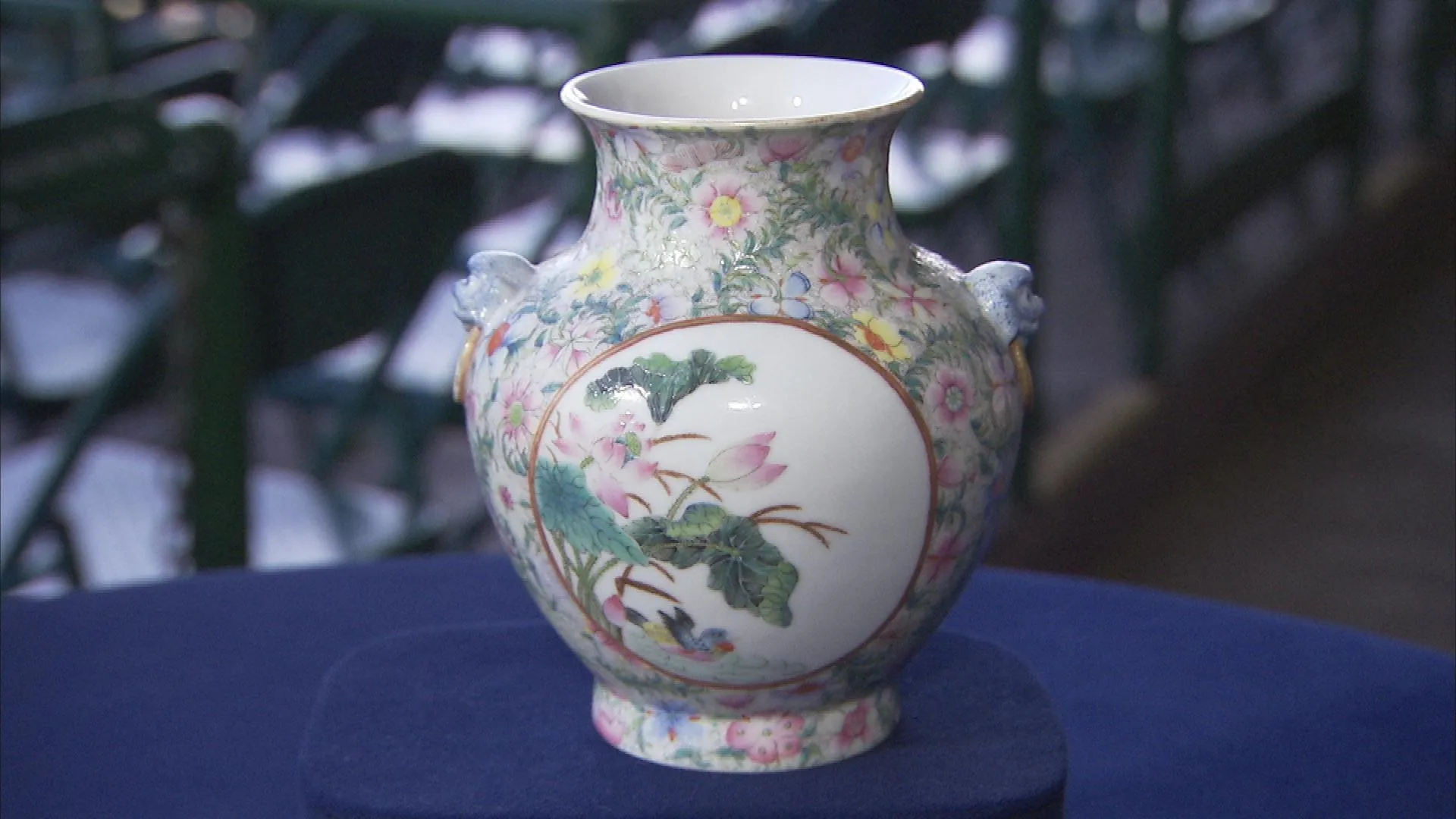
APPRAISER: It's very lightweight, because it's made of something called "faience," which is what the French call tin-glazed earthenware. It's pottery, very thinly potted with a layer all over it of whitish glaze made white by adding tin. And we can also tell, as well as it's being very lightweight, because in this area there are some little flecks where the glaze has chipped away, and revealing that brown-colored earthenware body inside.
GUEST: Uh-huh.
APPRAISER: Doesn't affect the value, that, by the way. It's a little tiny bit of damage. But we expect that. It's amazing the condition is so good. The French started making faience of this type in the 18th century, but most of it was made through the 19th century, and your plate is made in about 1880 or 1885, something like that. It's really much larger and better than most French faience of that period. It may even be large enough that it was made for an exhibition of some sort. It's a real showpiece. It's all hand-painted. We don't know who painted it or who made it, but look at this beautiful painting of the tulip here.
GUEST: Uh-huh.
APPRAISER: It's really well done, as are all of the wild flowers. And they've also painted birds-- completely out of scale, I might add. I mean, the birds are tiny compared to the flowers and the berries, but they probably copied them from a print. They probably had an ornithological print and some botanical prints, and they copied the, uh, the pictures. Now, if you bought it at a garage sale, you'd normally get a bargain. How much did you pay?
GUEST: I paid two dollars.
APPRAISER: Two dollars. Now, how long ago did you buy it?
GUEST: About two years ago.
APPRAISER: Well, I think you should have looked at that yard sale for a few more things, because this is a great quality object, and today, if it was in a good antique shop-- I talked to some of my colleagues on the table-- we felt it could be priced at about $1,500.
GUEST: Wow.
APPRAISER: Something in that area.
GUEST: Wow, that's great.
APPRAISER: Thanks for bringing it in.
GUEST: Oh, thank you.