Frank McCarthy Oil Painting, ca. 1950
GUEST: We purchased it about 40 years ago at a small gallery near our home in Lake Elsinore, California. Just loved it. I don't even think we paid $1,000 for it. But I know it's by Frank McCarthy, a very famous Western artist. We love all this action. Little vignettes everywhere.
APPRAISER: It's easy to see why he was nicknamed the Dean of Western Action Painters. This is what he specialized in. What-what else do you know about him?
GUEST: Well, it, uh, has to do with Chief Joseph, his surrender in 1877, a Nez Perce Indian. They were forced to surrender. We had had the magazine at one time, Argosy magazine. It had the picture in the magazine and a story concerning what was going on in the picture. So that's how we knew.
APPRAISER: He did do Argosy magazine, and also Collier's and True, and alongside that, he did a lot of covers for the Western novels. He was from New York, originally. He always lived there, and-and also in Connecticut. He was best known for doing illustration. He studied commercial art, and so he did books. He also did movies.
GUEST: Yes.
APPRAISER: So he did a couple of the James Bond movies...
GUEST: Yes.
APPRAISER: ...like Thunderball, and You Only Live Twice.
GUEST: That's right.
APPRAISER: And one of my favorite action movies, The Great Escape. But 1973 was a real watershed year for him, because he had an exhibition of his art...
GUEST: Mm-hmm.
APPRAISER: ...and it sold out almost immediately.
GUEST: Right.
APPRAISER: And that gave him the impetus to move from New York to Arizona. And so he went from being an illustration artist to being thought of more as a Western artist. So there's more the fine art aspect of it. This is a oil on board. You had mentioned that it was in Argosy magazine, and unfortunately, you've lost track of that now. That would have been great in helping us to determine exactly when this was painted. But given that it's one of his illustration pieces, I'm thinking it's probably in the '40s, '50s. I think, and I spoke with my colleagues, we think, at auction, $12,000 to $18,000.
GUEST: Really?
APPRAISER: Yeah, comfortably.
GUEST: Guess I should get insurance. (chuckles) Well, thank you.
APPRAISER: I would suggest an insurance figure of $30,000.
GUEST: Oh, really?
APPRAISER: Yeah.

$12,000 Auction
$30,000 Insurance
Featured In

episode
Springs Preserve, Hour 3
ROADSHOW heads to the Mojave Desert in search of marvels at Springs Preserve in Las Vegas.
1950s
appraisal
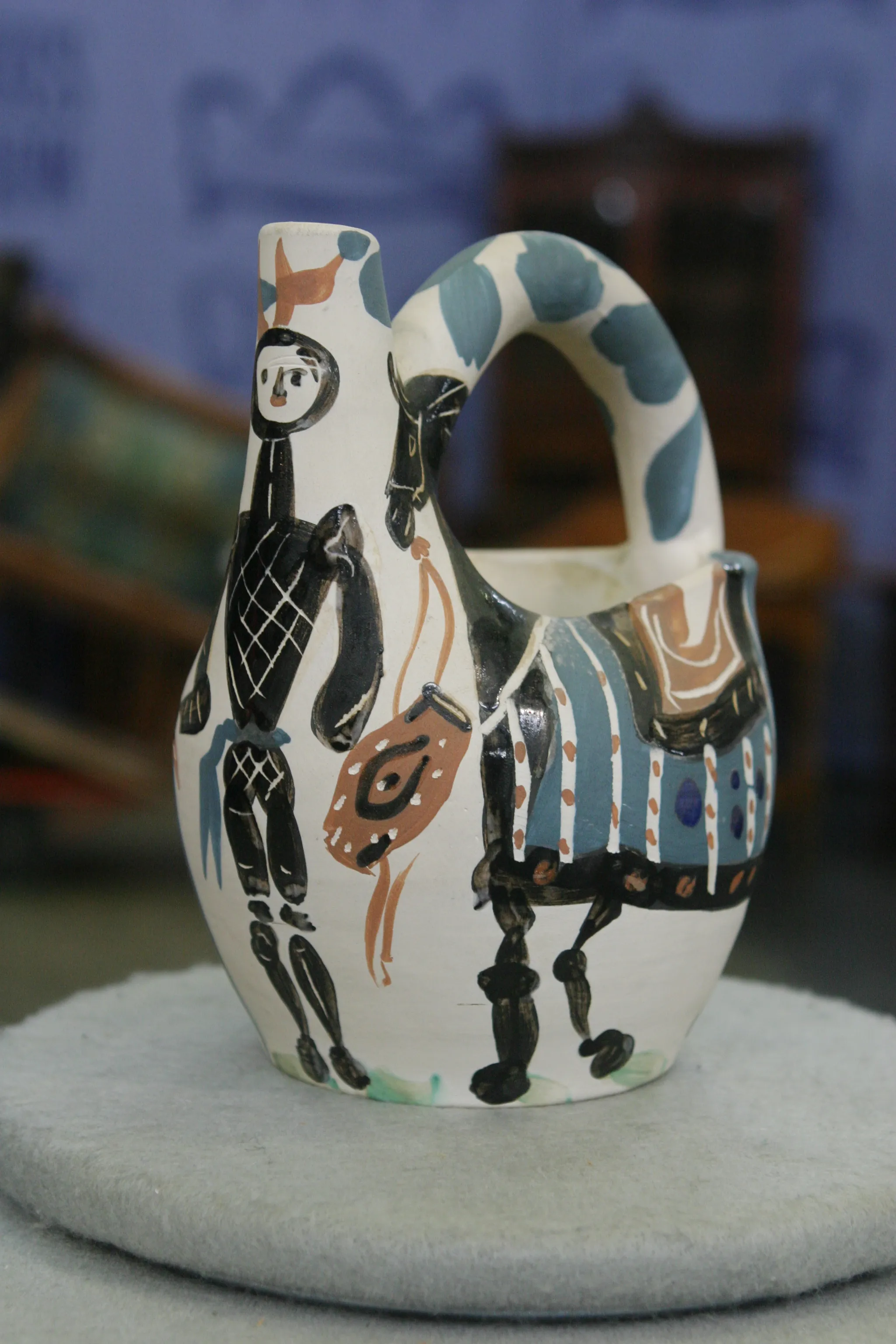
1952 Picasso Madoura Ceramic Jug

appraisal
José de Rivera Silver Pin, ca. 1944

appraisal
1952 Fender Esquire Guitar

appraisal
1957 Buddy Holly Contract
Understanding Our Appraisals
Executive producer Marsha Bemko shares her tips for getting the most out of ANTIQUES ROADSHOW.
Value can change: The value of an item is dependent upon many things, including the condition of the object itself, trends in the market for that kind of object, and the location where the item will be sold. These are just some of the reasons why the answer to the question "What's it worth?" is so often "It depends."
Note the date: Take note of the date the appraisal was recorded. This information appears in the upper left corner of the page, with the label "Appraised On." Values change over time according to market forces, so the current value of the item could be higher, lower, or the same as when our expert first appraised it.
Context is key: Listen carefully. Most of our experts will give appraisal values in context. For example, you'll often hear them say what an item is worth "at auction," or "retail," or "for insurance purposes" (replacement value). Retail prices are different from wholesale prices. Often an auctioneer will talk about what she knows best: the auction market. A shop owner will usually talk about what he knows best: the retail price he'd place on the object in his shop. And though there are no hard and fast rules, an object's auction price can often be half its retail value; yet for other objects, an auction price could be higher than retail. As a rule, however, retail and insurance/replacement values are about the same.
Verbal approximations: The values given by the experts on ANTIQUES ROADSHOW are considered "verbal approximations of value." Technically, an "appraisal" is a legal document, generally for insurance purposes, written by a qualified expert and paid for by the owner of the item. An appraisal usually involves an extensive amount of research to establish authenticity, provenance, composition, method of construction, and other important attributes of a particular object.
Opinion of value: As with all appraisals, the verbal approximations of value given at ROADSHOW events are our experts' opinions formed from their knowledge of antiques and collectibles, market trends, and other factors. Although our valuations are based on research and experience, opinions can, and sometimes do, vary among experts.
Appraiser affiliations: Finally, the affiliation of the appraiser may have changed since the appraisal was recorded. To see current contact information for an appraiser in the ROADSHOW Archive, click on the link below the appraiser's picture. Our Appraiser Index also contains a complete list of active ROADSHOW appraisers and their contact details and biographies.


