Ferdinand Strauss Santee Claus Toy, ca. 1925
GUEST: This was a toy from my father's collection. He was an avid toy collector for many, many years. Following his passing in 1993, I took approximately 50 or 60 of his toys. His collection was several hundred toys.
APPRAISER: Wow.
GUEST: And I focused predominantly on the holiday theme. Christmas and the Disney themes.
APPRAISER: Mm-hmm. Mm-hmm. And what happened to the rest?
GUEST: They're, uh, they went to auction.
APPRAISER: This is a classic lithograph tin toy from the 1920s and 1930s. It was made by a company called Ferdinand Strauss. Two major makers of tin wind-up toys of that era, '20s and '30s was Louis Marx and Ferdinand Strauss. They were the best of the best of that era. Marx was the much more prolific. But Ferdinand Strauss's toys were to my mind much more inventive, much more colorful. One of the great things about Strauss toys, his toys had some of the greatest lithography and some of the greatest artwork. And the colors are really vibrant. Here he is being pulled by the reindeer, and here he is putting out his toys, and it's just a fantastic piece. The golden era of the lithograph tin toys in America were the '20s and '30s. You see it has the patent dates of '21 and '23. The market on these values have sort of softened up, which is a generational thing.
GUEST: Yes. Right.
APPRAISER: You made a good choice in keeping with the holiday stuff because that market is quite strong. In today's market, the run of the mill example of this is in the $400 to $500 range. But this is not run of the mill-- this is an exceptional example. It has the, even-- I've never seen this-- the original reins. There's no question, you can see the little knot here. I mean, it's extraordinary.
GUEST: Mm-hmm.
APPRAISER: I think this example on today's market would easily sell for $800 to $1,200.
GUEST: (chuckles)
APPRAISER: So you kept the right one.
GUEST: (chuckles)
APPRAISER: But, let's see.
GUEST: (chuckles)
APPRAISER: What's the best part of these tin wind-ups?
GUEST: For me, it's the sentimental value of my father.
APPRAISER: But I mean in general.
GUEST: In general, whether they work or not. (laughs)
APPRAISER: Yes, and that's one of the key elements of, of popularity in a toy.
GUEST: Mm-hmm. Mm-hmm. Yeah.
APPRAISER: And so we're going to have to make a, make this work.
GUEST: Okay.
APPRAISER: We're gonna give it a good wind to get it going. So let's see what happens here. And now he's coming back.
GUEST: (chuckles)

$803 - $1,200 Auction
Featured In

episode
Castle Farms, Hour 3
ROADSHOW returns to storm Castle Farms (nicely) in scenic Charlevoix one final time! — Mon, April 13, 2026
1920s

appraisal
Tiffany Glass Candy Dish, ca. 1927
appraisal
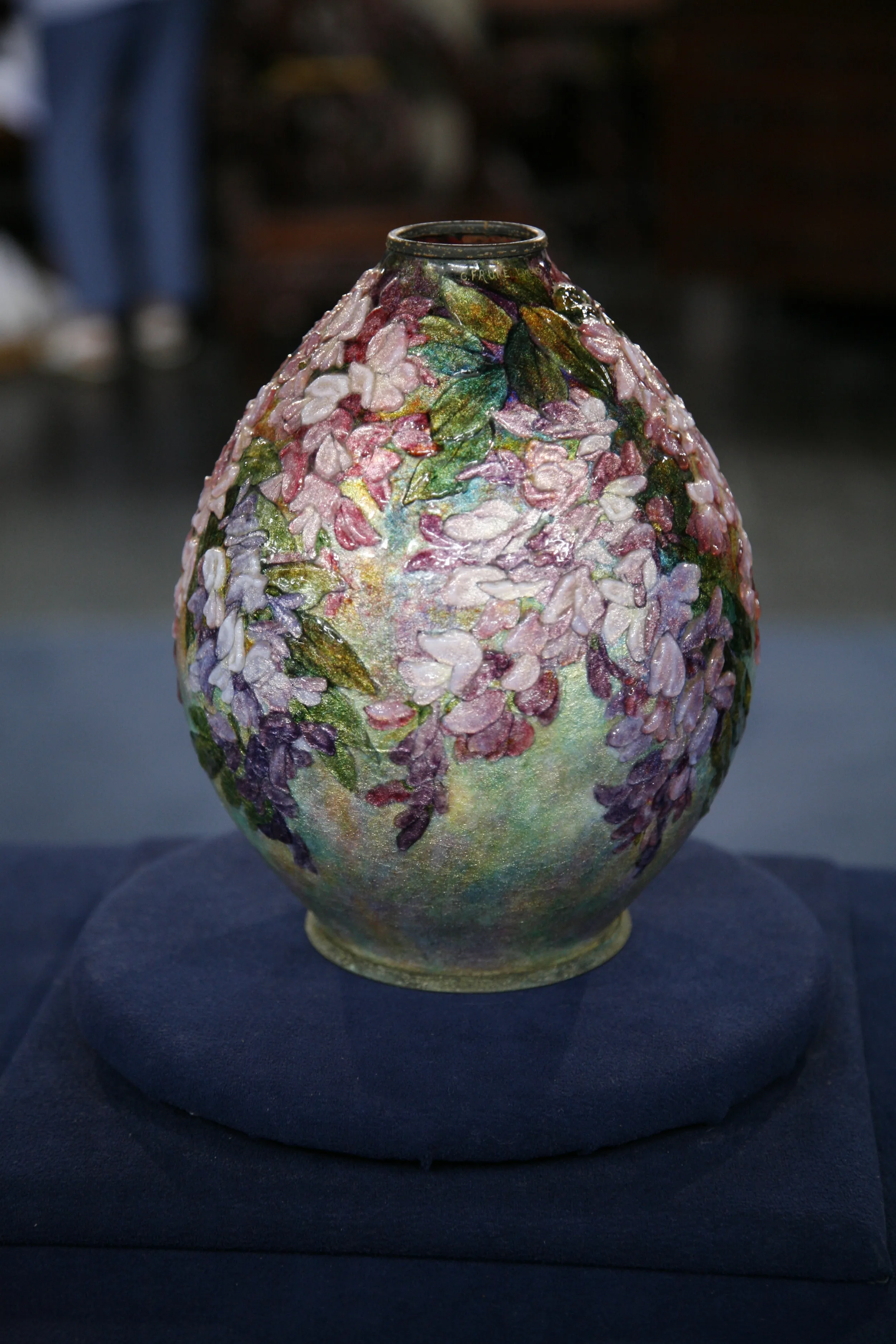
Camille Fauré Enameled Vase, ca. 1925

appraisal
Fern Isabel Coppedge Oil Painting, ca. 1925

appraisal
Gustave Baumann Print, ca. 1927
Understanding Our Appraisals
Executive producer Marsha Bemko shares her tips for getting the most out of ANTIQUES ROADSHOW.
Value can change: The value of an item is dependent upon many things, including the condition of the object itself, trends in the market for that kind of object, and the location where the item will be sold. These are just some of the reasons why the answer to the question "What's it worth?" is so often "It depends."
Note the date: Take note of the date the appraisal was recorded. This information appears in the upper left corner of the page, with the label "Appraised On." Values change over time according to market forces, so the current value of the item could be higher, lower, or the same as when our expert first appraised it.
Context is key: Listen carefully. Most of our experts will give appraisal values in context. For example, you'll often hear them say what an item is worth "at auction," or "retail," or "for insurance purposes" (replacement value). Retail prices are different from wholesale prices. Often an auctioneer will talk about what she knows best: the auction market. A shop owner will usually talk about what he knows best: the retail price he'd place on the object in his shop. And though there are no hard and fast rules, an object's auction price can often be half its retail value; yet for other objects, an auction price could be higher than retail. As a rule, however, retail and insurance/replacement values are about the same.
Verbal approximations: The values given by the experts on ANTIQUES ROADSHOW are considered "verbal approximations of value." Technically, an "appraisal" is a legal document, generally for insurance purposes, written by a qualified expert and paid for by the owner of the item. An appraisal usually involves an extensive amount of research to establish authenticity, provenance, composition, method of construction, and other important attributes of a particular object.
Opinion of value: As with all appraisals, the verbal approximations of value given at ROADSHOW events are our experts' opinions formed from their knowledge of antiques and collectibles, market trends, and other factors. Although our valuations are based on research and experience, opinions can, and sometimes do, vary among experts.
Appraiser affiliations: Finally, the affiliation of the appraiser may have changed since the appraisal was recorded. To see current contact information for an appraiser in the ROADSHOW Archive, click on the link below the appraiser's picture. Our Appraiser Index also contains a complete list of active ROADSHOW appraisers and their contact details and biographies.


