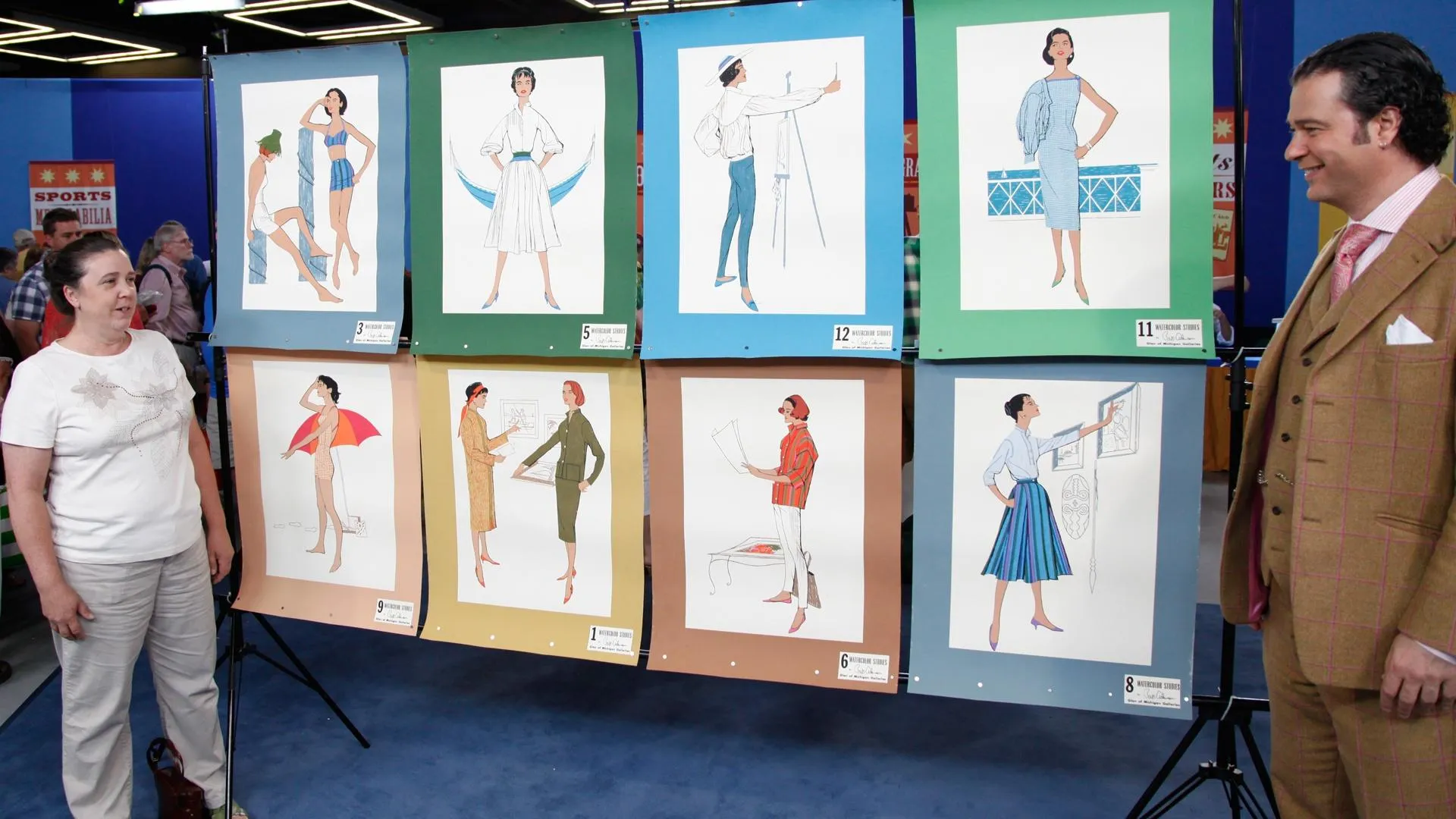
GUEST: I found them at an estate sale. They were just so iconic of the '60s, and I really love old fabrics, so I just bought them.
APPRAISER: How much did you pay for them?
GUEST: Eight dollars, and there's still a few more. I'm not sure if I have all 12 or not.
APPRAISER: Eight dollars each?
GUEST: No, for the total amount.
APPRAISER: Eight dollars for 12 of them?
GUEST: Yeah, 11 or 12.
APPRAISER: They are great fashion images. Bill Atkinson was a designer of some renown. Not enough to be known by my colleagues here at the textiles table, who I consulted with them. They hadn't heard of him. But then I consulted my other colleague, the omniscient Internet. Atkinson was actually a very renowned designer in the 1950s and 1960s. He began his life as an architect, and curiously enough, an article in Sports Illustrated from May 7, 1956, describes Atkinson as follows: they say, "Atkinson was an architect who has applied the precise standards of the building trades to the making of women's clothes." A little further research shows us that Atkinson is one of the people attributed to making sort of casual and sportswear more our everyday wear. And I think we really see that here in some of these fantastic designs. I think you can see the architect's eye in some of these designs-- the very straight lines, also the continuous, repeating patterns that we see here, and in the bathing suit design closest to you. Now, do you have any idea what these were used for?
GUEST: I'm assuming they were for a clothing line.
APPRAISER: I would say for a clothing line, but I think more specifically, they were used in stores as a way to sell the merchandise. Now, you see that they're called watercolor studies. In fact, these are not watercolors; these are printed. But the original studies that Atkinson would have done would have been watercolor. And as you said, they are all numbered, and it seems there should be at least 12 of them. Glen of Michigan was the dress designer who turned Atkinson's designs into clothing. And to my eye, these are probably late 1950s, early 1960s. My colleagues at the textile table told me that old design is new again, and contemporary designers keep looking back to older designers for inspiration. These are extremely rare. I haven't seen them before. I think with all of the resurging interest in all things 1950s and 1960s, based on other design samples, other fashion designer plates like this, I would estimate each one of these between $300 and $400, making all eight of them at auction estimated at $2,400 to $3,200 for the group of eight that we see here, not including the ones you have at home.
GUEST: That's wonderful.