English Porcelain Ornithological Dessert Service, ca. 1860
GUEST: My grandfather had seven sisters and one of them was a fairly renowned antiques dealer in Joplin, Missouri. Visited her house one time, it was just jammed with stuff. So she gave this set to my mother and it was a wedding present. Hm. And my mom would always say, "May said this was one of the finest examples of this type of work that she'd ever seen."
APPRAISER: It's a beautiful service.
GUEST: Nice.
APPRAISER: It is a dessert service and it's complete. There is what we would call a cake plate or a cake stand. You can see there's a pedestal on this one. And eight plates to go with it. And they're in beautiful condition, which suggests they haven't had a lot of use. These services were made typically with one fruit stand and eight plates. It's rare to find more than one fruit stand. Ornithological services typically depict birds. And these are all hand-painted, very beautifully done, of a more exotic nature. What I like here is that these are common British birds.
GUEST: Oh, British.
APPRAISER: Um, and common in this case is unusual.
GUEST: Mm-hm. Mm-hmm.
APPRAISER: So, you know, here's a thrush, there are finches. They're-they're common birds of a garden variety. There is one that's an exception. What is that? Do-- have you noticed?
GUEST: Well, I think it would be this one, right?
APPRAISER: It would, the parrot.
GUEST: Right, parrot.
APPRAISER: And you don't see many parrots flying around naturally in the British Isles.
GUEST: No.
APPRAISER: I think someone has chosen-- whoever painted this chose the parrot, perhaps because that is a fruit stand or a dessert stand. And fruit, after all, in Britain, is mostly exotic.
GUEST: Right.
APPRAISER: Now, I don't know who made it and I don't know who painted it. Almost certainly made in the county of Staffordshire or very nearby. I think these are probably mid-Victorian, meaning made perhaps around 1860 or 1870. There are no marks on them. There was a time when services of this type were more valuable, frankly, than they are today. A retail price, it's going to be at least $1,000.
GUEST: Okay.
APPRAISER: And possibly a dealer would price it at $1,500 or $1,600.
GUEST: Okay, great.

$1,000 - $1,600 Retail
Featured In

episode
Denver Botanic Gardens Chatfield Farms, Hour 3
NEW! ROADSHOW discovers treasures during the third hour from Littleton, CO.
Tableware

appraisal
1876 John Alexander Stoneware Cooler
appraisal
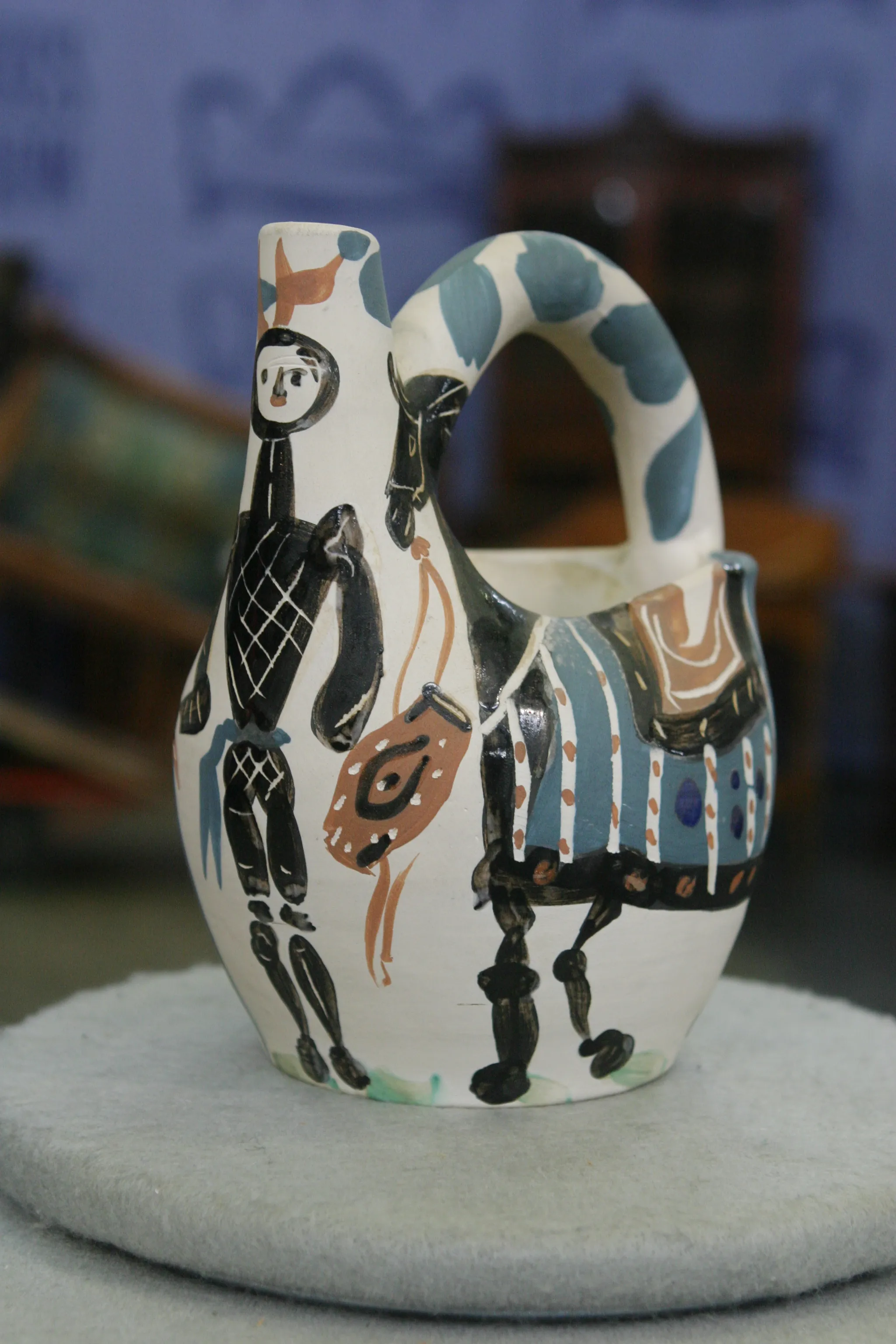
1952 Picasso Madoura Ceramic Jug

appraisal

appraisal
Majolica Fish Tureen attributed to George Jones & Sons, ca. 1870
Understanding Our Appraisals
Executive producer Marsha Bemko shares her tips for getting the most out of ANTIQUES ROADSHOW.
Value can change: The value of an item is dependent upon many things, including the condition of the object itself, trends in the market for that kind of object, and the location where the item will be sold. These are just some of the reasons why the answer to the question "What's it worth?" is so often "It depends."
Note the date: Take note of the date the appraisal was recorded. This information appears in the upper left corner of the page, with the label "Appraised On." Values change over time according to market forces, so the current value of the item could be higher, lower, or the same as when our expert first appraised it.
Context is key: Listen carefully. Most of our experts will give appraisal values in context. For example, you'll often hear them say what an item is worth "at auction," or "retail," or "for insurance purposes" (replacement value). Retail prices are different from wholesale prices. Often an auctioneer will talk about what she knows best: the auction market. A shop owner will usually talk about what he knows best: the retail price he'd place on the object in his shop. And though there are no hard and fast rules, an object's auction price can often be half its retail value; yet for other objects, an auction price could be higher than retail. As a rule, however, retail and insurance/replacement values are about the same.
Verbal approximations: The values given by the experts on ANTIQUES ROADSHOW are considered "verbal approximations of value." Technically, an "appraisal" is a legal document, generally for insurance purposes, written by a qualified expert and paid for by the owner of the item. An appraisal usually involves an extensive amount of research to establish authenticity, provenance, composition, method of construction, and other important attributes of a particular object.
Opinion of value: As with all appraisals, the verbal approximations of value given at ROADSHOW events are our experts' opinions formed from their knowledge of antiques and collectibles, market trends, and other factors. Although our valuations are based on research and experience, opinions can, and sometimes do, vary among experts.
Appraiser affiliations: Finally, the affiliation of the appraiser may have changed since the appraisal was recorded. To see current contact information for an appraiser in the ROADSHOW Archive, click on the link below the appraiser's picture. Our Appraiser Index also contains a complete list of active ROADSHOW appraisers and their contact details and biographies.


