GUEST: Well, my grandfather had the painting. It was given to him by an older couple that he used to work for on their farm. They said they traveled a lot, overseas possibly. But other than that we don't know anything about it.
APPRAISER: And how long have you had it?
GUEST: I've had it, I guess, for about nine years now.
APPRAISER: And so you aren't sure who the artist is or anything?
GUEST: No, ma'am. I really couldn't read it out there on the end.
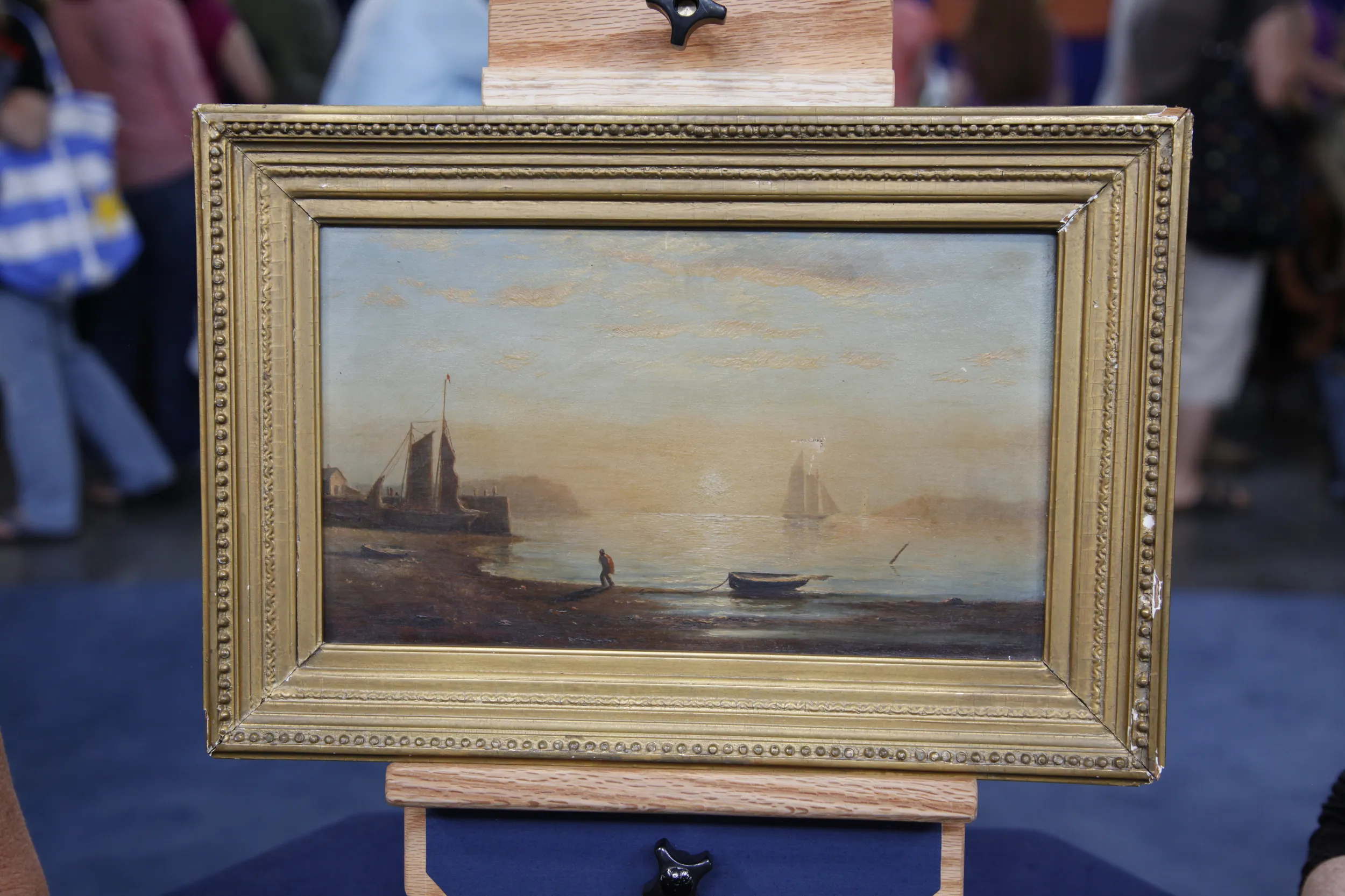
APPRAISER: What we have is a watercolor and gouache by the Philadelphia artist Edmund Darch Lewis. And so it's signed "E.D. Lewis." And Lewis was from Philadelphia. He was born of wealthy parents, so he didn't really have to work for a living. But he did study with a German artist named Paul Weber, again in Philadelphia, and exhibited as early as 1854 at the Pennsylvania Academy as well as in New York at the National Academy. And all of these were institutions that most artists strived to show in, so he was quite prominent at the time. And the main things that he began to paint were large Romantic landscapes, and mostly in and around Philadelphia. And then he turned more to watercolors. He more or less gave up painting oils. As we can see on the plaque, the piece is called "Summer Day," and it's named Narragansett. And Narragansett is an area of Rhode Island that's right on the water. Now, the piece you'll see is dated here in the lower right, and it looks like one, eight, and then a little bit of a mystery for the third figure, and then a total mystery for the fourth one. Many people thought it was 1850-something. However, when you examine it carefully, it really is another eight, so it's 1880, and then we really aren't sure about this last number. It is on paper, and the paper is in turn backed with wood. And that was something that was being done in the late 19th, early 20th century. But over time, that wood actually causes staining to the surface of whatever is on top of it, whether it's canvas or paper. So the paper you see here is a bit darker because of that wood backing.
GUEST: Okay.
APPRAISER: So that really needs to be removed at some point. The frame is the original frame. It's a beautiful oak frame, and it's even more detailed than most, with this wonderful leaf motif and florets. This is an outstanding frame. So a watercolor like this, if it were for sale in a gallery in New York, would probably sell in the range of $6,000 to $6,500.
GUEST: Oh, that's great, thank you. Thank you, that's wonderful.
APPRAISER: It was worth the trip.
GUEST: Well, I'm glad.
APPRAISER: That's good, that's good. (laughing)