Diamond & Star Sapphire Jewelry, ca. 1940
GUEST: I didn't know much about them, but I called my Aunt Carol and she told me a little bit about this ring. It was handed to her by her father-in-law and gave it to her as a present.
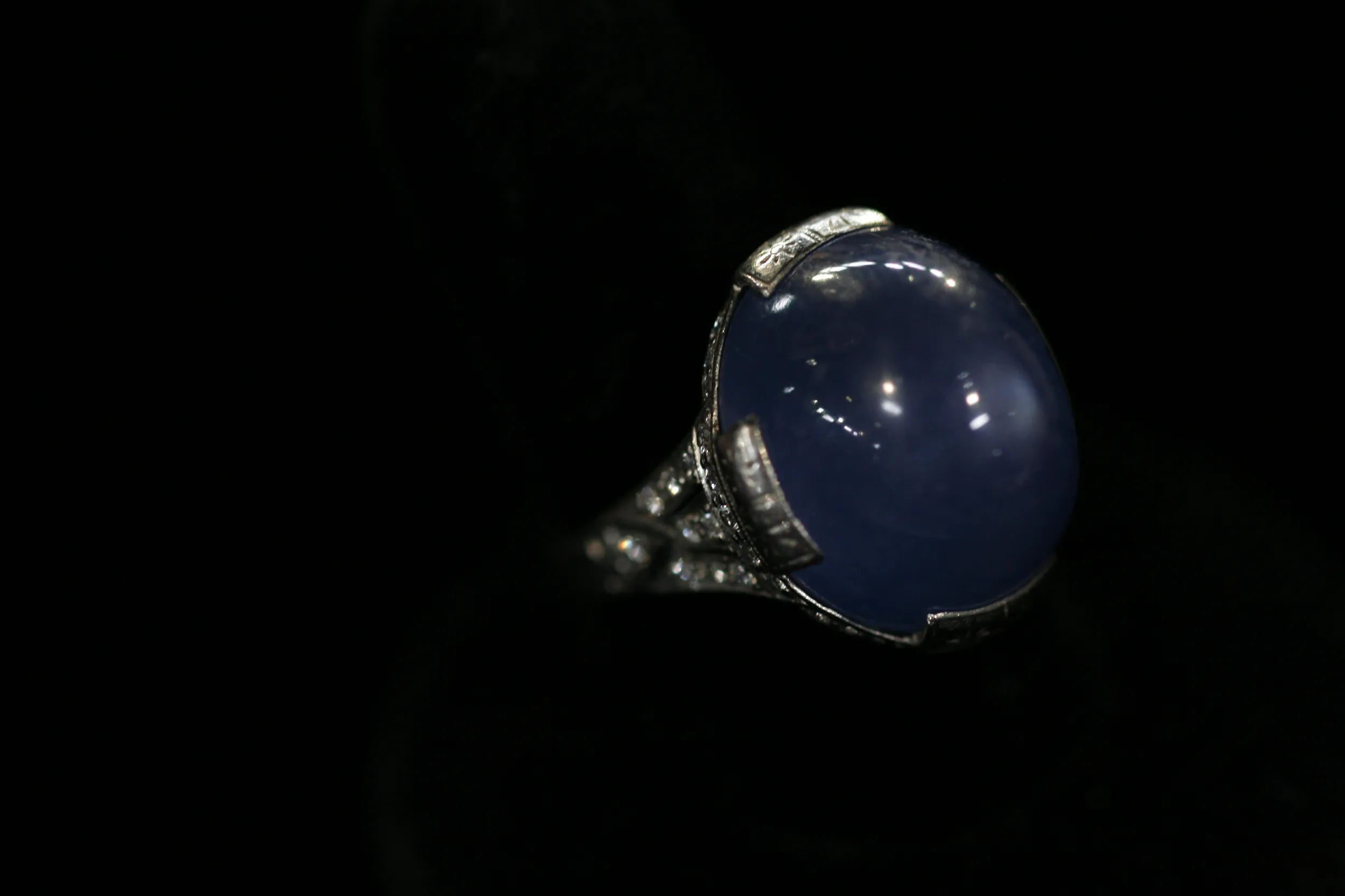
APPRAISER: I’m a September baby, so I have a soft spot for sapphires. This is a platinum diamond and star sapphire ring, and then you have a pair of platinum diamond and star sapphire earrings. While they look so, so similar and it's difficult to match these things this well...
GUEST: Mm-hmm, right.
APPRAISER: …that beautiful cornflower blue color, the ring actually predates the earrings.
GUEST: Oh.
APPRAISER: So I would date the ring to the late Art Deco period, probably around about 1935 to 1939.
GUEST: Oh, wow. Okay.
APPRAISER: That central stone there is about 20 carats in a cabochon cut. And then it's surrounded by old European cut and tapered baguette-cut diamonds, which together equal just under two carats. Similarly, the earrings are also set with star sapphires, single-cut diamonds, which is an iteration of diamond cutting which is much more typical for the mid-1940s, so sort of the war era. And I would date the earrings to the Retro period, mid-1940s. Without a certification, you can't say with 100% certainty, but I would bet that they probably were mined in Ceylon, which is modern day Sri Lanka. They're not signed, neither piece, unfortunately. I do think that they're probably American. Phenomena gems, particularly star sapphires in this case, are actually made by tiny rutile needle inclusions that overlap in a hexagonal pattern inside the stone.
GUEST: Oh, wow.
APPRAISER: And when a light shines on them directly, they make a beautiful star. You can see the star best when you use a pinpoint light source. It can be difficult to make out in daylight, but you can see here this strong six-pointed star when I shine this pinpoint light directly on it. The earrings, conservatively, are in the range of $6,000 to $8,000...
GUEST: Okay, great.
APPRAISER: …in an auction situation, fair market value.
GUEST: Okay.
APPRAISER: And the ring, comfortably, is in the range of $10,000 to $15,000.
GUEST: All right, great. Thank you. Good to know.
APPRAISER: It’s a very pretty star sapphire ring.
GUEST: Thank you.

$16,000 - $23,000 Auction
Featured In

episode
Red Butte Garden & Arboretum, Hour 3
Premiered Mon, Jan 19, 2026 — See a bounty of Utah treasures from ROADSHOW’s visit to Red Butte Garden & Arboretum!
Sapphire
appraisal
Tiffany & Co. Ceylon Star Sapphire Ring, ca. 1922
appraisal
Kashmir Sapphire & Diamond Pendant, ca. 1935
appraisal
Cartier Covered Wristwatch, ca. 1945
appraisal
Understanding Our Appraisals
Executive producer Marsha Bemko shares her tips for getting the most out of ANTIQUES ROADSHOW.
Value can change: The value of an item is dependent upon many things, including the condition of the object itself, trends in the market for that kind of object, and the location where the item will be sold. These are just some of the reasons why the answer to the question "What's it worth?" is so often "It depends."
Note the date: Take note of the date the appraisal was recorded. This information appears in the upper left corner of the page, with the label "Appraised On." Values change over time according to market forces, so the current value of the item could be higher, lower, or the same as when our expert first appraised it.
Context is key: Listen carefully. Most of our experts will give appraisal values in context. For example, you'll often hear them say what an item is worth "at auction," or "retail," or "for insurance purposes" (replacement value). Retail prices are different from wholesale prices. Often an auctioneer will talk about what she knows best: the auction market. A shop owner will usually talk about what he knows best: the retail price he'd place on the object in his shop. And though there are no hard and fast rules, an object's auction price can often be half its retail value; yet for other objects, an auction price could be higher than retail. As a rule, however, retail and insurance/replacement values are about the same.
Verbal approximations: The values given by the experts on ANTIQUES ROADSHOW are considered "verbal approximations of value." Technically, an "appraisal" is a legal document, generally for insurance purposes, written by a qualified expert and paid for by the owner of the item. An appraisal usually involves an extensive amount of research to establish authenticity, provenance, composition, method of construction, and other important attributes of a particular object.
Opinion of value: As with all appraisals, the verbal approximations of value given at ROADSHOW events are our experts' opinions formed from their knowledge of antiques and collectibles, market trends, and other factors. Although our valuations are based on research and experience, opinions can, and sometimes do, vary among experts.
Appraiser affiliations: Finally, the affiliation of the appraiser may have changed since the appraisal was recorded. To see current contact information for an appraiser in the ROADSHOW Archive, click on the link below the appraiser's picture. Our Appraiser Index also contains a complete list of active ROADSHOW appraisers and their contact details and biographies.


