Diamond Horseshoe Pin, ca. 1915
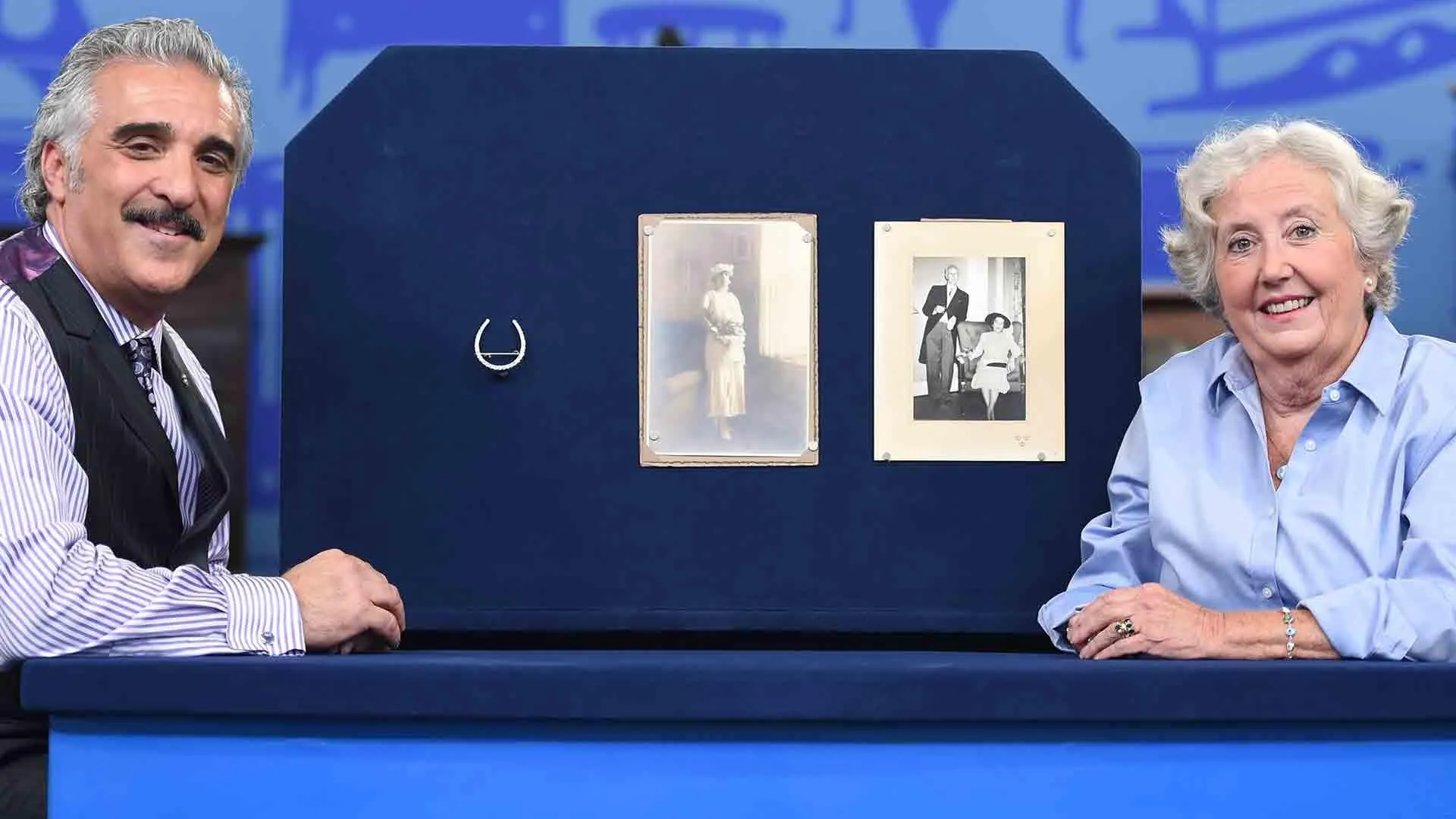
GUEST: The pin was actually my great-grandmother's, I understand, and she gave it to my grandmother, and this is my grandmother in 1918 in her wedding day. And then my grandmother had one child, my father, and this is my grandmother on my father and mother's wedding day in 1948, and she's wearing the pin each time.
APPRAISER: Yeah, in this one right here, in the first picture, you can see she's wearing it.
GUEST: Right.
APPRAISER: And what I did notice, if you're superstitious... I'm not putting this on you, it's your grandmother.
GUEST: Okay.
APPRAISER: But some people...
GUEST: She wore it upside-down!
APPRAISER: She wore it upside-down.
GUEST: I saw that!
APPRAISER: So what do they say when a horseshoe's hanging upside-down?
GUEST: I don't know, is that bad luck?
APPRAISER: Well, they say all the luck is running out of it. (both laughing)
GUEST: Well, it could have been, though she stayed happily married for an awful lot of years.
APPRAISER: I did notice that in the other picture, she's clearly, clearly wearing it.
GUEST: Yes.
APPRAISER: But if you do notice, she's wearing it as a pin in both photographs.
GUEST: Yes.
APPRAISER: It's a great horseshoe. You see a lot of horseshoes in jewelry. However, they're not always this large. Usually, they're quite a bit smaller. We have 37 round old mine diamonds in it.
GUEST: Okay.
APPRAISER: All right, when you add them all up, there's approximately six carats total weight of diamonds in it.
GUEST: Really?
APPRAISER: Really.
GUEST: Wow, I didn't know that. I know they're graduated-- I mean, they get smaller towards the end of the horseshoe.
APPRAISER: They are graduated. They start over here, about point two zero, which is about a fifth of a karat, and when you get all the way around to the back, they're about ten points each.
GUEST: Okay.
APPRAISER: So a tenth of a karat. The pin itself is made in platinum. It's unsigned-- it's not even stamped platinum. But back when this pin was made in the early part of the 20th century, 1915, 1920, in your case, we'll say 1918, things did get out and they're not stamped. A lot of things in Europe would have been, so my feeling is that there's a good chance this was manufactured in the United States.
GUEST: Oh.
APPRAISER: You see how the pin is there? When you're wearing it pinned on a garment, you don't see the pin.
GUEST: Right.
APPRAISER: Have you ever thought about wearing this as a necklace?
GUEST: I would love to, but I don't know how you could do that.
APPRAISER: There's a little hinge here. And what it would have been is a little ring that folds down when it's being worn as a pin.
GUEST: Oh, but it's, like, something you can put on a chain?
APPRAISER: Right. And you could wear it...
GUEST: But then would you have it upside-down?
APPRAISER: You would have it upside-down. When you're wearing it as a pendant the way it was certainly designed...
GUEST: Uh-huh.
APPRAISER: What do you do now you have the pin there? Doesn't look so great. I see a solder mark over here. Typically, the pin would have unscrewed, so when you're wearing it as a pendant, you would be able to remove it. At some point in time, this piece is missing.
GUEST: Okay.
APPRAISER: And this piece has been soldered stiff. The other thing you'll notice is that it has this beautiful, beautiful work along here, it's all hand done.
GUEST: I didn't know that.
APPRAISER: It's really stunning. So any thoughts on what something like this would be? If you went to an auction?
GUEST: I have no idea.
APPRAISER: If you had to raise your paddle and bid on it?
GUEST: (laughs): I'd be scared. I don't know, I really don't know.
APPRAISER: Well, I feel today, at auction, a pin like this would be $5,000 to $7,000 at auction.
GUEST: That much?
APPRAISER: Absolutely.
GUEST: Oh, my goodness, thank you so much, I had no idea.
$5,000 - $7,000 Auction
Featured In
episode
Charleston, WV, Hour 3 (2015)
Mark L. Walberg and appraiser Rafael Eledge look at Civil War cigarette booklets.
Gems and Minerals

appraisal
Carved Emerald & Ruby Ring, ca. 1925

appraisal
Audemars Piguet Watch, ca. 1940

appraisal
Pendant Jewelry by Faberge from 1880

appraisal
Marsh Steel, Jade & Diamond Ring, ca. 1950
Understanding Our Appraisals
Executive producer Marsha Bemko shares her tips for getting the most out of ANTIQUES ROADSHOW.
Value can change: The value of an item is dependent upon many things, including the condition of the object itself, trends in the market for that kind of object, and the location where the item will be sold. These are just some of the reasons why the answer to the question "What's it worth?" is so often "It depends."
Note the date: Take note of the date the appraisal was recorded. This information appears in the upper left corner of the page, with the label "Appraised On." Values change over time according to market forces, so the current value of the item could be higher, lower, or the same as when our expert first appraised it.
Context is key: Listen carefully. Most of our experts will give appraisal values in context. For example, you'll often hear them say what an item is worth "at auction," or "retail," or "for insurance purposes" (replacement value). Retail prices are different from wholesale prices. Often an auctioneer will talk about what she knows best: the auction market. A shop owner will usually talk about what he knows best: the retail price he'd place on the object in his shop. And though there are no hard and fast rules, an object's auction price can often be half its retail value; yet for other objects, an auction price could be higher than retail. As a rule, however, retail and insurance/replacement values are about the same.
Verbal approximations: The values given by the experts on ANTIQUES ROADSHOW are considered "verbal approximations of value." Technically, an "appraisal" is a legal document, generally for insurance purposes, written by a qualified expert and paid for by the owner of the item. An appraisal usually involves an extensive amount of research to establish authenticity, provenance, composition, method of construction, and other important attributes of a particular object.
Opinion of value: As with all appraisals, the verbal approximations of value given at ROADSHOW events are our experts' opinions formed from their knowledge of antiques and collectibles, market trends, and other factors. Although our valuations are based on research and experience, opinions can, and sometimes do, vary among experts.
Appraiser affiliations: Finally, the affiliation of the appraiser may have changed since the appraisal was recorded. To see current contact information for an appraiser in the ROADSHOW Archive, click on the link below the appraiser's picture. Our Appraiser Index also contains a complete list of active ROADSHOW appraisers and their contact details and biographies.


