GUEST: My grandmother and her family, which was my father as a teenager, moved to Arizona in 1925.
APPRAISER: Okay.
GUEST: She had, previous to that, been a fabric designer, which was her professional training. And all of her previous works was lost in transit of some kind, a trunk was lost. So she started over. When she arrived in Phoenix in 1925, drawing with colored pencil, the Arizona cactus.
APPRAISER: Okay.
GUEST: And later, expanded into wildflowers in eastern Arizona when they bought a cabin in that area.
APPRAISER: And how long did she work in Arizona?
GUEST: Well, she died in 1951, so that was a 26-year career of drawing these flowers.
APPRAISER: Do you remember her?
GUEST: Oh, very much. As a child I grew up spending summers at this cabin in eastern Arizona. And she took me on walks in the woods and pointed things out, and we gathered raspberries. And all of these lovely things that a child would remember about their grandmother.
APPRAISER: Sure.
GUEST: I remember looking for flowers with my parents that she had not drawn. And it finally got to where we could not find any flowers that she had not drawn.
APPRAISER: Okay, and what was her... give me her full name.
GUEST: Her name was Cora Estelle Cameron Mosher.
APPRAISER: When I saw this collection, which includes 141 total watercolors or colored pencil sketches, I was a little taken aback. I was surprised at the meticulous attention to detail that she devoted to these works. And I assume that after she arrived in 1925, she probably worked pretty aggressively on these, all the way leading up to her death.
GUEST: I think so.
APPRAISER: They sort of harken back to an earlier period of botanical study in the early 19th century, even the 18th century, where many artists would take detailed studies of certain regions of plants or fungi. And in this case, there are several studies of cactus. And there weren't many artists working during that period of time, but that intense passion and that attention to detail.
GUEST: Yes.
APPRAISER: I noticed in these books that several of them are identified with their scientific name and her name. So can you tell me a little bit about how that happened?
GUEST: This collection existed in a suitcase since she died. And they never saw the light of day. But one day my mother had now moved to Utah, decided to take the collection down to the Monte Bean Museum at BYU. When she opened the books and showed them to the horticulturists, they were so blown away by the quality and the amazing detail that she had put into these drawings that they called all kinds of people around. And they were able not only to recognize the flowers, but to give them scientific names.
APPRAISER: I did a little research just to make absolutely certain, and there does not exist another collection of Arizona region botanical studies that is this comprehensive.
GUEST: Wow.
APPRAISER: She clearly devoted a great deal of time and attention to detail to it. There are these collections that occasionally surface on the market today. But oftentimes they're published. And so we have perhaps a group of published engravings to compare them to. Or published lithography to compare them to. In this case, I understand they were not published.
GUEST: No.
APPRAISER: And so they're all original works. At auction today, given that there are 141 studies, as a collection, I would fully expect a range of $7,000 to $10,000 today.
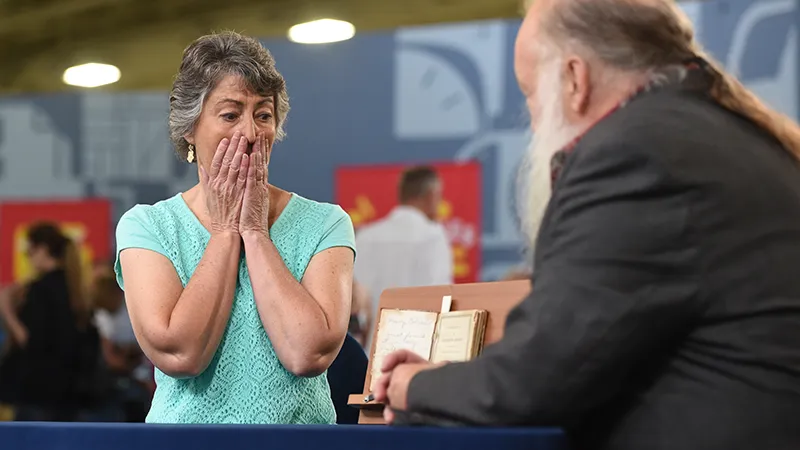
GUEST: Wow. (laughing)
APPRAISER: Had you ever thought that would be the case with her work?
GUEST: Well, no. (laughs)