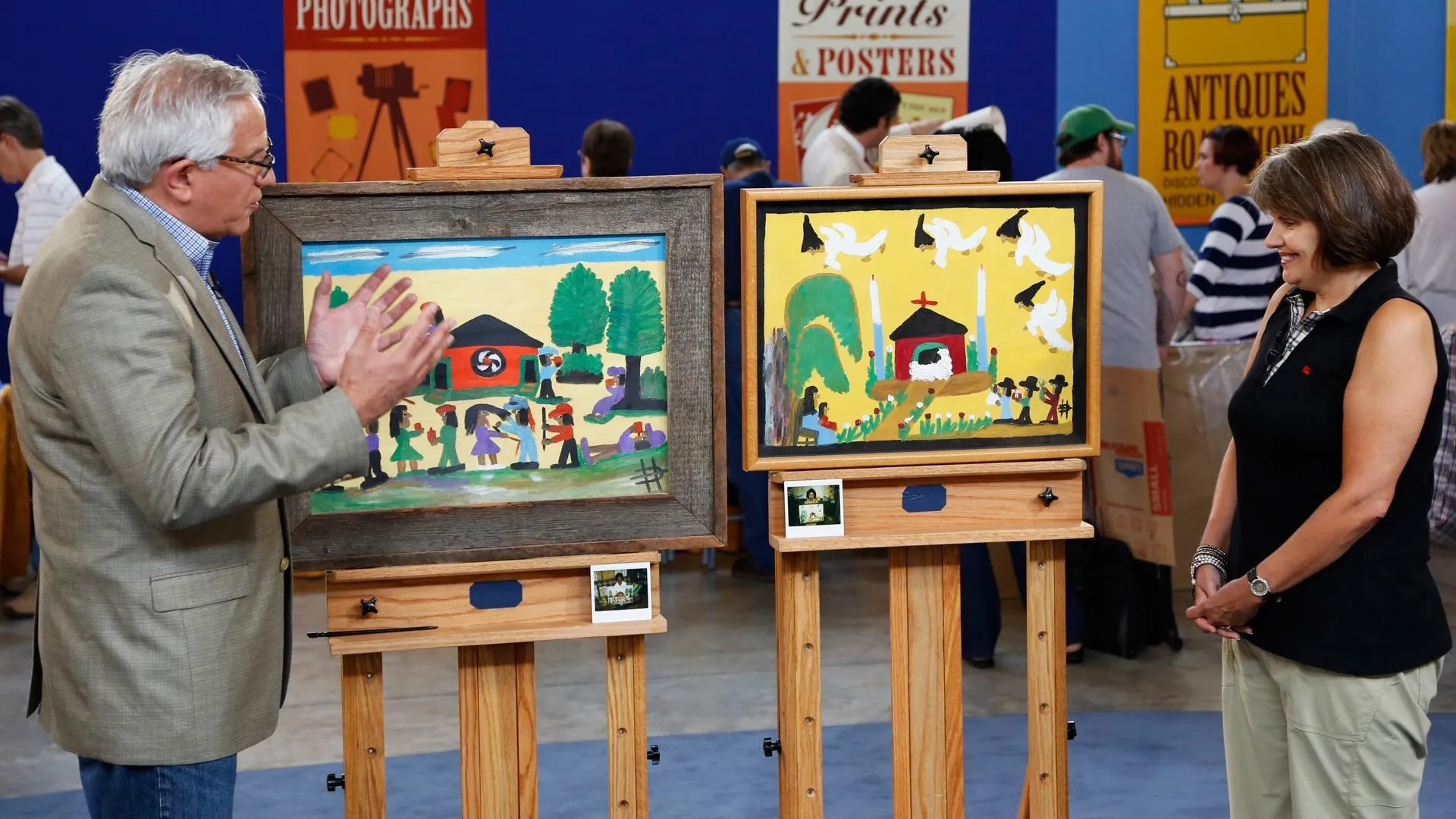
GUEST: The artist is Clementine Hunter. I have had the joy of owning these paintings for between 30 and 40 years. This is a depiction of a nativity scene. It's Mary seated with Baby Jesus with the manger, and the three wise men and the angels flying overhead. I know people asked her, "Why do you paint the hair so unusual?" And she said, "Well, because they're flying, and so their hair is flying."
APPRAISER: Exactly. And how about this one? What do you know about this one?
GUEST: That one was called "Something Saturday Night." It's obviously a very raucous scene. They're out in front of what would be a little bar, and they're sort of cutting up, drinking and brawling and fighting and just having a big old Saturday night good time.
APPRAISER: Yeah, it's a country juke joint, isn't it?
GUEST: Exactly.
APPRAISER: In the world of folk art and outsider art, Clementine Hunter is a very well-known name. Clementine Hunter was the granddaughter of a slave, and spent most of her life on Melrose Plantation, which in itself was a center for the arts. When I came to the ROADSHOW, I sat down at the folk art table this morning, and I told my colleagues, "You know, I'll bet we're going to see some Clementine Hunter paintings this morning." And lo and behold, they started rolling in. She was a very prolific artist.
GUEST: Yes.
APPRAISER: Clementine Hunter's signature changed over the course of her career. This particular signature is a signature she was using in the '80s, when she was signing it with a backward C interlocking with an H. You have Polaroid photographs of her with the paintings, right?
GUEST: That's right, and I am so, so very fortunate that the person who sold the paintings to me knew that it was important to authenticate them. She was fascinated with Clementine, and she went up to meet her and took these photographs.
APPRAISER: Normally, one would think that's all the proof you need. But in the 1980s, when these were apparently painted, there was an unscrupulous dealer who was bringing these paintings like these to Clementine Hunter, paying her a dollar to pose with them, then taping the picture on the back to prove that she actually painted these. So what's that mean for these Clementine Hunter paintings? You need to have them looked at by a Clementine Hunter expert. What did you pay for them?
GUEST: I paid about $400 for each of them.
APPRAISER: What she was doing in the '40s and the '50s is scarcer.
GUEST: Yes.
APPRAISER: And in general, because of that, is a little more valuable than her later works.
GUEST: Yes.
APPRAISER: If they're genuine Clementine Hunter paintings, I would think that each are worth about $2,000 to $2,500 apiece, so maybe $4,000 to $5,000 for both. And that's in an auction setting.
GUEST: I see.
APPRAISER: In a retail setting, they might be even higher.
GUEST: I see, that's great. That's amazing, that's wonderful.
APPRAISER: But because there have been so many forgeries, you need to have this looked at by a Clementine Hunter expert. Thanks for bringing them in. They're really great.
GUEST: Thank you.