HOST: Self-taught folk artist Clementine Hunter is famous for her colorful and compelling depictions of Louisiana plantation life she painted throughout much of the 20th century. Louisiana State University Museum of Art invited Roadshow to explore the Hunter paintings in their collection. Kathleen, Clementine Hunter lived her entire life in Louisiana, barely traveled beyond these borders. How did she become a painter?
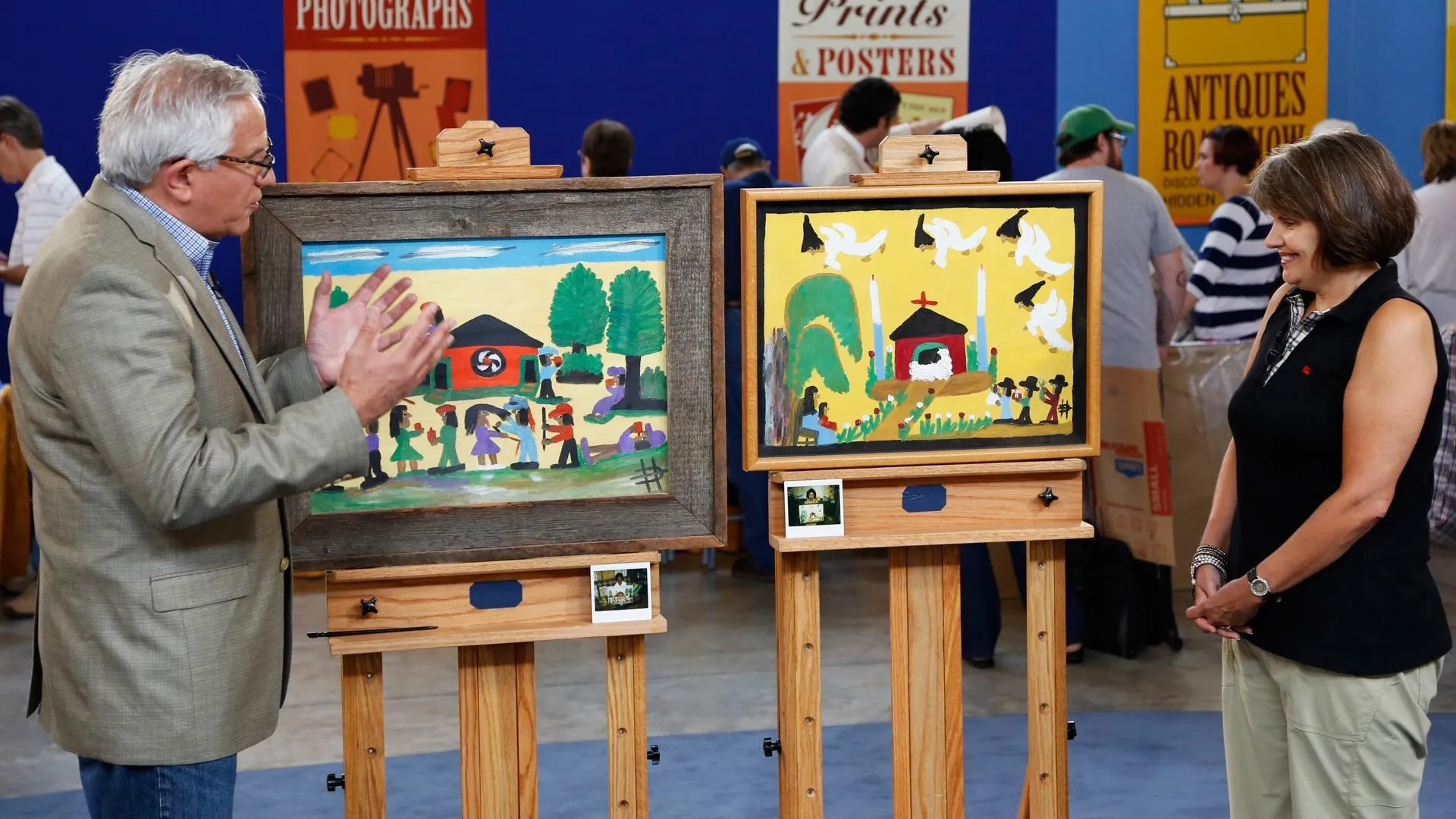
APPRAISER: She was living and working at a plantation called Melrose in rural Louisiana. Melrose was run by a very enlightened woman named Cammie Henry. She brought artists and writers to Melrose and encouraged them to live and work there. This would have been in the late 1930s. Clementine was in the house and she saw the work. And that would have probably been her first exposure to painting. She apparently felt she could do that and was inspired to try, was given some old, used-up paint tubes and went off and a day or two later came back with a painting. She painted obsessively, and she turned out literally thousands of paintings during her lifetime. Her style was like many self-taught artists-- very simple, lacking in any perspective as we know it in a formal sense. She used bright colors. She painted scenes from everyday life from her memory. She painted household tasks, field tasks, figures at the honky-tonk in the evening, births, baptisms, weddings and funerals. And we have a funeral picture here. You can see there are many activities going on, from the procession through the carrying of the coffin, through the digging of the grave.
I would imagine because she's untrained and her style is somewhat simple that there were fakers out there that were faking her work.
APPRAISER: She was faked almost from the time she began painting. There are at least six known fakers. The earliest one was her grandson and the most recent one was a pretty notorious case involving the FBI in New Orleans. In between is what I think is perhaps the most interesting one, and we have an example here, which is another version of the funeral picture we've just looked at. Cammie Henry's son and his wife concocted a scheme. His wife Juanita painted the fakes in a shed out behind the house and he took the fake pictures to Clementine. He paid her a dollar apiece to hold the painting and he took a photograph of her holding the painting. He then took the photograph and pasted it on the back of the painting, thereby establishing a seemingly ironclad provenance. She was financially comfortable at this point, and I don't think she really cared at all. She took the dollar, held up the picture, went on her way.
HOST: Any ways to tell the difference?
APPRAISER: It requires an expertise that very few people possess, and it's extremely difficult. A few of the hints that those people might give us include, do not pay too much attention to the signature. She actually didn't know how to read and write and was taught how to produce the C and the H. But there are so many variations of it, both in her original work and in the fake work that, while it's a prominent signature, it's not something you can rely on in any way. She was known to never use an easel. She always held what she was painting on in her hands, so there are often fingerprints and smudges around the edges. There's pencil under drawing under most of her pictures. To my knowledge, none of the known fakers did that. So pencil under drawing is a good sign, although by no means a guarantee. Having said that, there's a very healthy market for her work. People do love her work, it still sells. You have to buy from a reputable source. In terms of auction values, the smallest pictures can be had for under $1,000, the most expensive tend to be in the sort of $10,000 range. A painting like the funeral procession we're looking at here, probably in the $4,000 and $6,000 range.
HOST: Very good. Well, it's great to learn the history of this fascinating artist, and thank you for sharing.
APPRAISER: It's my pleasure.