Civil War 6th Missouri Union Officer Group
GUEST: My best friend is the third generation, I believe, that this has been handed down to. She wanted me to have it. All of the family at that point had passed away. When I read the book, I couldn't put it down. It was mesmerizing. Four generations back, George Bailey was known as the carriage man in St. Louis, Missouri. He made carriages in the early 1800s. And this is his son. He was captured by the Confederate Army. They were being marched to Andersonville. He asked several of the men that had been captured to bury him in the ground and cover him with limbs and bushes and leaves, where he stayed in the ground, according to his book, for I think two days. He was breathing through a reed. I think he heard the scouts go by, so he thought it was safe to get up. He was shot twice. He made his way close to Atlanta where he came upon some Union soldiers and they put him in the hospital.
APPRAISER: That is quite a story.
GUEST: Yeah, it's fascinating.
APPRAISER: Well, he's a man from my home state, this is a Missourian.
GUEST: That's true.
APPRAISER: Which made it appeal to me. The Union 6th Missouri was an incredibly hard-fought unit. This is the hat badge from the side of the Hardee hat. This is from the front. A couple of subdued infantry, lieutenant shoulder straps. But the thing that really struck me about his service is he clearly had an eye for history. The first thing that pointed that out to me is this cartridge, this little rolled up piece of paper here is a Confederate cartridge, on which he has written "Rebel cartridge. Vicksburg, July 4, 1863."
GUEST: Yes, he did.
APPRAISER: Ju-July 4, 1863 is a big, big day for the Union. That's when Vicksburg fell, and he had the presence of mind to realize that he was involved in something greater than himself.
GUEST: Mm-hmm.
APPRAISER: He also has a couple of other trophies. We have a Port Hudson style or an Army of Tennessee style, depending on who you ask about it, Confederate belt plate.
GUEST: Mm-hmm.
APPRAISER: This one is from the state of Louisiana.
GUEST: Mm-hmm.
APPRAISER: And then we get into this, Which you would look at and think, "That's a rag."
GUEST: Right.
APPRAISER: "What are we doing with that?" He has recorded and told us why that's important.
GUEST: He would, um, find his way to a plantation or to someone's home out in,
I guess, the swampy areas, and they would hide him. They would give him food.
APPRAISER: This was the enslaved people in that area?
GUEST: Correct. I guess when the war was over and he was out of the hospital and he had healed, he went back and visited some of those people.
APPRAISER: It is my firm belief that the whole is greater than the sum of the parts. But simply adding up the individual parts, together, that alone is $15,000 to $20,000.
GUEST: Okay.
APPRAISER: But, as a collection, I think $25,000 to $30,000
GUEST: Okay, that's wonderful.
APPRAISER: If you choose to insure it, I would make sure that you have an insurance policy on this that covers it for $35,000.
GUEST: Okay.

$25,000 - $35,000 Auction
Featured In

episode
Springs Preserve, Hour 3
ROADSHOW heads to the Mojave Desert in search of marvels at Springs Preserve in Las Vegas.
Memorabilia

appraisal
20th-Century Presidential Autographs
appraisal
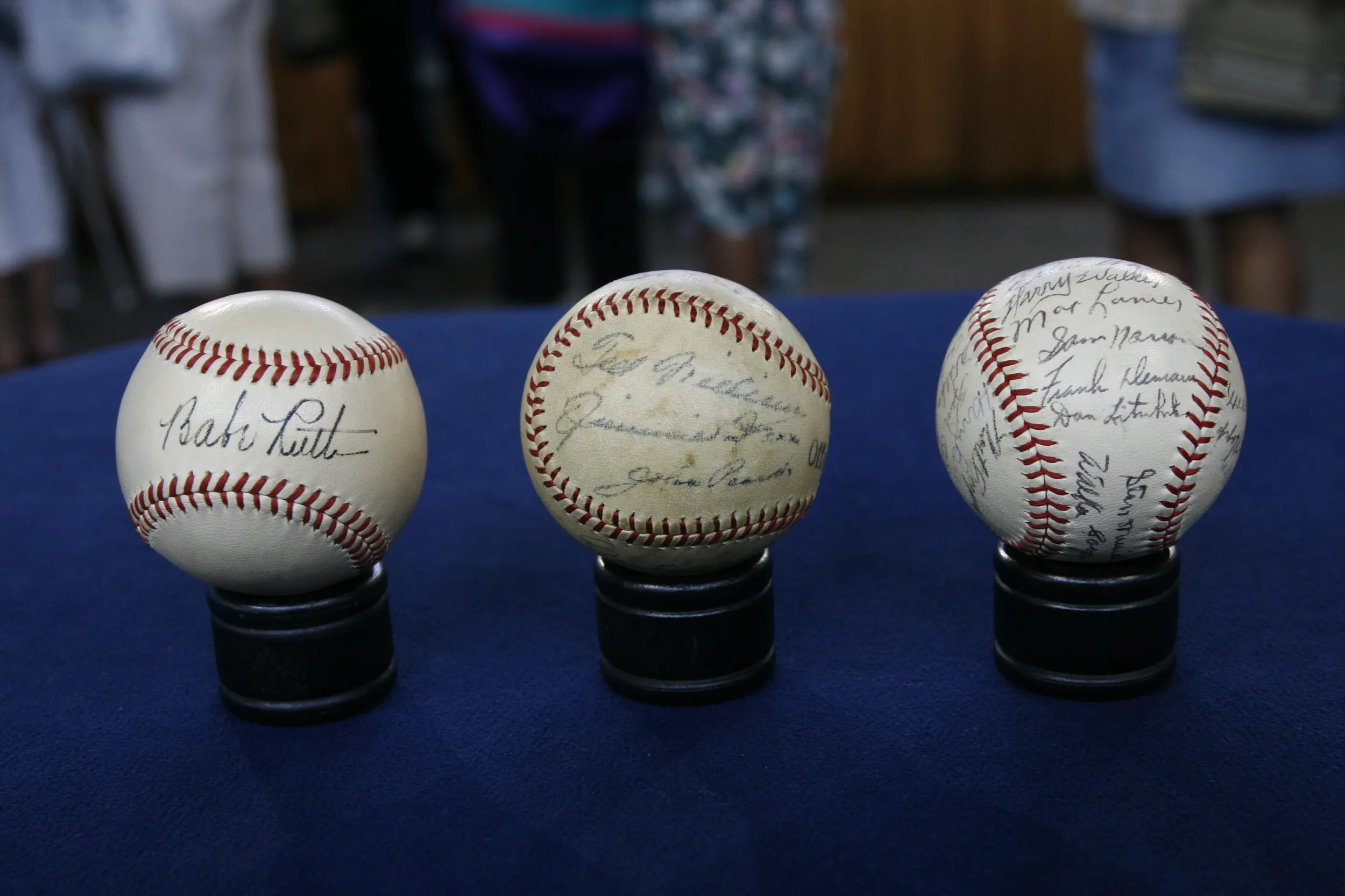
Three 1940s Signed Baseballs

appraisal
1935 Signed "Porgy & Bess" Book

appraisal
1957 Buddy Holly Contract
Understanding Our Appraisals
Executive producer Marsha Bemko shares her tips for getting the most out of ANTIQUES ROADSHOW.
Value can change: The value of an item is dependent upon many things, including the condition of the object itself, trends in the market for that kind of object, and the location where the item will be sold. These are just some of the reasons why the answer to the question "What's it worth?" is so often "It depends."
Note the date: Take note of the date the appraisal was recorded. This information appears in the upper left corner of the page, with the label "Appraised On." Values change over time according to market forces, so the current value of the item could be higher, lower, or the same as when our expert first appraised it.
Context is key: Listen carefully. Most of our experts will give appraisal values in context. For example, you'll often hear them say what an item is worth "at auction," or "retail," or "for insurance purposes" (replacement value). Retail prices are different from wholesale prices. Often an auctioneer will talk about what she knows best: the auction market. A shop owner will usually talk about what he knows best: the retail price he'd place on the object in his shop. And though there are no hard and fast rules, an object's auction price can often be half its retail value; yet for other objects, an auction price could be higher than retail. As a rule, however, retail and insurance/replacement values are about the same.
Verbal approximations: The values given by the experts on ANTIQUES ROADSHOW are considered "verbal approximations of value." Technically, an "appraisal" is a legal document, generally for insurance purposes, written by a qualified expert and paid for by the owner of the item. An appraisal usually involves an extensive amount of research to establish authenticity, provenance, composition, method of construction, and other important attributes of a particular object.
Opinion of value: As with all appraisals, the verbal approximations of value given at ROADSHOW events are our experts' opinions formed from their knowledge of antiques and collectibles, market trends, and other factors. Although our valuations are based on research and experience, opinions can, and sometimes do, vary among experts.
Appraiser affiliations: Finally, the affiliation of the appraiser may have changed since the appraisal was recorded. To see current contact information for an appraiser in the ROADSHOW Archive, click on the link below the appraiser's picture. Our Appraiser Index also contains a complete list of active ROADSHOW appraisers and their contact details and biographies.


