Chinese Vase with French Ormolu Mount
GUEST: My mom collected Oriental stuff in the '80s, and found this at an auction house in Nairobi, which is where they were living. And I don't know how much
she paid for it. She called this a double gourd vase, she was quite sure was Chinese-- that's all I know.
APPRAISER: Well, I think your mom did a great job. When you first look at it, one of the things that strikes you, aside from the shape, is that it's mounted with these gilded bronze mounts, a group of entwined snakes, and then you have groups of reeds that are bound together on foliate feet. And the top looks like the capital of a column.
GUEST: Mm-hmm.
APPRAISER: And all of that is decidedly of classical origin, from the west, not China.
GUEST: Mm-hmm.
APPRAISER: And I would venture to say that, in fact, it's probably French. And the surface is particularly interesting, this fabulous kind of brilliant color blue with this magenta little circles. It's almost like oil spots...
GUEST: Yeah.
APPRAISER: ...on the surface. That gives it this almost textural feel, but there's no texture to it.
GUEST: Right.
APPRAISER: It's all beneath this smooth glaze. So there was this fascination in China with replicating natural forms, the appearance of natural forms and surfaces in objects made of porcelain. And that was particularly, I would say, it reached an apogee during the reign of the Emperor Qianlong. 1736 to 1795.
GUEST: Oh.
APPRAISER: So what we have here is the vase, that was created as a work of art.
GUEST: Mm-hmm.
APPRAISER: Merged with French gilt bronze mounts. Now, when did that happen? Well, I think that the vase, of course, would have been in the possession of someone who is a wealthy Chinese collector.
GUEST: Mm-hmm.
APPRAISER: And then, at some point, that left their possession probably sometime
in the 1860 to 1880 period.
GUEST: Okay.
APPRAISER: Ordinarily, we can turn it over and take a look at the underside.
GUEST: I know.
APPRAISER: But what do we see underneath?
GUEST: Repair.
APPRAISER: It's not a repair.
GUEST: Oh!
APPRAISER: This was an application meant to cover up the base. They put in a material that is simulating lacquer. So we're having to guess what's underneath. So in my guessing, I am going to be thinking of this from the position of maybe there's not a mark.
GUEST: Yeah.
APPRAISER: I think, and my colleagues agree, that if this came up for auction, we believe it would likely sell in the range of $8,000 to $12,000.
GUEST: Fantastic.
APPRAISER: I thought it was worth something, but I thought it was maybe $1,000.
(both laugh)
GUEST: So that fills in the blanks.

$8,000 - $12,000 Auction
Featured In

episode
Living History Farms, Hour 1
ROADSHOW visits Living History Farms for treasures and a top $75,000 to $125,000 find.
Gilt

appraisal
Allen & Brother Parlor Table, ca. 1870
appraisal
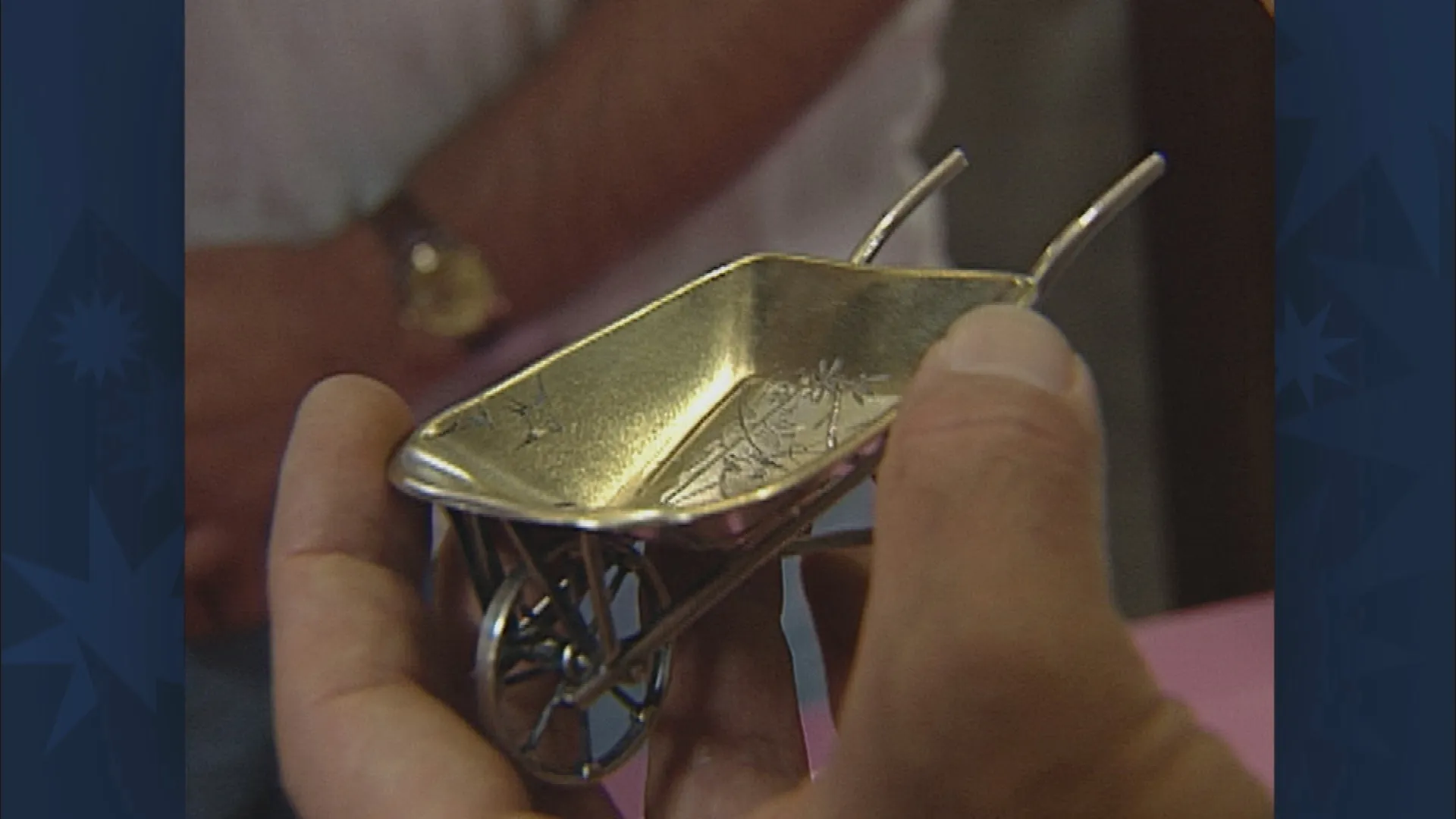
Tiffany Mixed-Metal Wheelbarrow
appraisal
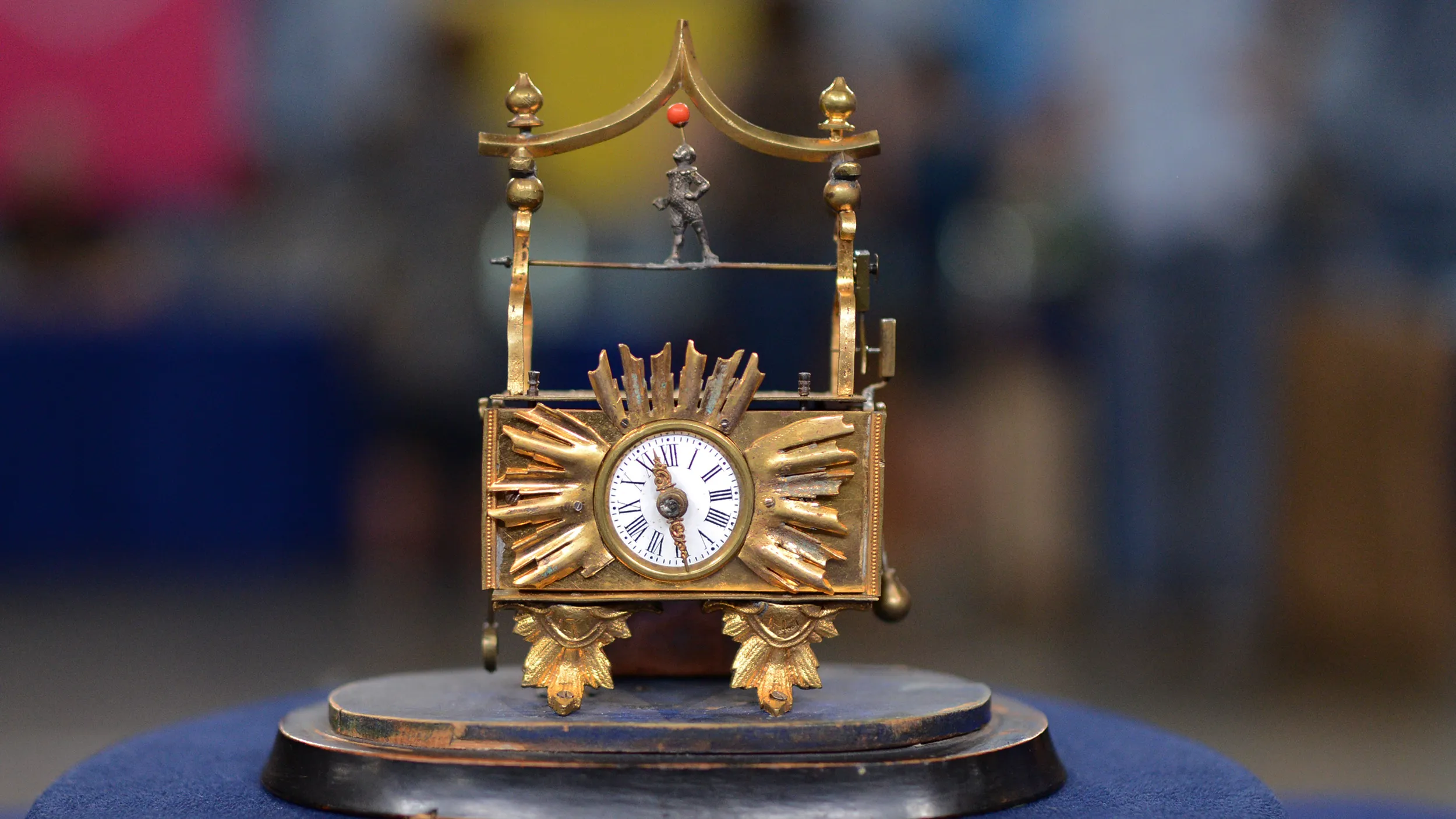
Austrian "Zappler" Animated Clock, ca. 1810

appraisal
1875 Russian Silver Gilt Teaspoons
Understanding Our Appraisals
Executive producer Marsha Bemko shares her tips for getting the most out of ANTIQUES ROADSHOW.
Value can change: The value of an item is dependent upon many things, including the condition of the object itself, trends in the market for that kind of object, and the location where the item will be sold. These are just some of the reasons why the answer to the question "What's it worth?" is so often "It depends."
Note the date: Take note of the date the appraisal was recorded. This information appears in the upper left corner of the page, with the label "Appraised On." Values change over time according to market forces, so the current value of the item could be higher, lower, or the same as when our expert first appraised it.
Context is key: Listen carefully. Most of our experts will give appraisal values in context. For example, you'll often hear them say what an item is worth "at auction," or "retail," or "for insurance purposes" (replacement value). Retail prices are different from wholesale prices. Often an auctioneer will talk about what she knows best: the auction market. A shop owner will usually talk about what he knows best: the retail price he'd place on the object in his shop. And though there are no hard and fast rules, an object's auction price can often be half its retail value; yet for other objects, an auction price could be higher than retail. As a rule, however, retail and insurance/replacement values are about the same.
Verbal approximations: The values given by the experts on ANTIQUES ROADSHOW are considered "verbal approximations of value." Technically, an "appraisal" is a legal document, generally for insurance purposes, written by a qualified expert and paid for by the owner of the item. An appraisal usually involves an extensive amount of research to establish authenticity, provenance, composition, method of construction, and other important attributes of a particular object.
Opinion of value: As with all appraisals, the verbal approximations of value given at ROADSHOW events are our experts' opinions formed from their knowledge of antiques and collectibles, market trends, and other factors. Although our valuations are based on research and experience, opinions can, and sometimes do, vary among experts.
Appraiser affiliations: Finally, the affiliation of the appraiser may have changed since the appraisal was recorded. To see current contact information for an appraiser in the ROADSHOW Archive, click on the link below the appraiser's picture. Our Appraiser Index also contains a complete list of active ROADSHOW appraisers and their contact details and biographies.


