Chinese Silk Altar Frontal, ca. 1775
GUEST: This is a silk tapestry. It was given to my dad by a client of his back in the early '50s, I believe.
APPRAISER: Okay.
GUEST: My mother took it to an appraisal. She was told that it was probably circa 1900, and that it was worth around $700.
APPRAISER: How long ago did you have it appraised for $700?
GUEST: I think it was somewhere in the neighborhood of 20 years or so. It went from my folks to me, but it's always just been stored either in their basement or in my basement. (both chuckle)
APPRAISER: Country of origin: Chinese. And very, very overtly Chinese. But in terms of the date, this is where it's really interesting. If they were to identify this border, for example, 1900, not so far off. But, the majority of this so-called tapestry or textile, 18th century.
GUEST: Oh!
APPRAISER: So this is quite, quite old. And this would date, I would say, likely the last quarter of the 18th century, 1775. It has this lovely horizontal shape, but it didn't begin its life this way. This textile that you have, very symmetrical with these seams that sort of separate four panels. This was originally a robe, a garment, mind you, that not just had these four dragons, but would have had five others, too.
GUEST: Wow.
APPRAISER (chuckling): Five dragons are elsewhere, who knows, hopefully still in existence. But this is the configuration that has nine dragons in all. It would have been in the style of an imperial court robe, but it also has some Buddhist iconography on it. So this may have been a priest's robe done in the imperial style. In the 18th century, the emperors, specifically, were devout Buddhists. So Buddhist iconography and imperial iconography really sort of came together. It's a roiling sea with mountains that come out of it. The mountains are the earth. And then finally, this realm in which the dragons fly, this is the heavens, the celestial realm. Furthermore, though, these creatures right here, which somewhat resemble butterflies, these are actually bats. And bats only have the significance that they do here in Chinese. Why? Because the word in Chinese for bat, "fú," is also the word for prosperity. Even the clouds, the shape of the clouds are reminiscent of a, of a particular fungus called the lingzhi fungus, which bestows immortality. So everything in this has meaning, it's auspicious, and it is in some respects associated with the divine. So this is an altar frontal. So in a shrine or in a Buddhist temple...
GUEST: Oh...
APPRAISER: ...they would repurpose these robe panels to go into the front of an altar. Right. There is a strong market right now for Chinese textiles, and this is driven by Chinese interest. I think that this particular textile would have an auction value from $4,000 to $6,000.
GUEST (laughing): Oh, my goodness. I'm speechless. (laughs) You know, I think about it just being stored in the pole barn. (laughs)

$4,000 - $6,000 Auction
Featured In

episode
Castle Farms, Hour 1
Don't miss ROADSHOW's first visit to charming Charlevoix, Michigan! — Mon, March 30, 2026
Silk

appraisal
Mary Balch School Mourning Picture, ca. 1805

appraisal

appraisal
Egyptian Needlework Jacket, ca. 1925
appraisal
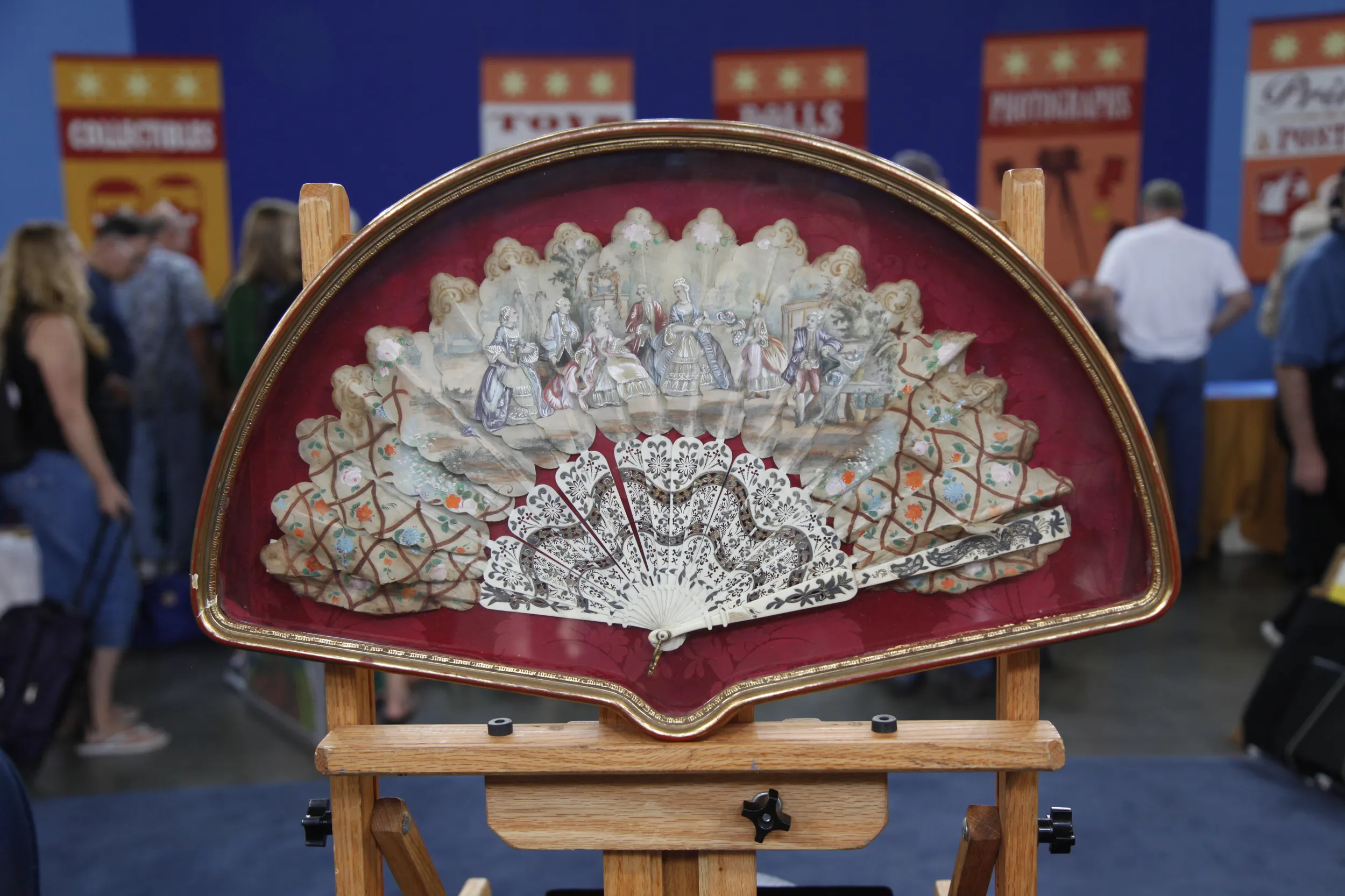
French Silk and Bone Fan, ca. 1800
Understanding Our Appraisals
Executive producer Marsha Bemko shares her tips for getting the most out of ANTIQUES ROADSHOW.
Value can change: The value of an item is dependent upon many things, including the condition of the object itself, trends in the market for that kind of object, and the location where the item will be sold. These are just some of the reasons why the answer to the question "What's it worth?" is so often "It depends."
Note the date: Take note of the date the appraisal was recorded. This information appears in the upper left corner of the page, with the label "Appraised On." Values change over time according to market forces, so the current value of the item could be higher, lower, or the same as when our expert first appraised it.
Context is key: Listen carefully. Most of our experts will give appraisal values in context. For example, you'll often hear them say what an item is worth "at auction," or "retail," or "for insurance purposes" (replacement value). Retail prices are different from wholesale prices. Often an auctioneer will talk about what she knows best: the auction market. A shop owner will usually talk about what he knows best: the retail price he'd place on the object in his shop. And though there are no hard and fast rules, an object's auction price can often be half its retail value; yet for other objects, an auction price could be higher than retail. As a rule, however, retail and insurance/replacement values are about the same.
Verbal approximations: The values given by the experts on ANTIQUES ROADSHOW are considered "verbal approximations of value." Technically, an "appraisal" is a legal document, generally for insurance purposes, written by a qualified expert and paid for by the owner of the item. An appraisal usually involves an extensive amount of research to establish authenticity, provenance, composition, method of construction, and other important attributes of a particular object.
Opinion of value: As with all appraisals, the verbal approximations of value given at ROADSHOW events are our experts' opinions formed from their knowledge of antiques and collectibles, market trends, and other factors. Although our valuations are based on research and experience, opinions can, and sometimes do, vary among experts.
Appraiser affiliations: Finally, the affiliation of the appraiser may have changed since the appraisal was recorded. To see current contact information for an appraiser in the ROADSHOW Archive, click on the link below the appraiser's picture. Our Appraiser Index also contains a complete list of active ROADSHOW appraisers and their contact details and biographies.


