GUEST: My mom and dad traveled extensively out of the country, in the country, and they would come back with things they picked up at antique stores. I think they brought this back from somewhere in their travels in the U.S.
APPRAISER: Approximately what period of time?
GUEST: Probably in the '70s.
APPRAISER: Oh, yeah.
GUEST: In the '80s?
APPRAISER: Yeah.
GUEST: They never really told me what it was. I was the one that got them, and they've been sitting on a shelf for the last 25, 30 years.
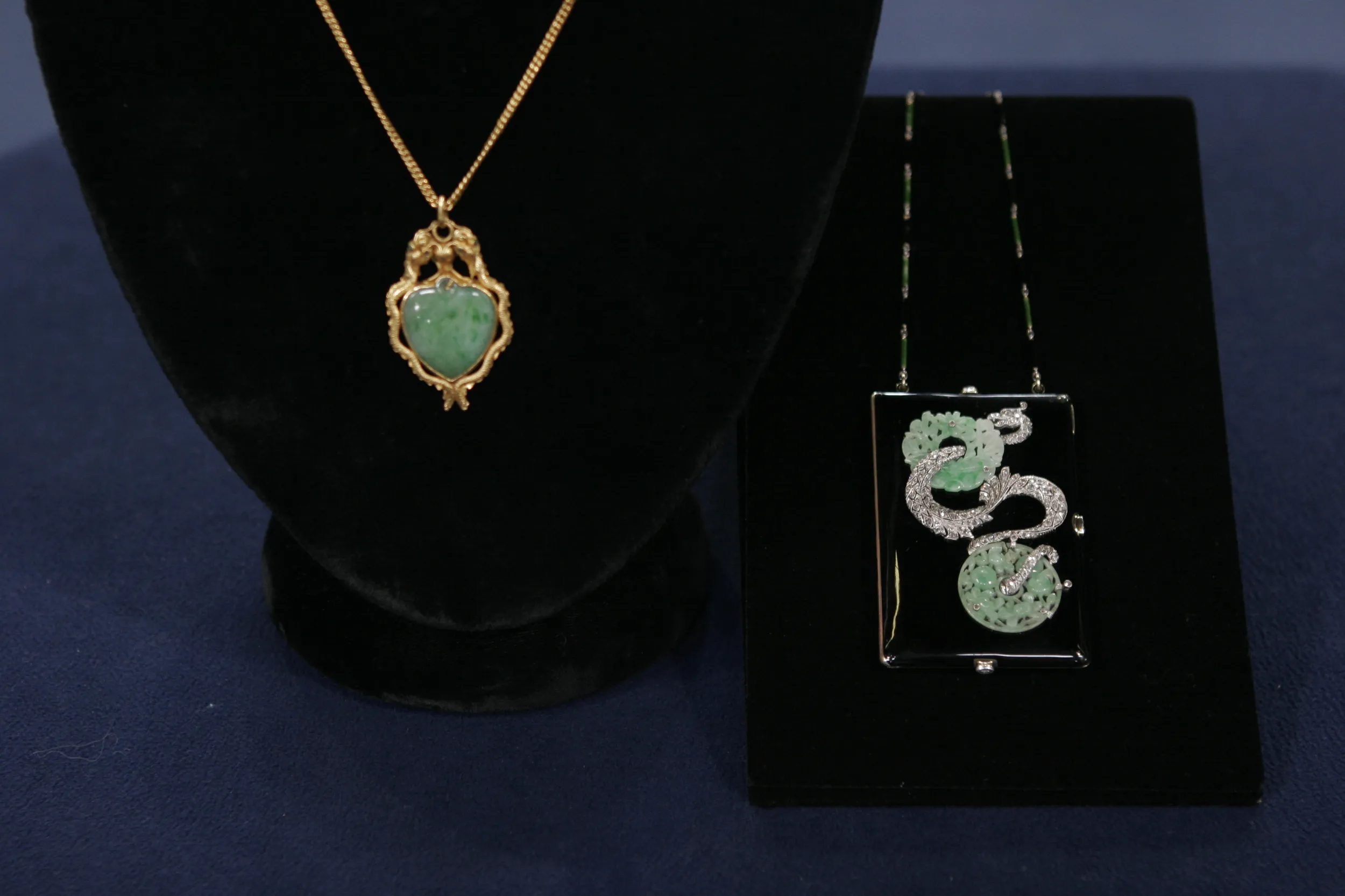
APPRAISER: Well, they're both jade.
GUEST: Okay.
APPRAISER: And this one is 18th-19th century, and Chinese.
GUEST: Oh.
APPRAISER: And it's actually mounted by a famous New York jeweler named Edward Farmer.
GUEST: Oh.
APPRAISER: And his mark is on the bottom of it here.
GUEST: Right.
APPRAISER: It doesn't necessarily add to the value, but it ensures its salability. It's a pomander, for holding spices and things...
GUEST: Oh, okay.
APPRAISER: To make the room fragrant. And it has archaic scrolling around it. This one here, on the other hand, is actually most solidly 18th century, and it's what they called Mughal style. This is Chinese, but carved in an Indian manner. It was made after jades that were either exported to India or imported from India. And one of the reasons why you can tell it's an 18th-century one is because it's quite a bit thicker than the later ones.
GUEST: Hm.
APPRAISER: The later ones are carved like a light bulb-- they're very, very thin. Those yellow spots are referred to as just russet markings. And those are just in the nature of the jade itself.
GUEST: Oh, okay.
APPRAISER: These jades are notoriously difficult to pin down on a date.
GUEST: Mm-hmm.
APPRAISER: That's why it's 18th-19th century, because one of the things, too, is, these people were carving in the same style over and over and over through centuries, with very little variation.
GUEST: So this would have been hand, hand-engraved?
APPRAISER: All hand-done.
GUEST: Oh, okay.
APPRAISER: Every single thing would be hand-done.
GUEST: And this... The, uh, the... Mr. Farmer would have gotten this piece and he would've mounted it out of...
APPRAISER: Mounted it, exactly.
GUEST: Oh, okay.
APPRAISER: This one here, with the Farmer name on it, would be probably $6,000 to $8,000.
GUEST: Mm-hmm.
APPRAISER: The other one that's here, the Mughal one, would be more like $8,000 to $12,000.
GUEST: You're kidding. (laughs) Unbelievable.
APPRAISER: And, and that is at auction.
GUEST: Right.
APPRAISER: That's an auction estimate.
GUEST: Right, right.
APPRAISER: And I would not be surprised if they sold for much more at the end of the day.
GUEST: Really?
APRPAISER: Yeah.
GUEST: Very interesting-- thank you very much.
APPRAISER: Wonderful things.
GUEST: Yeah, thank you.