GUEST: I received it from my grandmother, who got it from a friend of hers who is an antique collector, about 30 years ago.
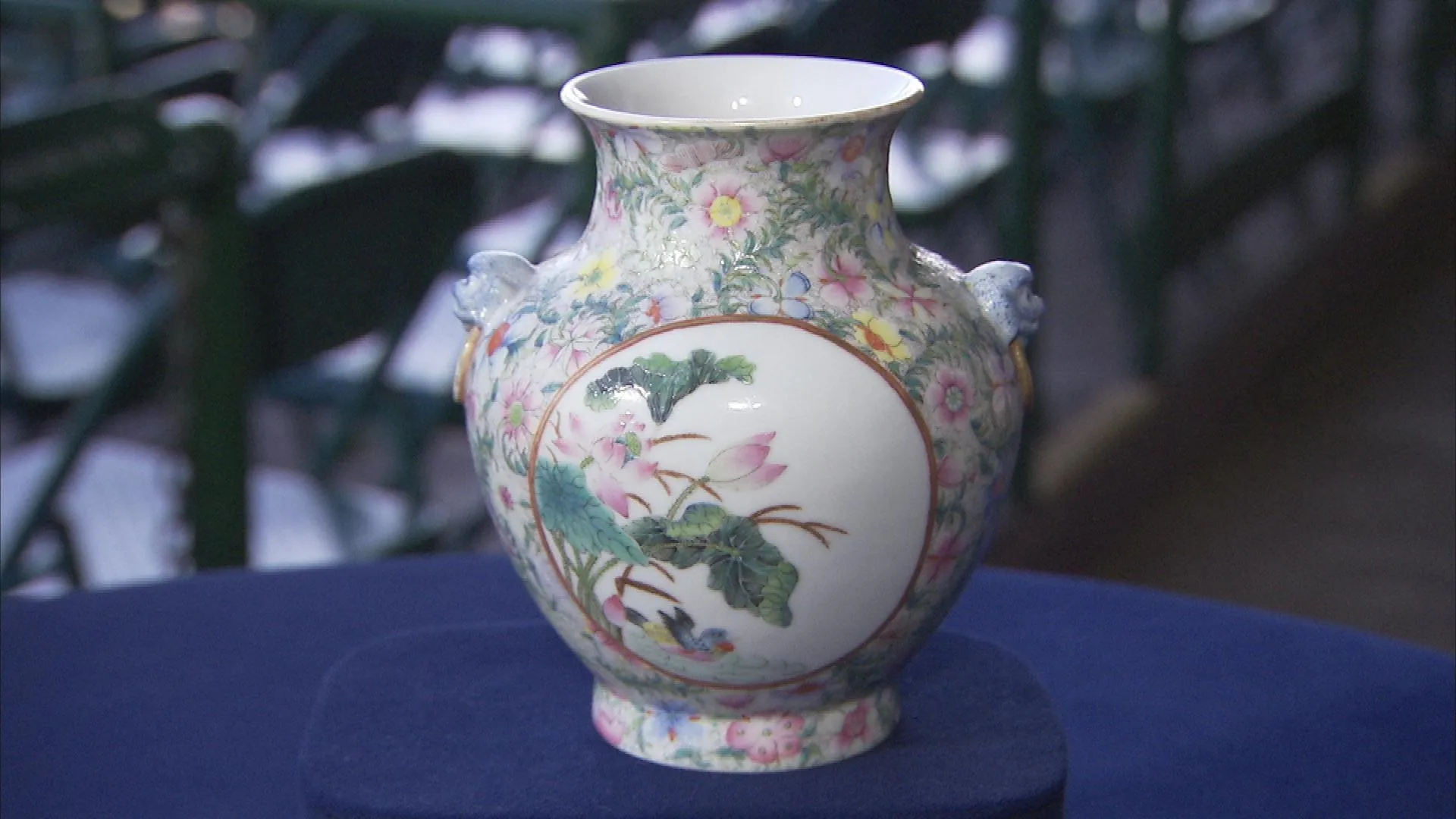
APPRAISER: Well, it's marvelous. It's a Chinese eggshell porcelain bowl. Eggshell means, of course, very thin.
GUEST: Mm-hmm.
APPRAISER: So thin that you really have to be careful handling it, and it was originally one of a pair. So probably what happened to the other one is somebody broke it. This was produced in the 1920s in China.
GUEST: Oh, okay.
APPRAISER: An imitation of a Ming or Qing type of bowl. Decorated with beautiful women, and that's sort of a typical pattern that would appeal to Western buyers.
GUEST: Right.
APPRAISER: Sort of you could look at the bowl and it screams Chinese porcelain. This little stand came with it, and it probably had a box that was beautifully rendered. But you've got the bowl. And it actually holds a Qianlong mark. Qianlong was a very important emperor of the Qing Dynasty, who lived between 1735 and 1795.
GUEST: Okay.
APPRAISER: However, as I said, this is a 20th-century bowl that was made really for the tourist market.
GUEST: Okay.
APPRAISER: In imitation of an older imperial porcelain. Now, made for expats in...who lived in China, or maybe for export to Europe and the United States, okay?
GUEST: Right.
APPRAISER: There were many of these made during that period of time. Now that China has opened up, the Chinese are very interested in buying these back.
GUEST: Ah.
APPRAISER: So, if you had brought this in to us 15 years ago, before this was the case, I would have told you, "No value."
GUEST: Right.
APPRAISER: However, now, at auction, you'd be looking at an estimate of $2,000 to $3,000.
GUEST: (laughing) Awesome.
APPRAISER: Now if you had the pair...
GUEST: That would be...
APPRAISER: It would be somewhere in the vicinity of about $8,000 to $12,000.
GUEST: Wow, wow. That's amazing.
APPRAISER: So, good timing. Good timing.