GUEST: My dad called it a jewelry box, and I acquired it-- kind of interesting-- I wanted to make pickles and my mother knew that there were some jars in my grandparents' house. And so we went over there and found the box of jars-- dirty, filthy. And this was sitting beneath all those old canning jars. I asked my mother, "Could I have it?" and she said, "I don't know whose it is." Because someone had rented the farm. But she said, "It doesn't look like they used the jars." And she said, yeah, I could have it. So we came home and I cleaned it up and it kind of fell apart. It was a damp, old musty, icky basement. And the plaster was softened. And it fell apart. So I cleaned it up, and my dad came home and he almost had a fit. He says, "Where did this come from? It's Ma's jewelry box!"
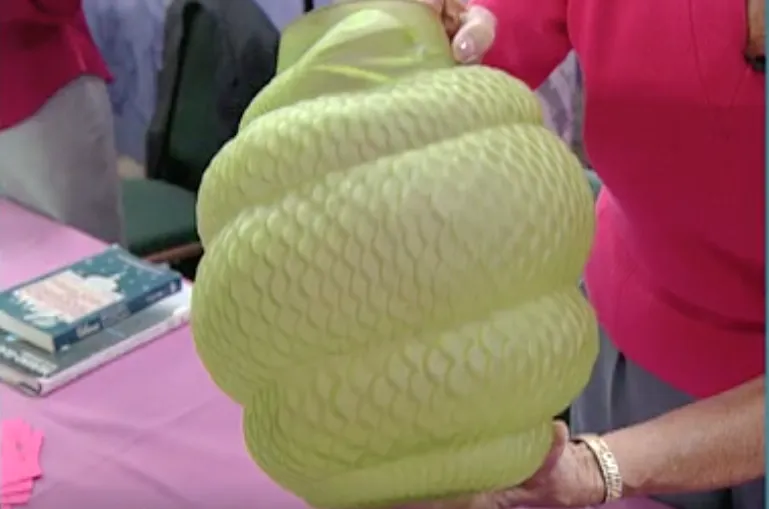
APPRAISER: So the lost is found. This is an opal glass. It was a white glass made around 1900. It was made by the C.F. Monroe Company.
GUEST: Okay.
APPRAISER: Now, you did mention...
GUEST: I thought it was Japanese, because it says "Nakara" on it.
APPRAISER: Well, we'll get to that. This is a dresser jewelry box. And I'm going to lift this lid off. It is loose.
GUEST: Yes, it really is.
APPRAISER: And just set it down here. And then we have the frame. And that's the part that fell apart for you.
GUEST: Yeah, it was damp.
APPRAISER: Well, plaster of Paris goes in there. And it tightens up, and it covers up all of this. This is not dirt. This is just from the plaster of Paris. So that will clean up. I suggest to take this to a silversmith, have this cleaned, have him put the plaster on. And then you can put it all back together and have a perfect piece. This is a very inexpensive repair-- under $100. Now, the lid, that is Queen Louise on there. And this is one of their more popular patterns. Sometimes they're done a little with transfer and then they're touched up with hand painting.
GUEST: Mm-hmm.
APPRAISER: Now, getting back to the "Nakara"... on here. It was made by C.F. Monroe Company-- American company. They had three lines of products. One was Wave Crest, one was Kelva and one is Nakara. Wave Crest being line number one and then Kelva and Nakara next. So this is not Japanese. Now, as to value, if you get this fixed, it's a $2,000 box for insurance.
GUEST: It is?
APPRAISER: Yes, a finding in your jars.
GUEST: I could... That is really something. When I got married, I set it in my china cabinet and it's been sitting like that since 1965.
APPRAISER: Well, it's a lovely box.
GUEST: Well, thank you very much.
APPRAISER: Thank you.