Cartier Platinum, Diamond & Onyx Brooch, ca. 1925
GUEST: It belonged to my stepmother, who inherited it from her grandmother. My stepmom was born in 1917, so I think her grandmother probably had her heyday at the end of the 19th century. Her second husband, I think, gave her this beautiful brooch. But she had been a single mom and had her own millinery shop in New York.
APPRAISER: Wow, wow.
GUEST: Which at that time was very unusual.
APPRAISER: Totally.
GUEST: I think it's diamonds and onyx. That's what my, I was always told. But I don't know exactly the year, or the maker, or anything more.
APPRAISER: You're spot-on, it is diamond and onyx. What I love about it is, these onyx are sort of faceted.
GUEST: Yes.
APPRAISER: So you get that play of the light in the darkness of the stones. These are old-European-cut diamonds, and all in all, they weigh about five carats. The piece firmly dates to the Art Deco period. It's very much in the Deco color palette. It feels very architectural. And then, on top of that, what's kind of fun is that it's, it's a ribbon bow, which has been interpreted in jewelry for centuries. But the best thing about it is that it's signed by the maker Cartier.
GUEST: Oh, wow!
APPRAISER: Do you ever wear this piece?
GUEST: I never have. I've always been afraid I'd lose it. (both laughing)
APPRAISER: Well, it is a brooch.
GUEST: Yeah.
APPRAISER: Um... And if you turn it over here, you can see that it's marked on the pin stem along the side of the piece. And then it also has a serial number on the center element. Cartier was, and continues to be, preeminent jewelry maker to royalty and important socialites, especially at this time. They were the leaders of this style of jewelry. Of course, they started as a French firm and expanded into the U.K., and then, ultimately, into New York. And I feel that this is Cartier New York. Conservatively, an auction estimate today would be in the neighborhood of $8,000 to $12,000.
GUEST: Wow, okay!
APPRAISER: Yeah. And I'd expect that it would perform at the high end of that estimate, because it just epitomizes Cartier, 1920s, Art Deco jewelry.
GUEST: And I chose it 'cause I just thought it was beautiful.

$8,000 - $12,000 Auction
Featured In

episode
Filoli, Hour 2
Golden State treasures shine at Filoli, with an appraisal valued up to $150,000!
Diamond

appraisal
French Enamel & Diamond Watch, ca. 1860

appraisal
Emerald-cut Diamond Ring, ca. 1955

appraisal
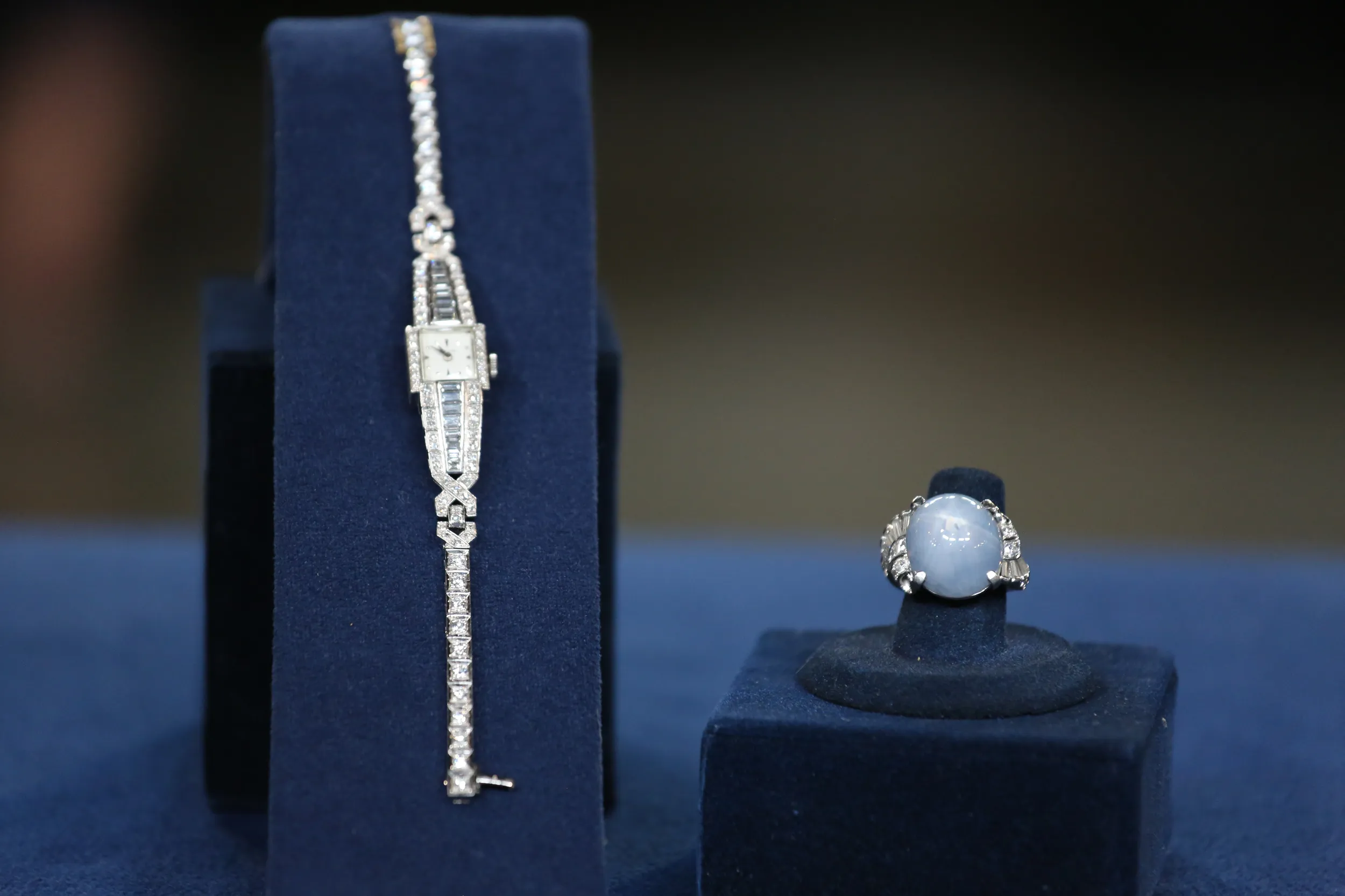
appraisal
Diamond Watch & Art Deco Star Sapphire Ring
Understanding Our Appraisals
Executive producer Marsha Bemko shares her tips for getting the most out of ANTIQUES ROADSHOW.
Value can change: The value of an item is dependent upon many things, including the condition of the object itself, trends in the market for that kind of object, and the location where the item will be sold. These are just some of the reasons why the answer to the question "What's it worth?" is so often "It depends."
Note the date: Take note of the date the appraisal was recorded. This information appears in the upper left corner of the page, with the label "Appraised On." Values change over time according to market forces, so the current value of the item could be higher, lower, or the same as when our expert first appraised it.
Context is key: Listen carefully. Most of our experts will give appraisal values in context. For example, you'll often hear them say what an item is worth "at auction," or "retail," or "for insurance purposes" (replacement value). Retail prices are different from wholesale prices. Often an auctioneer will talk about what she knows best: the auction market. A shop owner will usually talk about what he knows best: the retail price he'd place on the object in his shop. And though there are no hard and fast rules, an object's auction price can often be half its retail value; yet for other objects, an auction price could be higher than retail. As a rule, however, retail and insurance/replacement values are about the same.
Verbal approximations: The values given by the experts on ANTIQUES ROADSHOW are considered "verbal approximations of value." Technically, an "appraisal" is a legal document, generally for insurance purposes, written by a qualified expert and paid for by the owner of the item. An appraisal usually involves an extensive amount of research to establish authenticity, provenance, composition, method of construction, and other important attributes of a particular object.
Opinion of value: As with all appraisals, the verbal approximations of value given at ROADSHOW events are our experts' opinions formed from their knowledge of antiques and collectibles, market trends, and other factors. Although our valuations are based on research and experience, opinions can, and sometimes do, vary among experts.
Appraiser affiliations: Finally, the affiliation of the appraiser may have changed since the appraisal was recorded. To see current contact information for an appraiser in the ROADSHOW Archive, click on the link below the appraiser's picture. Our Appraiser Index also contains a complete list of active ROADSHOW appraisers and their contact details and biographies.


