APPRAISER: You and I have more in common than just our love of Beatrice Wood's pottery. I understand you met her at one point?
GUEST: Yeah, I did. I met her at a gallery, Garth Clark Gallery in Los Angeles.
APPRAISER: Mm-hmm.
GUEST: They were the exclusive showers of her work in both New York and Los Angeles. And there was an opening there one night, and my partner was the manager of the gallery.
APPRAISER: Hm.
GUEST: So he said, "You really need to come tonight because she's really something else." And she really is something else.
APPRAISER: Well, what was that like, meeting Beatrice Wood, for you?
GUEST: Well, it was just a brief encounter for me, but just to kind of know who she was and to see the way she moved around the room. She had these really flowy kind of garments on, and just an eccentric but wonderful, warm person.
APPRAISER: Fascinating woman. I used to go actually buy pottery from her in Ojai, California.
GUEST: Mm-hmm.
APPRAISER: She died at 104 or something.
GUEST: 105, mm-hmm.
APPRAISER: She lived for a long time-- 105. And she was asked what the secret was to her longevity. And she said, "Chocolates and young men."
GUEST: (laughs)
APPRAISER: She was interviewed on her 100th birthday in the "L.A. Times." I don't know if you saw that or not.
GUEST: I did see the article.
APPRAISER: And she was asked why-- again, she was really sassy-- she was asked why she didn't drink alcohol. And she said, "I don't have a problem with alcohol, but I always want to be sober when I'm seduced." (both laughing) So we're gonna talk about her pots, but it's important, because you can't really separate the artist from the art, especially in her case. She was called "The Mama of Dada."
GUEST: Mm-hmm.
APPRAISER: The Dadaists back in the teens in New York City and ran with Marcel Duchamp and a very edgy art crowd.
GUEST: Right.
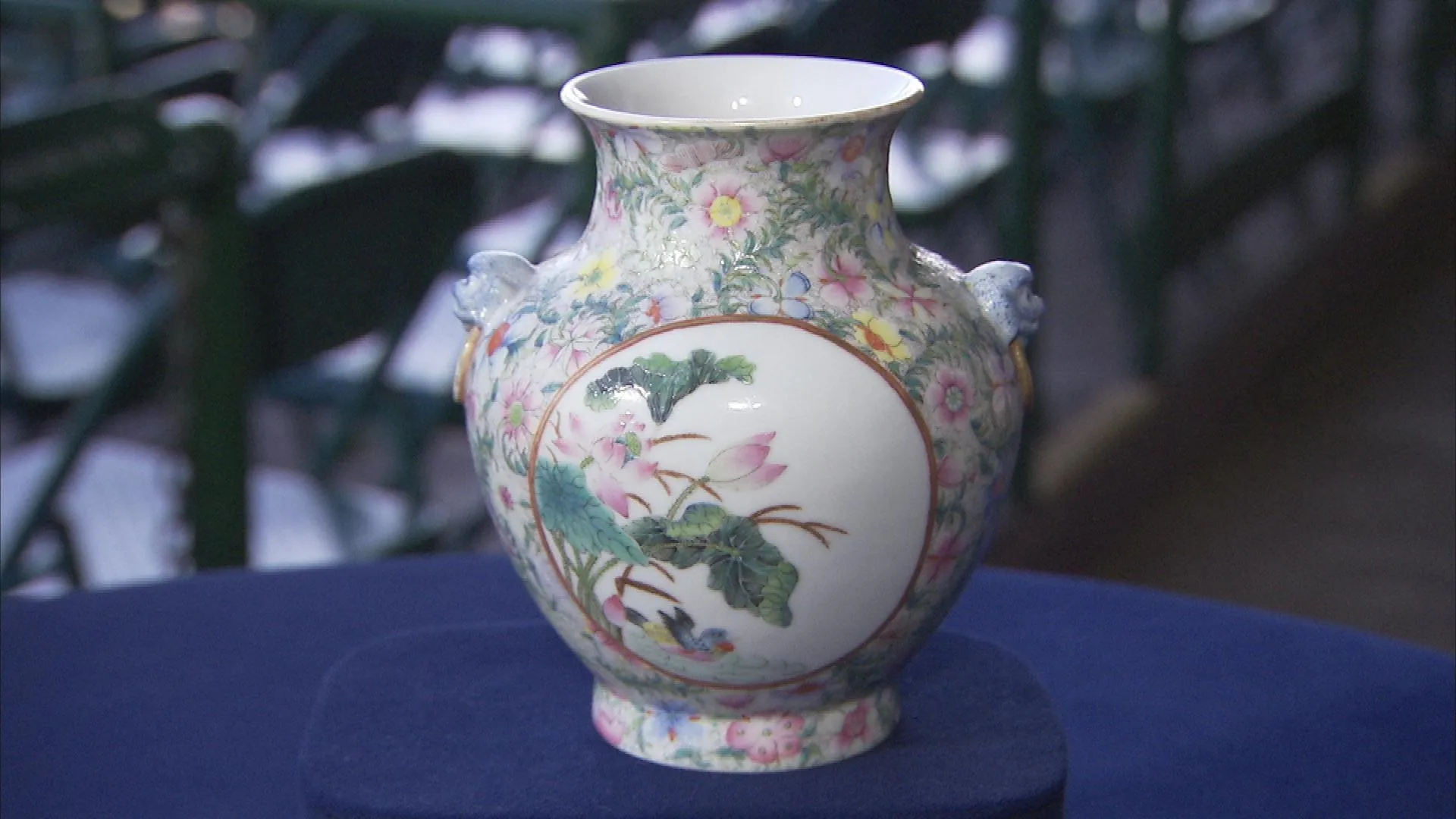
APPRAISER: She discovered ceramics, and she studied under Gertrud and Otto Natzler. But what she really became known for were these colorful nacreous iridescent glazes. So this vase, actually, really neoclassical-- takes... Straight take-off on a Roman vase, has a great nacreous finish to it, a good multicolored flambé. It's also marked. This is, uh, Beatrice Wood's mark. It says "Beato." That's how she signed her pieces. Then this bowl... This is the finger ridges shown on the outside of this. On the bowl, they're more prominent. On the back, you can see where she actually threw the piece. Again, there's the Beatrice Wood signature, and a great glaze on the backside of this. She potted in Ojai up until about the time of her death.
GUEST: Mm-hmm.
APPRAISER: Stylistically, I date them by what she was doing at certain periods of her, of her career. Later on, she tended to do more sculptural work. So this looks to me like classic '70s and '80s work of Beatrice Wood. You probably bought them when they were relatively recent.
GUEST: Yeah, because it was probably about... I would say '86, '87, '88, somewhere in that time frame when I bought them.
APPRAISER: Well, you got two classic examples, worth decent value. What did, what did you pay for these?
GUEST: Well, because my partner was the manager of the gallery, they were listed, I believe, for about $2,200, but he got a 20% discount, so we ended up getting them, I think, for about $1,700.
APPRAISER: For both of these.
GUEST: Yeah, for both the pieces.
APPRAISER: Well, on today's market at auction, I would estimate this for $2,000 to $3,000, and it would bring all that, and perhaps a little more.
GUEST: Wow.
APPRAISER: I tend to be a little conservative. And this bowl, bowls tend not to bring as much as vases, but this is such a good example. I think it's in the $1,500 to $2,000 range at auction. So I think easily you're looking at about $3,500 to $5,000 for the Beatrice Wood's work.
GUEST: Wow, that's great-- that's really good to hear.
APPRAISER: I've really wanted to talk about Beatrice Wood for many years here, and I've finally had my opportunity.