Augsburg Silver Kiddush Cup, ca. 1654
GUEST: It's a Kiddush cup that's been used for wine in Jewish ceremonies. It's been handed down in my family for as far back I know as my grandfather, who was born in 1877.
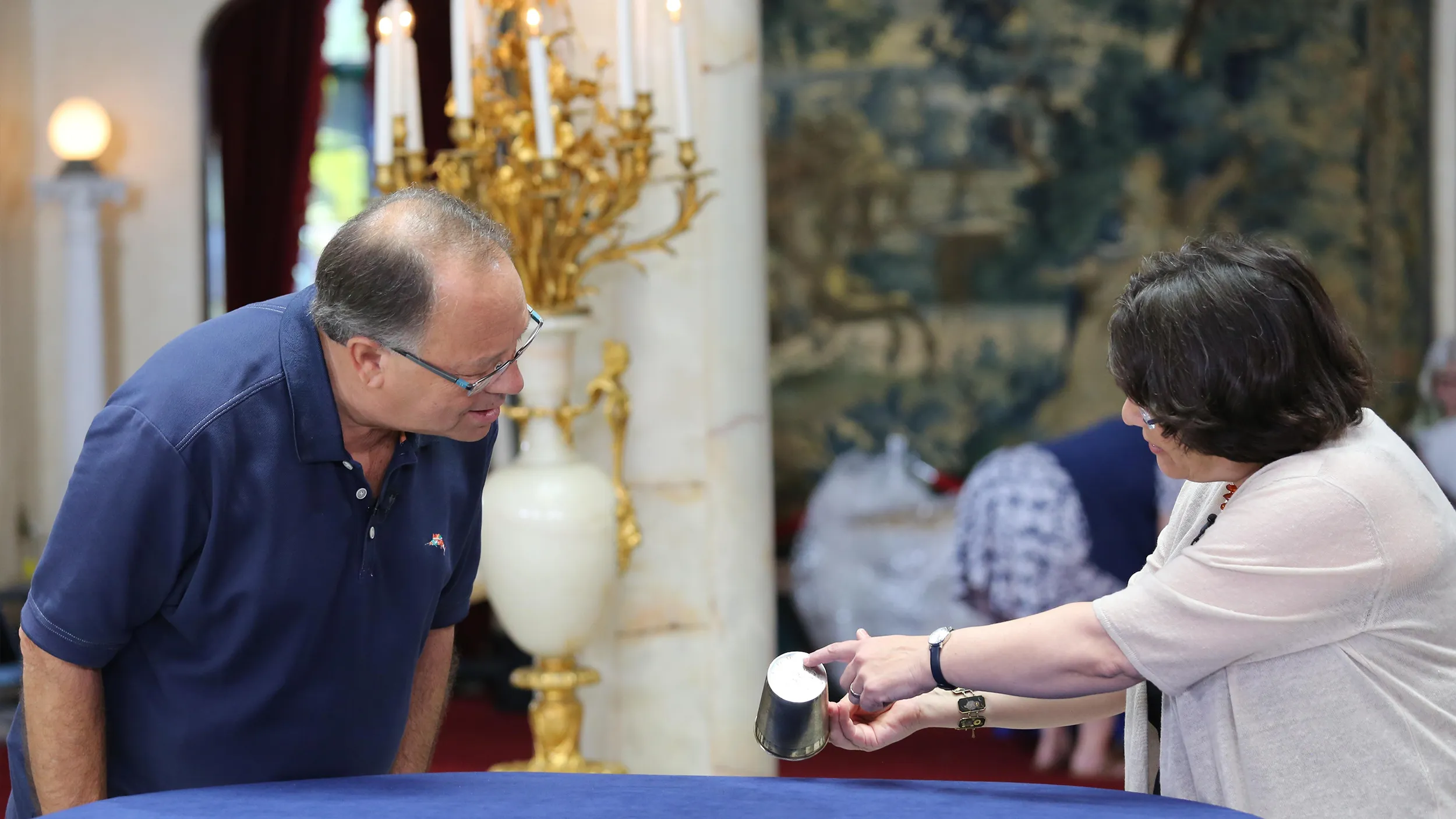
APPRAISER: There's a lot of history on the bottom of the cup. So it's pretty plain when you look at it.
GUEST: Yes.
APPRAISER: But it has this terrific crest on the bottom, a name, and also tells us where it was made and about when.
GUEST: Does it?
APPRAISER: It has an inscribed date of 1654.
GUEST: Yes.
APPRAISER: Which is early.
GUEST: Yes.
APPRAISER: We rarely see silver, or any item, that goes back quite that far.
GUEST: Right.
APPRAISER: And it has sort of the pinecone mark, which is for Augsburg.
GUEST: Okay.
APPRAISER: So it was made in...
GUEST: In Germany.
APPRAISER: In Germany.
GUEST: Okay.
APPRAISER: In Southern Germany, Bavaria.
GUEST: Right, right, that's where my family was from.
APPRAISER: Okay, so, do you know much of their history?
GUEST: My mother grew up in Southern Germany in a... south of Munich, a town called Neustadt an der Weinstrafle. In 1938, the family emigrated from Germany to the United States. My grandfather was... had a business in the town. They lived in the house above the business, selling sheets and linens and things like that. And when he was arrested, my grandmother tried to sell the house. It was before the Final Solution. They weren't gassing the Jews yet in '38. So, she sold the house to her brother, my grandmother did, because he said, "We're Germans. "They're not going to take us away, they're not going to harm us." And of course they were all exterminated later on. But my grandmother got the money from her brother, sold the house and the business, and then paid off the guards at the concentration camp, got my grandfather out. My uncle was there also, my mother's brother. Got them out, got the family to England and sailed to America. She managed to take this cup with her and also a menorah, a candelabra.
APPRAISER: A Hanukkah menorah, yeah.
GUEST: And the clothes on their back.
APPRAISER: It gives you shivers, I think.
GUEST: It does.
APPRAISER: Sort of thinking about the history. And what is particularly interesting is, today is Yom HaShoah. It's Holocaust Remembrance Day.
GUEST: Yes.
APPRAISER: So it's very, very fitting that we are looking at an object that survived the horrible effects...
GUEST: Yes-- the Holocaust.
APPRAISER: ...of the Holocaust and World War II, and is continuing to be, you know, in the family and to be carried forward.
GUEST: Yes.
APPRAISER: Augsburg was a center for silver manufacturing. There weren't Jews in Augsburg in this time period.
GUEST: Okay, right.
APPRAISER: They had been expelled, but certainly lived in surrounding areas. And Jews also were not allowed to be members of professional craftsmen's guilds.
GUEST: Oh, okay.
APPRAISER: So they would employ Christian silversmiths to make things for ceremonial use.
GUEST: Right. Right.
APPRAISER: So it, as you said, it's been used as a Kiddush cup. There aren't any identifications that cement that in...
GUEST: Okay.
APPRAISER: Sometimes Kiddush cups will have, will have an inscription.
GUEST: Right.
APPRAISER: Either part of a blessing, they'll have a snippet of text.
GUEST: Or a star of David, maybe.
APPRAISER: They'll have a dedication inscription, able to trace.
GUEST: Right.
APPRAISER: I think what is fascinating would be to try to figure out who the prior owner was, because this is a heraldic or crest or emblem.
GUEST: Okay.
APPRAISER: So, unlikely Jewish, but it would give us a little more background.
GUEST: Yes.
APPRAISER: So is this something that is used? Do you use it for...
GUEST: We do use it. We do use it...
APPRAISER: For Shabbat and for holidays?
GUEST: For Rosh Hashanah and the holidays, we do.
APPRAISER: Yeah, and it's the right size. Kiddush cups need to hold a certain amount of wine to be kosher.
GUEST: Right.
APPRAISER: And this, certainly you could fit four ounces in there without any problem.
GUEST: I suppose so.
APPRAISER: On the market, this form of cup is not that unusual.
GUEST: Right.
APPRAISER: They come up pretty regularly. There's a maker's mark that I haven't been able to identify, but maybe with some work, could be figured out.
GUEST: Right, okay.
APPRAISER: So, on face value, knowing that it's 17th-century...
GUEST: Right, right.
APPRAISER: It's Augsburg, it's silver gilt, with a lot of questions still...
GUEST: Right.
APPRAISER: I would say an auction estimate would be between $2,500 and $3,500.
GUEST: Right, okay.
APPRAISER: Jewish items that are sort of in continuous Jewish use from this time period, even the 18th century, are very rare.
GUEST: Yes, right.
APPRAISER: What an important item it was to bring with them, leaving in such haste is, you know, is telling.
GUEST: Right, sure, sure. I know.
$2,500 - $3,500 Auction
Photos


Featured In
episode
Silver
appraisal
appraisal
appraisal
Understanding Our Appraisals
Placeholder