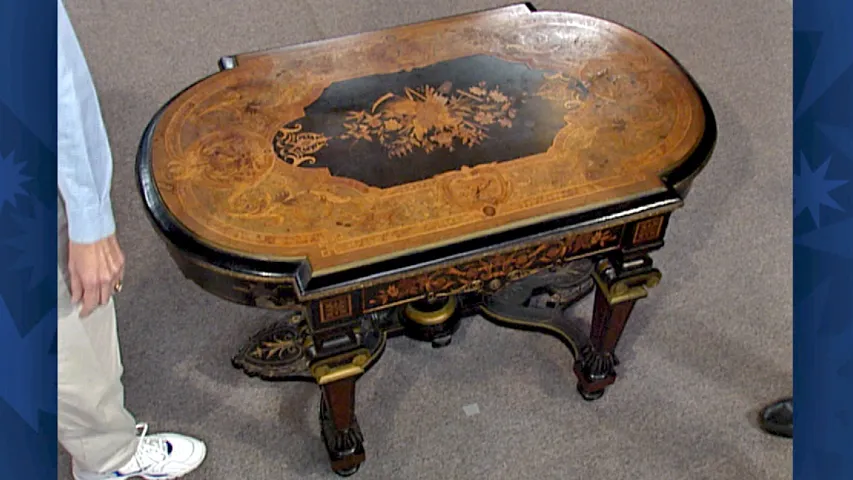
Anthyme Leveque Marquetry Taboret, ca. 1925
GUEST: This table I inherited through my family. A great uncle named Anthyme made this. And so he was my great-great-grandfather's brother. And I believe that he had gifted this to his youngest brother. Anthyme worked for over 50 years in the Homestake Mine in South Dakota. And before that, he had moved with his family as a young boy, uh, from Valcourt, Quebec.
APPRAISER: So he was miner by day, and then marquetry extraordinaire by night. This was...
GUEST: I-- yes, I suppose so. This must have taken a very long time to make.
APPRAISER: Yeah. The craftsmanship is so precise. And this is all about this tabletop. When you look at the table itself... I mean, in terms of a furniture designer, he was not a furniture designer. He was a master of marquetry. So when we turn over the table... And look at the base of it, it looks like it has been made by an engineer, by, by someone who is really understanding, you know, you want to put this thing together, but it's not terribly graceful. All of the grace, uh, is in the top of it. A whole group of exotic woods in here: African ebony wood, satinwood from India. There's just plain old oak wood, which we see here. I know he, uh, pulled maple from Vermont. People actually mailed him samples of woods from all over the world, which is kind of cool. There's also some indication that his work, Leveque's work, which was his last name, showed up in Folk Art Museum in, uh, in New York in a show.
GUEST: I believe so, yes.
APPRAISER: Yes.
GUEST: Around... 1998, I believe. Mm-hmm.
APPRAISER: So, so the joy of this piece is that we know who made it. Most of the marquetry furniture we find in the marketplace, we have no idea who made it. We do have examples of his work, which we see in the photograph dated 1933. He's born in 1880, so it's going to make him around 50 years old or so. I would say we're probably looking at late 1920s, maybe even early '30s. Uh, maybe at the beginning of his career, before he got very, very sophisticated in some of those finer pieces that we know he made. This is a collecting area that has just sort of faded a little bit out of style. This table, I would estimate it as an auction estimate in the $400 to $600 range. It would be less than that if we didn't know who the maker was. But the fact that we know who made it is really a charming, charming story.
GUEST: Well, this is really important to us, and we'll obviously keep this.

$400 - $600 Auction
Featured In

episode
Denver Botanic Gardens Chatfield Farms, Hour 1
Discover delightful ROADSHOW treasures at Denver Botanic Gardens Chatfield Farms!
Ebony
appraisal
1922 Vega Fairbanks Tubaphone #9 Banjo & 1924 F4 Gibson Mandolin

appraisal
Regency Mahogany Cellarette, ca. 1820
appraisal
appraisal
1935 Martin D-18 Acoustic Guitar
Understanding Our Appraisals
Executive producer Marsha Bemko shares her tips for getting the most out of ANTIQUES ROADSHOW.
Value can change: The value of an item is dependent upon many things, including the condition of the object itself, trends in the market for that kind of object, and the location where the item will be sold. These are just some of the reasons why the answer to the question "What's it worth?" is so often "It depends."
Note the date: Take note of the date the appraisal was recorded. This information appears in the upper left corner of the page, with the label "Appraised On." Values change over time according to market forces, so the current value of the item could be higher, lower, or the same as when our expert first appraised it.
Context is key: Listen carefully. Most of our experts will give appraisal values in context. For example, you'll often hear them say what an item is worth "at auction," or "retail," or "for insurance purposes" (replacement value). Retail prices are different from wholesale prices. Often an auctioneer will talk about what she knows best: the auction market. A shop owner will usually talk about what he knows best: the retail price he'd place on the object in his shop. And though there are no hard and fast rules, an object's auction price can often be half its retail value; yet for other objects, an auction price could be higher than retail. As a rule, however, retail and insurance/replacement values are about the same.
Verbal approximations: The values given by the experts on ANTIQUES ROADSHOW are considered "verbal approximations of value." Technically, an "appraisal" is a legal document, generally for insurance purposes, written by a qualified expert and paid for by the owner of the item. An appraisal usually involves an extensive amount of research to establish authenticity, provenance, composition, method of construction, and other important attributes of a particular object.
Opinion of value: As with all appraisals, the verbal approximations of value given at ROADSHOW events are our experts' opinions formed from their knowledge of antiques and collectibles, market trends, and other factors. Although our valuations are based on research and experience, opinions can, and sometimes do, vary among experts.
Appraiser affiliations: Finally, the affiliation of the appraiser may have changed since the appraisal was recorded. To see current contact information for an appraiser in the ROADSHOW Archive, click on the link below the appraiser's picture. Our Appraiser Index also contains a complete list of active ROADSHOW appraisers and their contact details and biographies.


