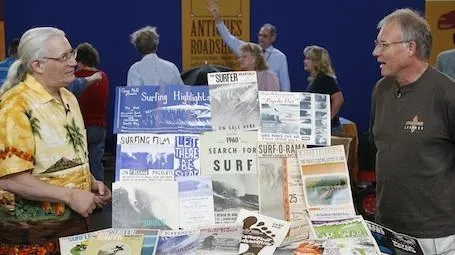
GUEST: This is some memorabilia from my earlier years. When I was in high school in Laguna Beach, California, about early '60s, there was a surfing craze going on, and I was right in the middle of it and hitting the beach every day. But they started showing surfing movies at our local high school, and for, like, a dollar and a quarter, you could go down and see them. And, of course, I went to the movies, but I couldn't help it. I just would pull these off telephone poles and out of the barbershop, wherever I could find them. And it got kind of out of hand. The next thing I knew, I had a lot of them. And it kind of became an obsession. And also I collected The Surfer magazines, the early issues.
APPRAISER: Well, it's interesting, because Bruce Brown, John Severson, all these guys, Greg Noll... they were all independent film makers, and they would carry the cameras out to the beaches, right, and they'd set up out there and they'd film the big waves and the big riders. You weren't one of those guys.
GUEST: No, they weren't filming me.
APPRAISER: No, so it was pretty exciting to watch. And this is right when surf music was catching on: the Beach Boys, Dick Dale, all those groups. Surfing is iconic, and there's more surfers today than there ever was.
GUEST: Yeah, that's true.
APPRAISER: And this is the... what we call the infancy of it, when the surf culture evolved from the islands to the mainland.
GUEST: Right.
APPRAISER: This is the beginning of it, and Bruce Brown and these guys captured it, and what's interesting about this stuff is, this stuff was thrown away. This is what we call ephemera-- stuff that's put up on a wall and thrown away. So not many of these exist. I heard you sold one of them.
GUEST: My son saw my collection in the attic, and he said, "I think I've seen this on the Internet." And this one, in particular, I have several of it. And I thought, "Well, I'll see if I can sell it," and it sold in a week for a hundred bucks.
APPRAISER: Now, you brought in, besides about 200 posters, many of them stapled into a book, but almost all of them with staples in them, tack holes in them, glue and tape from when they were mounted. That's real authenticity. It does detract a little in value, but not much. Besides that, you actually have the very first Surfer magazine.
GUEST: Right.
APPRAISER: This one's from 1960, and in any marketplace-- usually in an auction or even online-- it's worth probably $1,000, just for this one magazine. Now, you also brought in number 2 through number 20, and you say you have lots more.
GUEST: That's right.
APPRAISER: And I'm going to tell you, your collection that I saw, complete, at auction, is worth somewhere between $15,000 and $20,000.
GUEST: Unbelievable. But you know what? I don't think I'm going to sell it. I really like them. (chuckling)
APPRAISER: It's a passion for you.
GUEST: Well, I have some duplicates. Maybe I could sell a few of those.
APPRAISER: Do you think you did good on that at a hundred bucks?
GUEST: A hundred bucks-- yeah.
APPRAISER: I think you did good at a hundred bucks, but I think they're worth $200.
GUEST: Oh, great. Unbelievable. (chuckling) Thanks, Gary.