GUEST: These belonged to my grandmother. They're actually a set of six, my sister has the other three, and I've recently rediscovered them in, in a closet in my home during a remodel.
APPRAISER: Uh-huh.
GUEST: And I've had them since my grandmother passed away in 1999. These always sat in a special cabinet.
APPRAISER: Mm-hmm.
GUEST: We were not allowed to touch them.
APPRAISER: Right.
GUEST: We never got to eat out of them.
APPRAISER: Ah, okay.
GUEST (laughs): So...
APPRAISER: But she did eat out of them.
GUEST: Oh, yes. These were her special dinner, dessert...
APPRAISER: Uh-huh.
GUEST: …for people that, that came to her home.
APPRAISER: So what kind of dessert did she serve?
GUEST: Knowing my grandma, probably ice cream.
APPRAISER: Okay.
GUEST: She was from Texas, too, and she never had less than three kinds of ice cream in the freezer. (laughs)
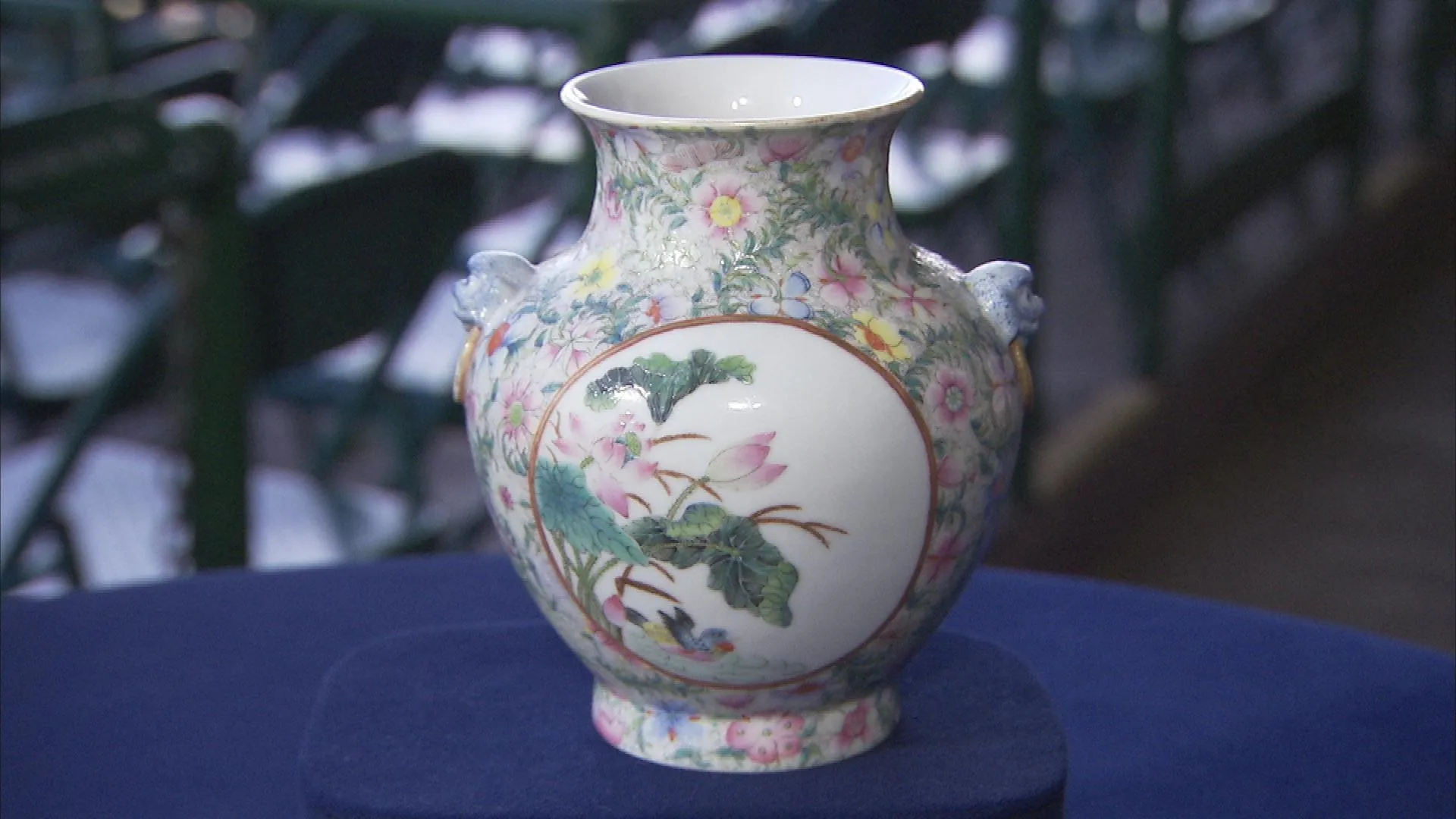
APPRAISER: They're, uh, footed dessert dishes. Each one has a different color. And, I assume, does your sister's? Are hers all different colors, as well?
GUEST: Yes. She has, she has three different colors than these.
APPRAISER: Okay. We'll take a look at the mark on the bottom, and we see that there's a gold painted flower on the top of the mark. And if we got a sharp object and we scraped off that gold, we would find the name of the manufacturer of the porcelain.
GUEST: Okay.
APPRAISER: So one company made the porcelain, and another company decorated it. And at the bottom, there's a picture of a sheep or a lamb and the word "Dresden" and the word "Germany." So people would say this is Dresden porcelain. But actually, there's no such thing as the Dresden Company. Dresden is a city, it's not the name of a manufacturer. This particular company is, uh, called Ambrosius Lamm, L-A-M-M, which in German means "lamb," L-A-M-B. These are all completely hand-painted with these wonderful scenes, and they're called Watteau scenes. And Watteau was an 18th-century French painter, and they're not exact copies of any of his paintings, but they show usually a man and a woman in a garden setting. They're talking, playing musical instruments. They have lots of richly raised gilding and gold designs. Now, this particular one has a design in the center of the bowl, which is just overkill.
GUEST: (chuckles)
APPRAISER: But interesting enough, the other two do not. These sherbet's cups always originally came in sets of 12, most likely. Now, normally, in any kind of antique object, a set, a complete set, is always more valuable than the individual's parts. But this is one exception, because there's so many people who collect them, and they're trying to get every color that was made. And I don't know how many colors, but there are more than 12 colors. A long time ago, these were highly collected in America. The company started in 1887, Ambrosius Lamm, and these were probably made around 1900.
GUEST: And my grandmother would have probably bought them in the early 1950s. That would be my guess.
APPRAISER: Okay, and then they would, so they would have been old, or secondhand at that point. They were still, they were always a luxury object. Now it seems to me that most of the, many of the major collectors of these are in Europe and in Asia, including Japan, Korea, China. Collectors there love this Dresden porcelain, and they particularly love Lamm porcelain. And they have driven the prices of these up. So in today's market, when, when they're sold at a retail price, they usually sell for between $1,500 and $2,000 each.
GUEST: Each?
APPRAISER: Each.
GUEST (chuckles): That certainly is a big surprise. I can assure you, my grandmother didn't pay that.
APPRAISER: So the, the combined value for your three would be between $4,500 and $6,000 retail price.
GUEST: I'm shocked, I really, I'm truly shocked.
APPRAISER: I, I think it's a little shocking myself.