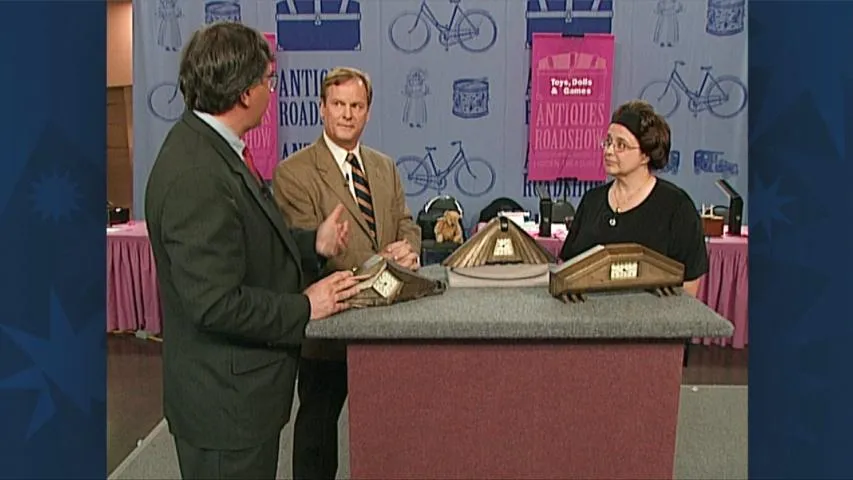
GUEST: My uncle gave them to my dad and my dad gave them to us. My uncle tells us the story that in Detroit, Michigan, during the very early and deep parts of the Depression era in the 1930s, he was approached by a man on the street and the man virtually begged him to purchase these from him. So he purchased them for ten dollars apiece from a gentleman who was very well dressed and in desperate financial need.
APPRAISER: Well, as soon as I saw these, I wanted to talk to Dave McCarron here, who I know can explain to us the value of what I considered to be, right away, very stylish, very snappy-looking cases. What do you know, Dave?
APPRAISER: Well, they're by a French artist, Albert Cheuret, born late 19th century in Paris. Worked in Paris and studied in Paris and flourished in the early 20th century. One of the significant artists from the beginning of the Modern movement. Each clock is signed on the front: Albert Cheuret. And if we could go back to Gordie and say, are the clockworks... do they back up that story?
APPRAISER: Yes. In the back-- it's covered by a plate which is screwed on-- but inside there is a French-made jeweled movement that tells time only. They don't strike. And you would have had a long key to insert in there and wind it once a week. And it just ran to tell time. The dials were very nicely stylistically done. They're all the same style of dial, although different shapes. If I were just looking at these as clocks, good-quality clocks of this period, I'd say, well, these are worth maybe $1,000 to $1,200 each. But I kind of thought they might be worth more because of the style, and so that's why I called Dave. What do you think?
APPRAISER: I think that this example and this example would sell for $30,000 to $50,000 apiece. This example closest to you, $15,000 to $25,000. I can't add that high. (laughing) That sounds like a nice round number for you, for the ten dollars each. (laughing)