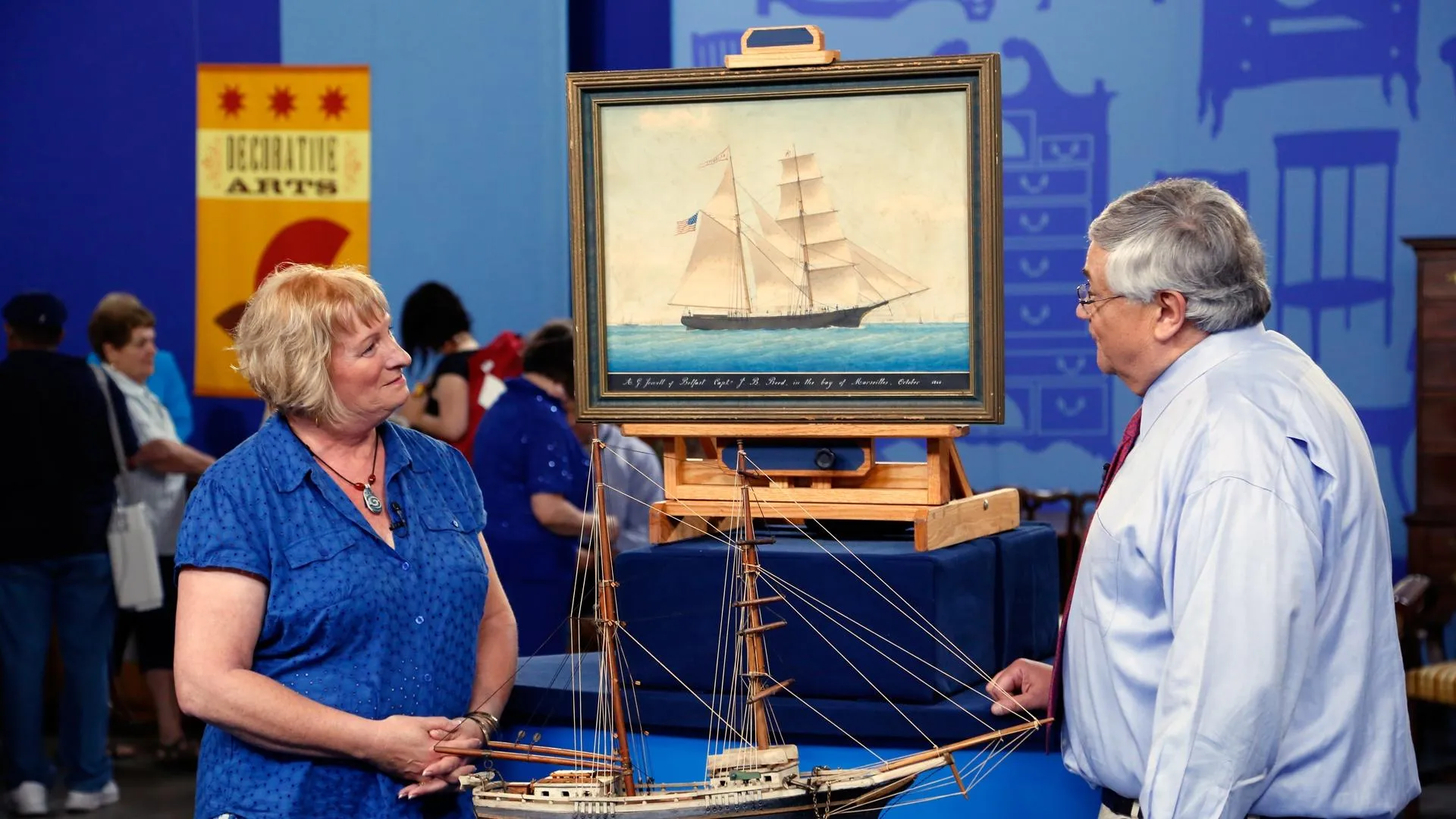
GUEST: My great-great-grandfather was Captain J.B. Reed. And these items came down through the family from the great state of Maine, which is where I'm from originally.
APPRAISER: Well, it is a great state. And this is a family ship, and it's the A.G. Jewett of Belfast, Maine, with Captain J.B. Reed, who was your ancestor, in the Bay of Marseilles, which is of course France, October, 1866. Tell me a little bit about the ship.
GUEST: Actually, that was its maiden voyage. They built the ship outside of Belfast, Maine, in a little town called Addison. It was what they consider a brig.
APPRAISER: Yes.
GUEST: It was a commerce ship and that was his first load he took to Marseilles, France. And someone did this painting. I'm not quite sure, is it a watercolor?
APPRAISER: Yes, it's a watercolor on paper. And there were port painters at every port that the American ships went to. And so they would have these port artists paint these so that they could bring them home. They really didn't want a painting that was done by a Maine artist. I mean that would be sort of tacky. And there were two members of the Roux family who did a lot of these. And there was also an artist by the name of Pellegrin, who also did these port paintings in watercolor in Marseilles at that period. I did a little bit of research, and it turned out that Mr. Jewett was a very successful lumberman and lawyer in Maine. He had actually been an ambassador under President Polk in 1843 to 1845 to Peru. It is my guess that maybe the model was made by the builder or the man who was hoping to build the ship and just enlisted somebody to buy it, because I really doubt if your ancestor owned it. Usually the owner of a ship and the captain were different people. Quite possibly Mr. Jewett owned the ship. Do you know how long it was in service?
GUEST: We had some records that showed it was built in 1866, and quite the colorful newspaper article about how it went down to Cape Hatteras in February of 1884 in a very bad storm. And of course, Captain Reid went down with it.
APPRAISER: Do you know where the vessel was bound for?
GUEST: Cuba.
APPRAISER: Right, and what was it carrying?
GUEST: Sugar machinery and coal, of course.
APPRAISER: Right, and the sugar machinery was very heavy, and he probably should not have carried it.
GUEST: When it hit a storm, the ship started to rock, the machinery let go and rocked to one side and that was the end of the vessel.
GUEST: Of the A.G. Jewett.
APPRAISER: Yes, but it's a wonderful painting. I think at auction they would bring between $10,000 and $12,000 for the two of them. (chuckling):
GUEST: You're kidding.
APPRAISER: No, I'm being very serious.
GUEST: Wow.
APPRAISER: Yes, most of the value is in the painting. But the model is so beautifully done and definitely done by somebody who knew what the vessel was all about and how to build it.
GUEST: Well, they definitely will stay together and go down to the next generation.