GUEST: My grandfather was a medical doctor 25 miles north of Manhattan, and one of his patients gave this to him.
APPRAISER: Huh.
GUEST: He was a GP in a small town and treated some people for chickens or eggs or produce. And this lady left him paintings after she died.
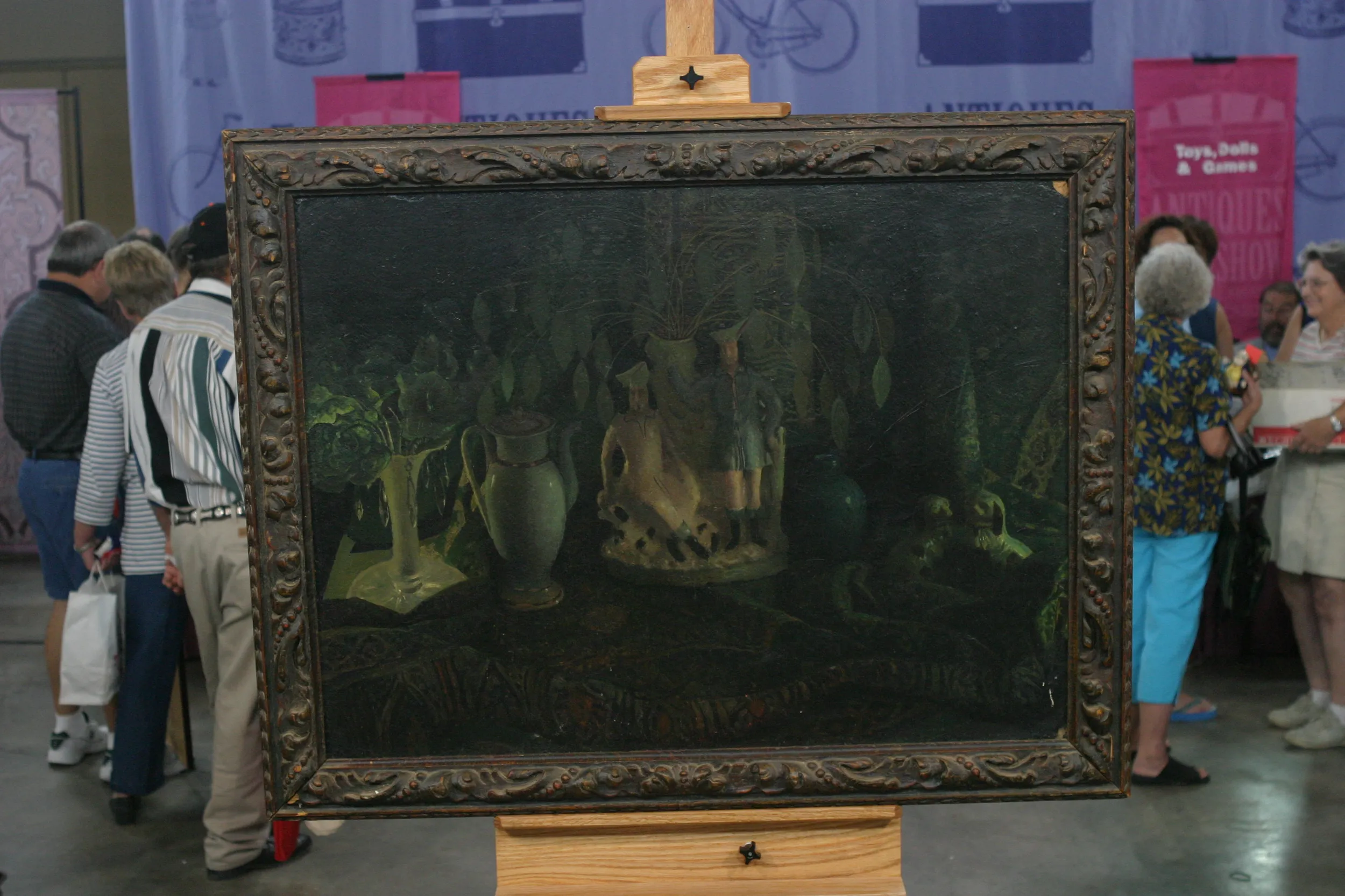
APPRAISER: Well, that's a good medical plan, isn't it? When you first brought it in, I was really overwhelmed with the great quality and detail of this still life and also with the great sensitivity of the painting of the monks on the right. Now, we have a very tough-to-read, 19th-century signature down there and it looks like R-u-m-b-o-r-g-a... Very tough to read. So, we decide to investigate it further. So what we do is we take a look at the back, see if we have any clues on the back... And...here it's that same signature: R-u-m-b-o-r-g.
GUEST: Yes.
APPRAISER: Take a look and see if we can find any reference for the artist. Nothing. And the painting is such, such good quality it has to be by someone good. So, three's a charm. And we have this great original label by the artist.
GUEST: Humborg.
APPRAISER: Humborg, yes. Adolf Humborg, who was a very well known 19th-century Hungarian artist and was especially well known for painting lavish interior scenes like this, with the monks and with these wonderful still lifes. I think we need to talk now about the elephant in the middle of the room-- or in the middle of the painting, in this case. What happened with the condition here?
GUEST: It was stored badly, in my possession, and it was in a closet and something banged into it and went through. We have some, but probably not all, of the pieces at home.
APPRAISER: Okay, but you do have some of the pieces.
GUEST: Yes, ma'am.
APPRAISER: Okay. Well, the condition of the painting is quite problematic. You have it coming off of the stretcher on the left-hand side, and then you have this incredible loss at a really problematic area. All loss isn't equal. If it was here in the background or somewhere where there wasn't so much activity, it wouldn't be... as problematic.
GUEST: Right.
APPRAISER: Humborg was a very important 19-century artist and everything that you have here is everything that he's well known for: these lush still lifes, beautifully, beautifully painted, but then you have this. As it is, with the pieces, I would estimate it at between $8,000 and $12,000.
GUEST: Hmm.
APPRAISER: Works by him come up often at auction, and pieces by him have sold for as much as $30,000, $40,000, $50,000. Were you to get the pieces together and it was to be beautifully restored, I would estimate it easily between $15,000 and $25,000.
GUEST: Wow. That's wonderful.
APPRAISER: And the difference between the $15,000 and $25,000 and the $30,000, $40,000, $50,000 is that it will always be an intensely restored piece. Given the losses that you have throughout and the fact that it's quite dirty, my sense is that you could have an expensive restoration, perhaps a few thousand dollars.
GUEST: Okay.
APPRAISER: But it's a great painting. Don't lose those pieces.
GUEST: No. Thank you so much.
APPRAISER: Great. Thank you.