1986 Leonard Nimoy Saturn Life Career Award
GUEST: This is a lifetime achievement award to Leonard Nimoy. He actually gave it to me.
APPRAISER: What was it like knowing the man, the myth, the legend (chuckling): that is Leonard Nimoy?
GUEST: He was a very nice man. He rented space from the company I worked for. I worked in a cubicle and he had the office right behind me. So he was 20 feet away, like, every day.
APPRAISER: Interesting, that is so cool. You are correct in that this is a lifetime achievement award. But what this award is actually known as is a Saturn Award. First awarded in 1973, these are given out by the Academy of Science Fiction, Fantasy, and Horror. A Saturn Award might not be a big name like we hear, you know, Emmys, Golden Globe and Oscar. But in the world of everything cool, pop culture, nerdy science fiction, a Saturn Award is a pretty big deal. The Academy of Science Fiction, Fantasy, and Horror was first created by Donald Reed in 1972, and they still give out the Saturn Award today. In 1986, Leonard Nimoy received this right here, the lifetime achievement award. And when it comes to Leonard Nimoy as a actor, as a personality, his name is synonymous with the world of pop culture. Obviously, everybody knows him from Spock on Star Trek. Spock was such an important character. Everybody remembers that-- I'm gonna embarrass myself. I don't know what it is, but I cannot do the Vulcan salute. I know! I don't have-- I don't know what it is. I don't have these muscles.
GUEST: (laughs)
APPRAISER: What do you think it's worth?
GUEST: I have no clue as to what it's worth. It almost doesn't matter because it's my connection to Leonard.
APPRAISER: Gotcha.
GUEST: I got to see this thing every day. So when he closed his office down and his assistant asked if I wanted anything, knowing I was a Trekkie, I said, "You know, I look at this thing every day, can I have this?" Not knowing what it was, I had no idea what it was. I just knew it was a statue in his office.
APPRAISER: (laughs)
GUEST: And she said, "Let me ask him." So she went, she asked him, next thing I know, it's on my desk.
APPRAISER: At auction for this award, today, at a pop culture entertainment memorabilia sale, we'd be able to conservatively estimate it $5,000 to $8,000.
GUEST: Okay, time for insurance. (laughing) Wow!
APPRAISER: Based on the other Saturn Awards that have come up, I think this would be arguably one of the best to hit the market. And I wouldn't be surprised if that high estimate was doubled in the $15,000-plus range.
GUEST: Holy cr... I won't say that, um. (laughs) Wow, that's...okay, it's still going back to my house. It's still going to go sit next to the TV, because we watch Star Trek every night.
APPRAISER: I would not insure it for any less than $15,000 because you're not
going to find another one. It's truly one of a kind.
GUEST: Oh, wow.

$5,000 Auction
$15,000 Insurance
Featured In

episode
Springs Preserve, Hour 3
ROADSHOW heads to the Mojave Desert in search of marvels at Springs Preserve in Las Vegas.
Memorabilia

appraisal
20th-Century Presidential Autographs
appraisal
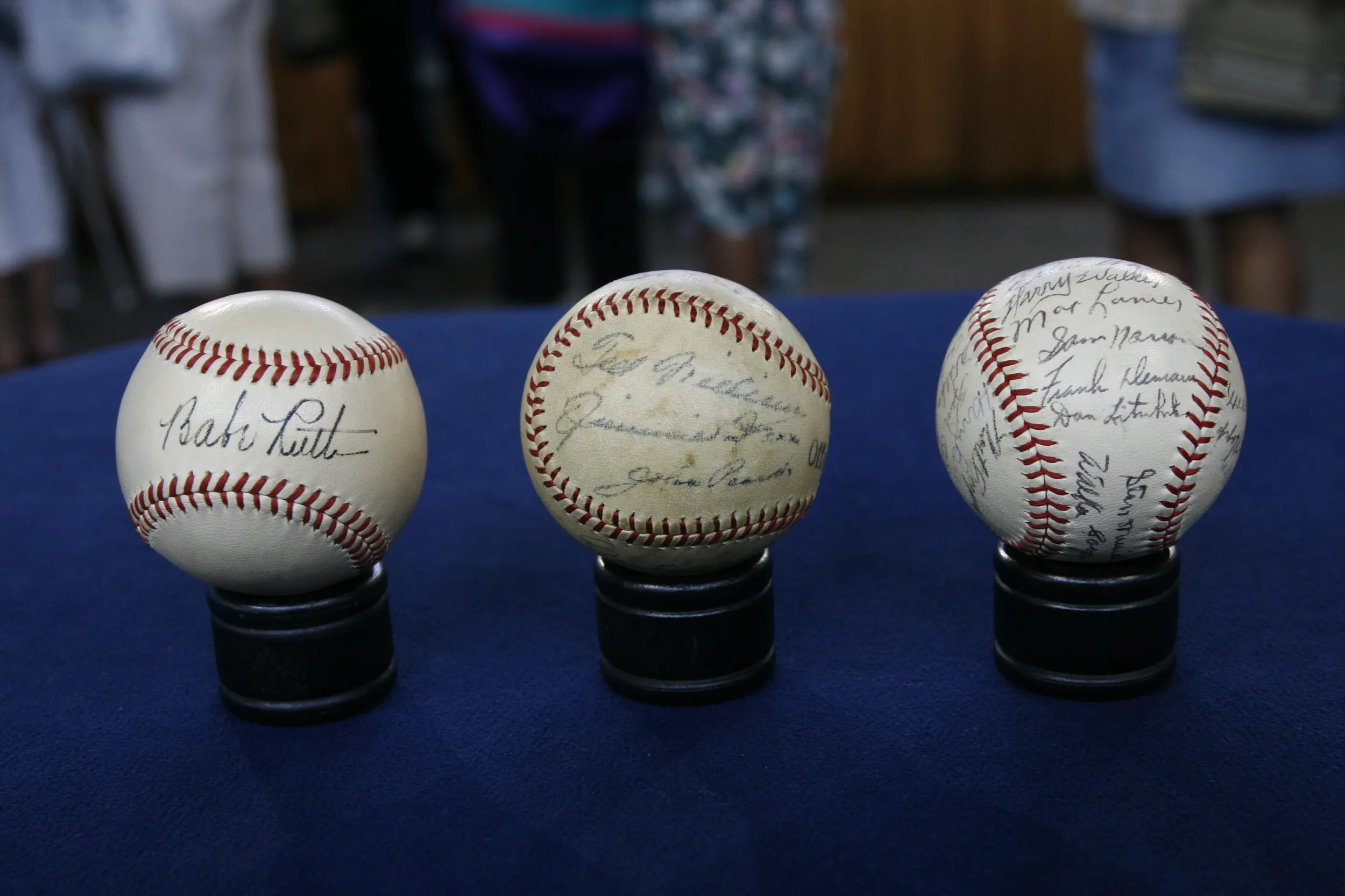
Three 1940s Signed Baseballs

appraisal
1935 Signed "Porgy & Bess" Book

appraisal
1957 Buddy Holly Contract
Understanding Our Appraisals
Executive producer Marsha Bemko shares her tips for getting the most out of ANTIQUES ROADSHOW.
Value can change: The value of an item is dependent upon many things, including the condition of the object itself, trends in the market for that kind of object, and the location where the item will be sold. These are just some of the reasons why the answer to the question "What's it worth?" is so often "It depends."
Note the date: Take note of the date the appraisal was recorded. This information appears in the upper left corner of the page, with the label "Appraised On." Values change over time according to market forces, so the current value of the item could be higher, lower, or the same as when our expert first appraised it.
Context is key: Listen carefully. Most of our experts will give appraisal values in context. For example, you'll often hear them say what an item is worth "at auction," or "retail," or "for insurance purposes" (replacement value). Retail prices are different from wholesale prices. Often an auctioneer will talk about what she knows best: the auction market. A shop owner will usually talk about what he knows best: the retail price he'd place on the object in his shop. And though there are no hard and fast rules, an object's auction price can often be half its retail value; yet for other objects, an auction price could be higher than retail. As a rule, however, retail and insurance/replacement values are about the same.
Verbal approximations: The values given by the experts on ANTIQUES ROADSHOW are considered "verbal approximations of value." Technically, an "appraisal" is a legal document, generally for insurance purposes, written by a qualified expert and paid for by the owner of the item. An appraisal usually involves an extensive amount of research to establish authenticity, provenance, composition, method of construction, and other important attributes of a particular object.
Opinion of value: As with all appraisals, the verbal approximations of value given at ROADSHOW events are our experts' opinions formed from their knowledge of antiques and collectibles, market trends, and other factors. Although our valuations are based on research and experience, opinions can, and sometimes do, vary among experts.
Appraiser affiliations: Finally, the affiliation of the appraiser may have changed since the appraisal was recorded. To see current contact information for an appraiser in the ROADSHOW Archive, click on the link below the appraiser's picture. Our Appraiser Index also contains a complete list of active ROADSHOW appraisers and their contact details and biographies.


