1978 Kenner Darth Vader with Double-telescoping Lightsaber
GUEST: I brought my vintage Kenner Star Wars Darth Vader action figure. I owned this since it came out in 1977.
APPRAISER: No way!
GUEST: Yes.
APPRAISER: So you actually remember getting this off the store shelf?
GUEST: Bought it new, played with it, kept it all this time; coming out of the movie, Vader was certainly the character to get. And being one of the earliest ones, it has the double-telescoping lightsaber.
APPRAISER: Correct, bingo, and that's why we're talking about this bad boy right here. So you did say '77? Actually, the Kenner Star Wars toys did not hit store shelves until 1978. When Star Wars came out in May of 1977, the movie was such a hit, it was an instant sensation. So Christmas of '77, Kenner comes out with this thing called the Early Bird kit. Are you familiar with the Early Bird?
GUEST: I had the Early Bird as well.
APPRAISER: No! You received an Early Bird kit?
GUEST: Yes.
APPRAISER: So you bought the mailer, you sent it, you did the whole process?
GUEST: Yes, still have it.
APPRAISER: You had four figures. You've got Luke, Leia, R2D2 and Chewbacca. Darth Vader wasn't introduced until the figures came out in what we call 12 backs. 12 back just simply refers to the fact that when we look at the packaging that this Vader would have been on, it showed 12 figures on the back of the card that you could have bought. Now, the double-telescoping element. There are three characters that could have had a double-telescopic saber: Luke Skywalker, Obi-Wan Kenobi, and Darth Vader. Out of the three, Luke Skywalker is the most common. Now, we're just going to show what does that mean. Well, you move the arm here... Typical Star Wars figures, you just get that single extension, but you pull out this little bad boy. Whoo hoo! Look at that. The reason why the double-telescopic saber is so rare, because when it came to Kenner and quality control, they realized, A, this was a hazard if it falls out, because it can be removed out of the, the shaft. But the other thing is, it broke all the time. So that's why they redesigned the lightsabers to just have that solid tip. Just like comics and trading cards and everything else today, they do professionally-grade toys. We look at him, his cape is super clean, no scuffs, it's not sticky, there's no plastic breakdown. We look at the paint applications on his chest. I mean, it's beautiful. I think it would very easily hit a 80, maybe an 80-plus. Conservatively, at auction, in its current shape, 23 20 ungraded, it would easily be a $6,000 to $9,000 action figure.
GUEST: Pretty good.
APPRAISER: Is it pretty good? Or it's pretty great, I think!
GUEST: It's pretty... it's great.
APPRAISER: Hey, especially when your mom paid $1.98 in 1978.
GUEST: That's right.
APPRAISER: Hypothetically speaking, on the ultimate high end, when this figure is graded 90, it has sold for as high as $30,000 out of the package. If you would have left him in the card back, you would have had a $60,000 to $90,000 action figure. But you were a kid, what are you supposed to do?
GUEST: I got a lot of play value out of it.

$6,000 - $9,000 Auction
Featured In

episode
Living History Farms, Hour 1
ROADSHOW visits Living History Farms for treasures and a top $75,000 to $125,000 find.
20th Century
appraisal
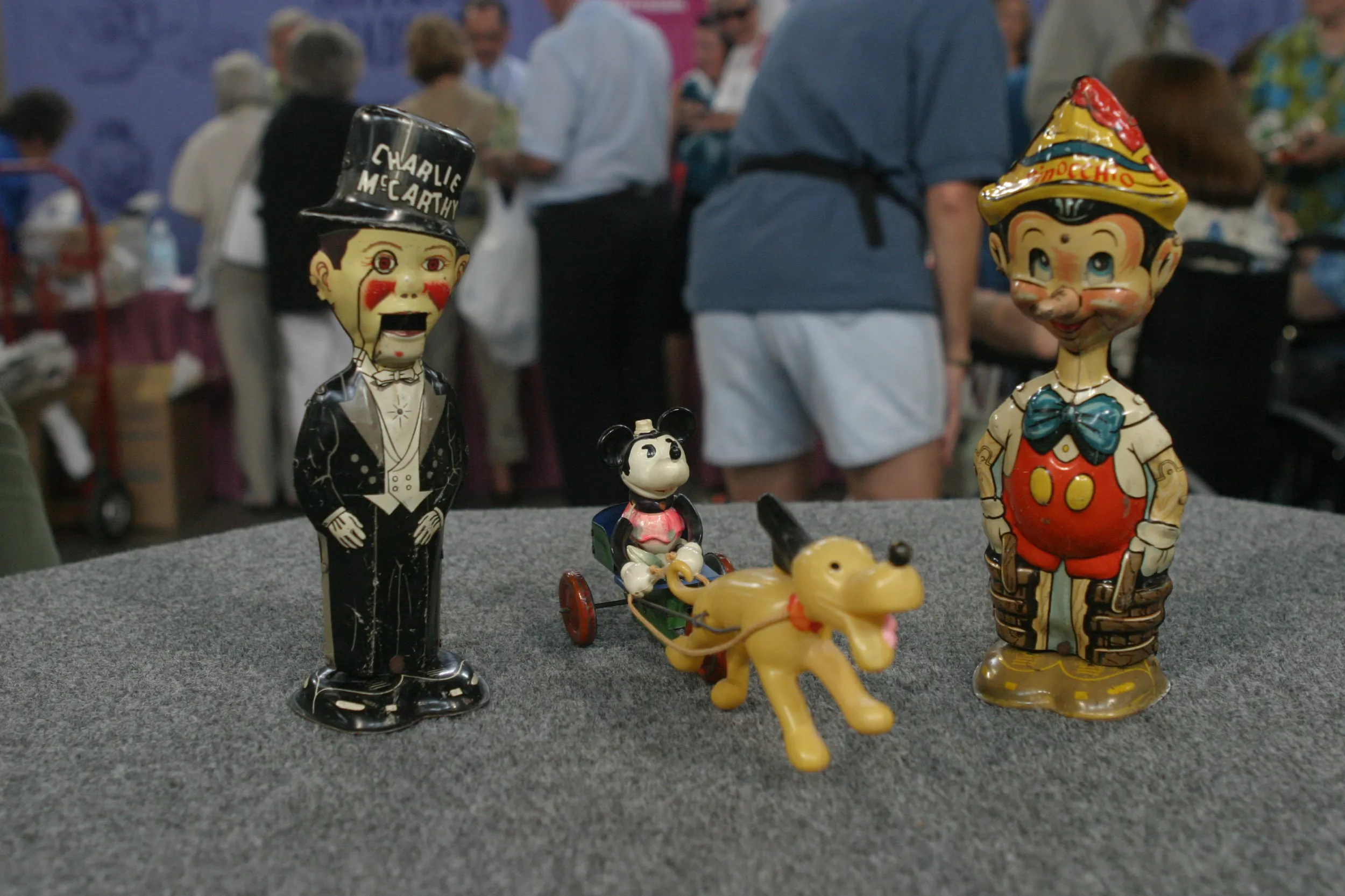
Comic Wind-up Toys, ca. 1930

appraisal
Barbie Accessories & Case, ca. 1960

appraisal
William Moorcroft Pottery, ca. 1910
appraisal
Understanding Our Appraisals
Executive producer Marsha Bemko shares her tips for getting the most out of ANTIQUES ROADSHOW.
Value can change: The value of an item is dependent upon many things, including the condition of the object itself, trends in the market for that kind of object, and the location where the item will be sold. These are just some of the reasons why the answer to the question "What's it worth?" is so often "It depends."
Note the date: Take note of the date the appraisal was recorded. This information appears in the upper left corner of the page, with the label "Appraised On." Values change over time according to market forces, so the current value of the item could be higher, lower, or the same as when our expert first appraised it.
Context is key: Listen carefully. Most of our experts will give appraisal values in context. For example, you'll often hear them say what an item is worth "at auction," or "retail," or "for insurance purposes" (replacement value). Retail prices are different from wholesale prices. Often an auctioneer will talk about what she knows best: the auction market. A shop owner will usually talk about what he knows best: the retail price he'd place on the object in his shop. And though there are no hard and fast rules, an object's auction price can often be half its retail value; yet for other objects, an auction price could be higher than retail. As a rule, however, retail and insurance/replacement values are about the same.
Verbal approximations: The values given by the experts on ANTIQUES ROADSHOW are considered "verbal approximations of value." Technically, an "appraisal" is a legal document, generally for insurance purposes, written by a qualified expert and paid for by the owner of the item. An appraisal usually involves an extensive amount of research to establish authenticity, provenance, composition, method of construction, and other important attributes of a particular object.
Opinion of value: As with all appraisals, the verbal approximations of value given at ROADSHOW events are our experts' opinions formed from their knowledge of antiques and collectibles, market trends, and other factors. Although our valuations are based on research and experience, opinions can, and sometimes do, vary among experts.
Appraiser affiliations: Finally, the affiliation of the appraiser may have changed since the appraisal was recorded. To see current contact information for an appraiser in the ROADSHOW Archive, click on the link below the appraiser's picture. Our Appraiser Index also contains a complete list of active ROADSHOW appraisers and their contact details and biographies.


