1976 Apple-I Operation Manual Mock-up for Apple-II
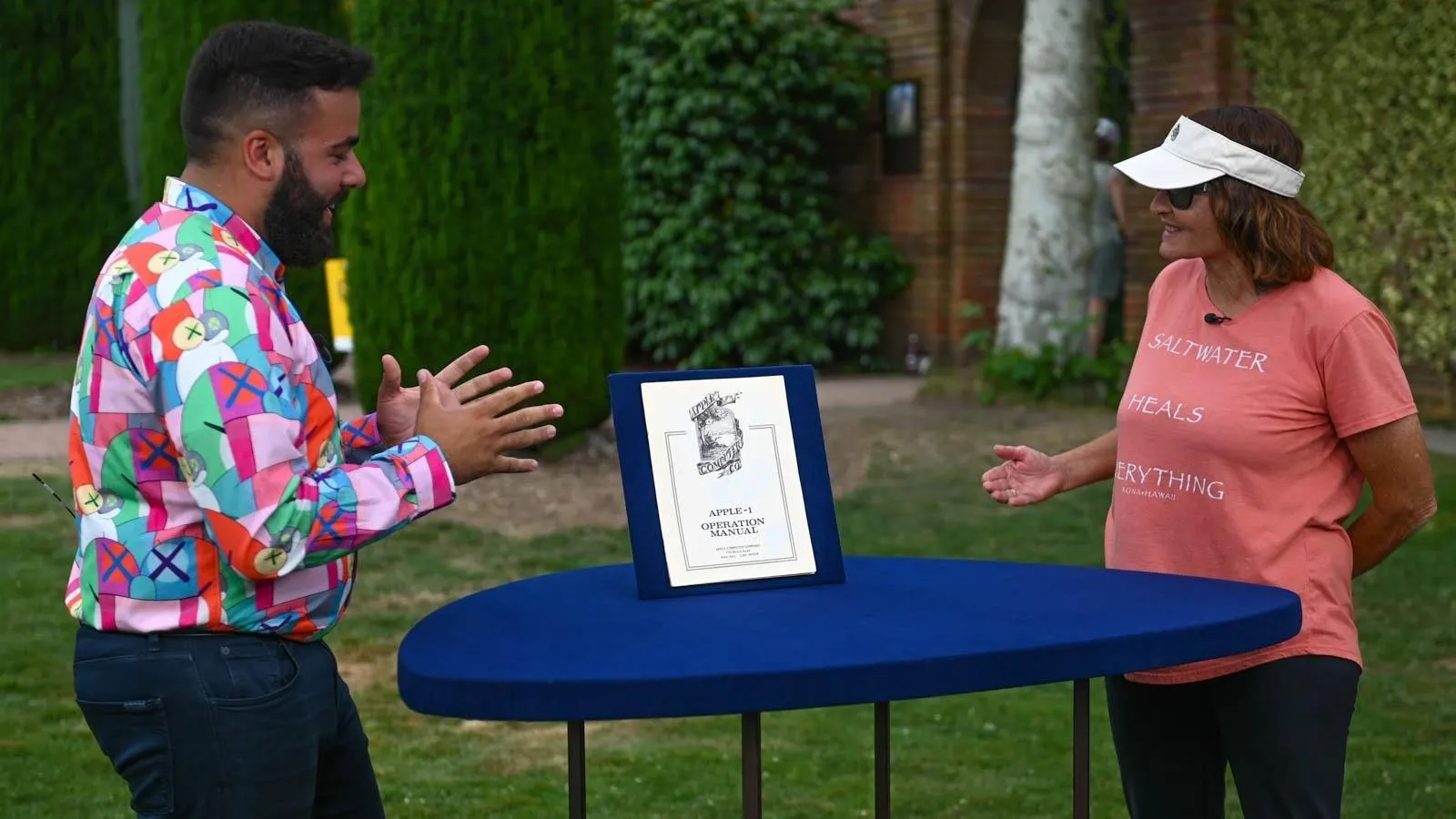
GUEST: I brought a original Apple I computer manual. One day I was at work, and I worked at Apple, and the, uh, facilities crew was cleaning out some closets, and they had a great big old dumpster, so I got it dumpster-diving. (laughing): That's what... I mean, I hate to say it, but it's true.
APPRAISER: D'oh! That is awesome.
GUEST: And that was in about 1987?
APPRAISER: How long did you work at Apple?
GUEST: 33 years. And it was like 33 years that went in the blink of an eye. Every day was different. You never knew who you were going to see. It was just an incredibly fantastic, enlightening time.
APPRAISER: There is no way to express how important the Apple I computer is. The first big debut was in 1976 at the Homebrew Computer Club in Palo Alto.
GUEST: Yep. Yep, yep.
APPRAISER: It carried a retail cost of $666.66, which, originally, you'd be, like, "Wow, 666."
GUEST: Whoa!
APPRAISER: "That might not..." (laughter) "That might not be the greatest number to market." But the reason why is, uh, Steve Wozniak loved, like, the soothing feeling of hearing repeated numbers. So they came up with $666.66, which is equivalent to a little bit over $3,000 in today's market, if you account for inflation.
GUEST: Mm-hmm.
APPRAISER: So this is a huge chunk of change back in the '70s. Now get to the manual. We have the original Apple logo on the front, with Isaac Newton sitting under the apple tree. This logo was designed by Apple's third co-founder, Ronald Wayne. Shortly after founding the company with Steve Jobs and Steve Wozniak, he ended up selling out of his shares for $800.
GUEST: (laughing): Wow.
APPRAISER: Now, why are we seeing this manual mocked up?
GUEST: This manual was actually the marketing comp, and there were all kinds of marks on it, like white-out, because they were going to be changing the Apple I operation manual tag to, like, the next-generation computer.
APPRAISER: You can see Apple preparing to change their logo from that Sir Isaac Newton to, now, you have the Apple lo... You have the updated address, you have the updated year.
GUEST: Yep, yep.
APPRAISER: They were mocking this up to get ready...
GUEST: Yep.
APPRAISER: ...for the Apple II in '77. So, this is, like, my crazy mind of thinking just imagine whose hands were making those changes to say, you know, "Oh, we gotta change this logo. We gotta change this wording." Even when you go to the back of the book, it's so cool seeing the mark-up "Replace with new art." The other thing is the historical significance of, this is a mock-up copy. So when it comes to putting a value on it, conservatively, at auction today, the pamphlet would be estimated $10,000 to $15,000.
GUEST: That is more than surprising, and more than I ever would have thought, I mean, even if you told me ten bucks, it would've been okay. (laughing): I mean, seriously. That is beyond my wildest expectation.

$10,000 - $15,000 Auction
Featured In
episode
Filoli, Hour 1
Kick off Season 27 with fascinating Filoli finds including a treasure of up to $330,000!
20th Century
appraisal
Comic Wind-up Toys, ca. 1930

appraisal
Barbie Accessories & Case, ca. 1960
appraisal
William Moorcroft Pottery, ca. 1910
appraisal
Understanding Our Appraisals
Executive producer Marsha Bemko shares her tips for getting the most out of ANTIQUES ROADSHOW.
Value can change: The value of an item is dependent upon many things, including the condition of the object itself, trends in the market for that kind of object, and the location where the item will be sold. These are just some of the reasons why the answer to the question "What's it worth?" is so often "It depends."
Note the date: Take note of the date the appraisal was recorded. This information appears in the upper left corner of the page, with the label "Appraised On." Values change over time according to market forces, so the current value of the item could be higher, lower, or the same as when our expert first appraised it.
Context is key: Listen carefully. Most of our experts will give appraisal values in context. For example, you'll often hear them say what an item is worth "at auction," or "retail," or "for insurance purposes" (replacement value). Retail prices are different from wholesale prices. Often an auctioneer will talk about what she knows best: the auction market. A shop owner will usually talk about what he knows best: the retail price he'd place on the object in his shop. And though there are no hard and fast rules, an object's auction price can often be half its retail value; yet for other objects, an auction price could be higher than retail. As a rule, however, retail and insurance/replacement values are about the same.
Verbal approximations: The values given by the experts on ANTIQUES ROADSHOW are considered "verbal approximations of value." Technically, an "appraisal" is a legal document, generally for insurance purposes, written by a qualified expert and paid for by the owner of the item. An appraisal usually involves an extensive amount of research to establish authenticity, provenance, composition, method of construction, and other important attributes of a particular object.
Opinion of value: As with all appraisals, the verbal approximations of value given at ROADSHOW events are our experts' opinions formed from their knowledge of antiques and collectibles, market trends, and other factors. Although our valuations are based on research and experience, opinions can, and sometimes do, vary among experts.
Appraiser affiliations: Finally, the affiliation of the appraiser may have changed since the appraisal was recorded. To see current contact information for an appraiser in the ROADSHOW Archive, click on the link below the appraiser's picture. Our Appraiser Index also contains a complete list of active ROADSHOW appraisers and their contact details and biographies.


