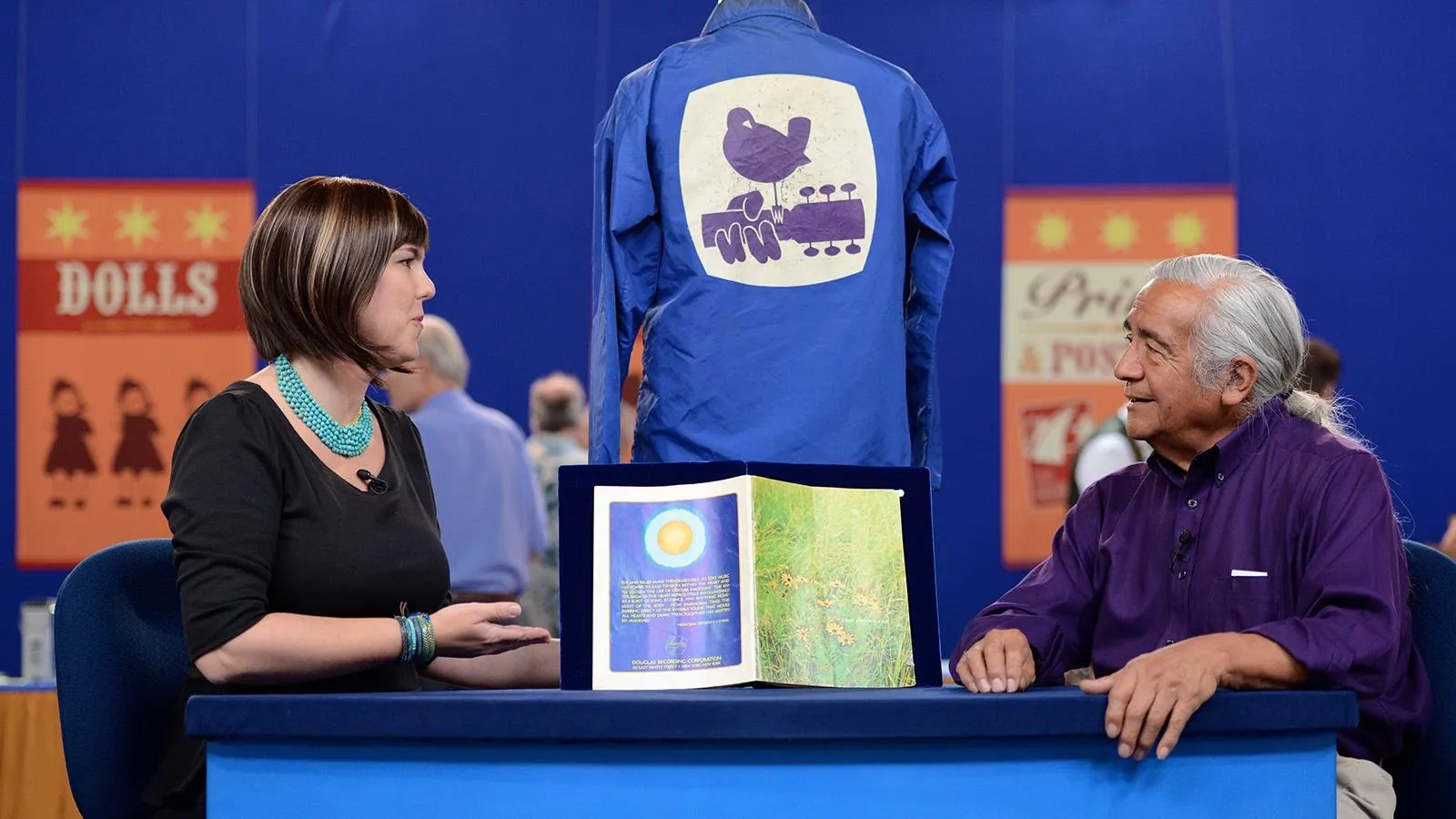
1969 Woodstock Jacket & Program
APPRAISER: Could you tell me the story of how you got these items from Woodstock?
GUEST: The jacket I picked up after everything was over on Monday morning. They were lying there in the mud, and I picked this one up and asked my girlfriend, "Do you want the other one?" She said, "Ew, no." And the program, there was a huge pile of them that was probably ten feet high. They never delivered them. They couldn't get them onto the grounds, and they got them there on Monday morning, and I guess they just dumped them there. But I picked up a whole handful, I've still got the one. It was called the Woodstock Music and Arts Fair, and they had asked a bunch of kids from the Institute of American Indian Arts in Santa Fe to come and be a part of it. They flew everybody in, so we were guests of management. It was really great, because all these guys were coming up and asking, "Where are you guys from?" And they were all excited to see "Indians," quote-unquote. When we first arrived there, we were given two tipis, and so when it rained, we were fine-- and with our passes, we could go to the performer pavilion and get a case of beer if we wanted and sit there dry and drink, and we had a good time. (laughs)
APPRAISER: Well, you had probably a very different experience at Woodstock than your average person who went, because you had passes from management. What you're discussing, bringing in the people from the Institute of American Indian Arts out of Santa Fe...
GUEST: Uh-huh.
APPRAISER: ...is a really well-documented story. And obviously, you were among those people who were lucky enough to go.
GUEST: Right, that's how it worked out, yeah.
APPRAISER: And while you were there, my question is, did you watch any of the acts?
GUEST: Oh, yeah, yeah.
APPRAISER: Who did you see?
GUEST: Well, I guess probably the most, what you might call the important thing, was Jimi Hendrix at the end. I remember waking up, it was still dark, and I heard them introducing him. So I woke up my partner and said, "Let's go down and catch this," and she was a big, huge fan. We were ten, 15 feet away from him while he was playing, and then when he started playing "The Star-Spangled Banner," that was... something that I had never imagined. It was incredible.
APPRAISER: Getting, I'm getting chills just thinking about it. Well, these are priceless memories that you have. We do see these come up for auction from time to time.
GUEST: Mm-hmm.
APPRAISER: There were different colors.
GUEST: Right.
APPRAISER: This is, carries the original logo that was on the poster designed by a man named Arnold Skolnick. You don't have to say Woodstock when you look at this jacket. You see this and everybody knows this is from Woodstock.
GUEST: Yeah.
APPRAISER: But to have one of the original jackets worn by management, and as you said, there are other colors of jackets. There's red and green.
GUEST: Yeah, red was for security.
APPRAISER: Yeah.
GUEST: And then the green was for stage crew.
APPRAISER: When these do come up for sale at auction, they traditionally sell anywhere between $2,000 and $2,500.
GUEST: Mm-hmm.
APPRAISER: And then you also mentioned the program. Because they were never officially kind of distributed there, there were kind of stacks of them that... Same with the tickets, that they just stopped taking tickets because people crashed the gates.
GUEST: Right.
APPRAISER: These are rare. The value on the programs is completely dependent upon condition. So in the condition that you have here, I would expect this one to sell anywhere in the $500 to $600 range at auction-- they have sold for as much as $1,200, but that was a near-mint, fine copy, and that's the difference condition will make on something like this.
GUEST: Oh, yeah, I'm sure.
APPRAISER: So all together, it's a really great group of objects here. And like I said, the memories that you have from the event are worth more than anything I could put a dollar figure on.
GUEST: Yeah, and I remember most of it.
APPRAISER (laughs)
GUEST: No.

$2,500 - $3,100 Auction
$2,500 - $3,100 Auction
Photos


Featured In

episode
Albuquerque, NM, Hour 1
A Woodstock collection, a wedding gown, and a Jane Peterson oil. Which is worth $300,000?
episode
American Stories
Celebrate the history of our country through personal accounts behind standout treasures.
Jacket

appraisal
Egyptian Needlework Jacket, ca. 1925

appraisal
Charles "Heinie" Wagner Red Sox Archive, ca. 1914

appraisal
World War II Painted A-2 Flight Jacket

appraisal
WWII Paratrooper Uniform Group
Understanding Our Appraisals
Executive producer Marsha Bemko shares her tips for getting the most out of ANTIQUES ROADSHOW.
Value can change: The value of an item is dependent upon many things, including the condition of the object itself, trends in the market for that kind of object, and the location where the item will be sold. These are just some of the reasons why the answer to the question "What's it worth?" is so often "It depends."
Note the date: Take note of the date the appraisal was recorded. This information appears in the upper left corner of the page, with the label "Appraised On." Values change over time according to market forces, so the current value of the item could be higher, lower, or the same as when our expert first appraised it.
Context is key: Listen carefully. Most of our experts will give appraisal values in context. For example, you'll often hear them say what an item is worth "at auction," or "retail," or "for insurance purposes" (replacement value). Retail prices are different from wholesale prices. Often an auctioneer will talk about what she knows best: the auction market. A shop owner will usually talk about what he knows best: the retail price he'd place on the object in his shop. And though there are no hard and fast rules, an object's auction price can often be half its retail value; yet for other objects, an auction price could be higher than retail. As a rule, however, retail and insurance/replacement values are about the same.
Verbal approximations: The values given by the experts on ANTIQUES ROADSHOW are considered "verbal approximations of value." Technically, an "appraisal" is a legal document, generally for insurance purposes, written by a qualified expert and paid for by the owner of the item. An appraisal usually involves an extensive amount of research to establish authenticity, provenance, composition, method of construction, and other important attributes of a particular object.
Opinion of value: As with all appraisals, the verbal approximations of value given at ROADSHOW events are our experts' opinions formed from their knowledge of antiques and collectibles, market trends, and other factors. Although our valuations are based on research and experience, opinions can, and sometimes do, vary among experts.
Appraiser affiliations: Finally, the affiliation of the appraiser may have changed since the appraisal was recorded. To see current contact information for an appraiser in the ROADSHOW Archive, click on the link below the appraiser's picture. Our Appraiser Index also contains a complete list of active ROADSHOW appraisers and their contact details and biographies.


