1963 Jerome Tiger "Trail of Tears" Paintings
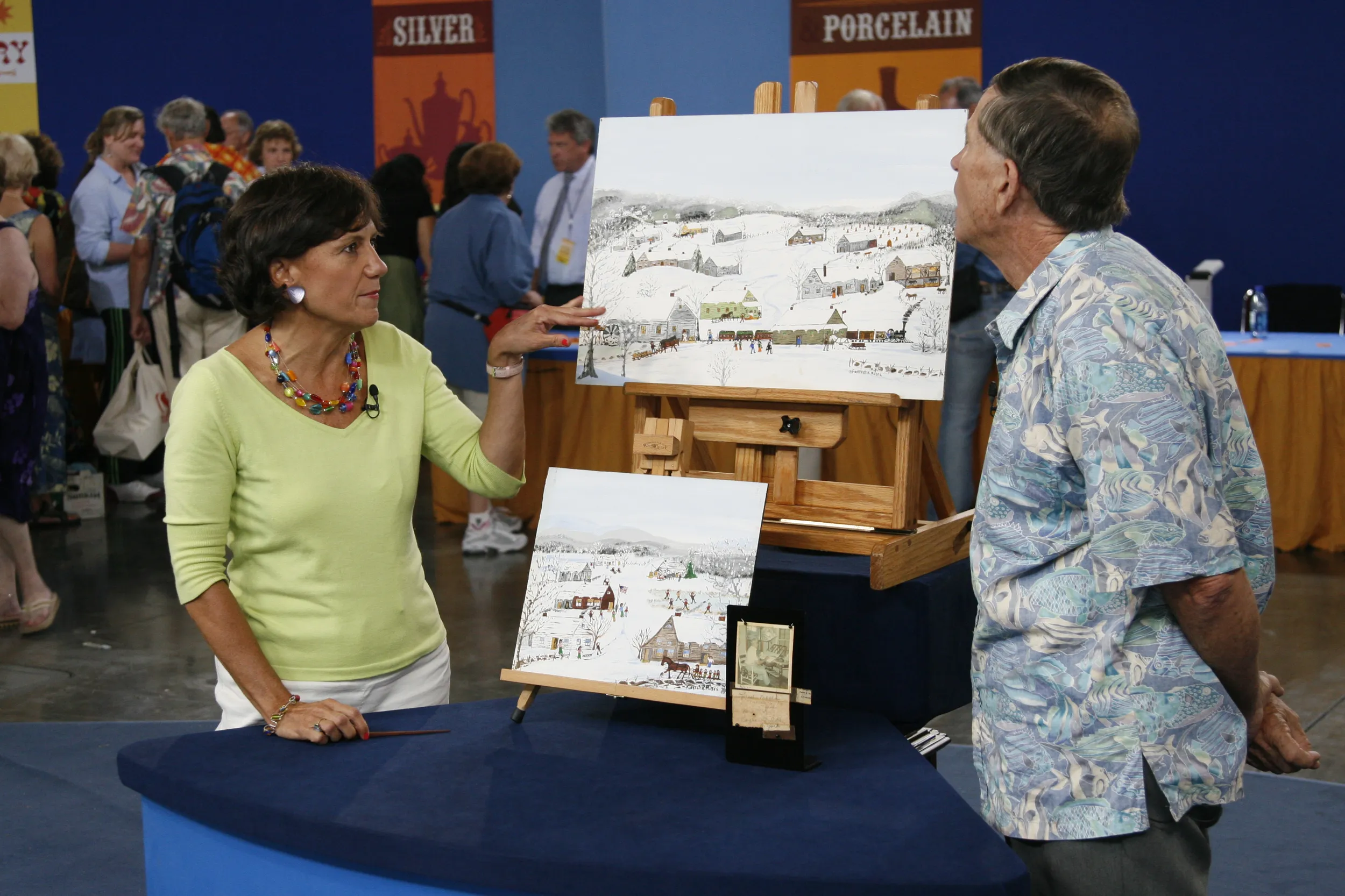
GUEST: My wife and her mother and father, before she was my wife, in 1963, went to Gallup, New Mexico, to the Indian International Tribal Council show and bought that first picture from Jerome Tiger.
APPRAISER: This one?
GUEST: Directly from him at the show. It actually won first prize in the show that year. The second picture, over here, my wife's aunt bought it at the Philbrook in 1963. The history of Jerome Tiger's life and his career is meteoric. He died in '67 in a gunshot situation in Eufaula.
APPRAISER: Yeah, 26 years old.
GUEST: 26 years old, and a tremendous loss. His impact, uh, in the art world was fairly significant. The title of that picture next to you is called The Defeated Ones. He really brought that depth of feeling about what happened to Native Americans really to the forefront.
APPRAISER: Jerome Tiger was born in 1941 in Tahlequah, and I expect the reason he was born in Tahlequah, Oklahoma, is, that's where the big Indian hospital is. But he's Muscogee Creek, and Tahlequah's the Cherokee capital. Both of these paintings Jerome painted in 1963, which was very early in his career. This is a family that suffered a lot of pain. They've had a lot of tragedy. And the way Jerome got through this, as have his relatives and descendants, like his daughter, is by creating great beauty, and the beauty depicts the pain of their history, as well.
President Andrew Jackson, after a war with the Creek tribe, which involved Sam Houston and David Crockett, where the Creeks were brutally put down, signed the Indian Removal Act of 1830 to clear out the Southeast. The first tribe was the Muscogee Creeks. The second the Seminole, Chickasaw, Choctaw, and then his supposed allies in the Creek war, the Cherokee, that Sam Houston was married into. They would ride into one of the towns and say, "We're moving you this week. Pack your things, we're done." The worst of it was in the middle of winter, and everyone suffered. About 3,000 to 5,000 Muscogee people died on the Trail of Tears going to Eastern Oklahoma, which at that time was Indian Territory. That's what these depict. I've never seen one this big with this many figures in it. These are military officers on horseback that are part of the removal team. More people dead in the snow. This did not just set the standard for Native American politics in the 1830s. It set the, the tone for Native American politics with the United States government till today. It just changed their world permanently. And it was a very painful change. They're painted on matboard and they're painted with temper paint and watercolors. He changed the approach to Native American painting, in my thinking. He didn't do just outlined color blocks, which was very popular at that time and before. You see more things in diagonal, as opposed to profile. You see things like this man laying face down in the snow. Do you know what these paintings cost?
GUEST: We have the receipt for the one next to you, for $65. On the back of this one, on the tag from the Philbrook, it's $85.
APPRAISER: They used to never come on the market. He was such an agent of change in the short time he was alive. These paintings, in a retail situation, would sell each $20,000 to $25,000. So $40,000 to $50,000 for the pair.
GUEST: Wow. They're wonderful paintings, and they certainly depict a huge tragedy in American history.
$40,000 - $50,000 Retail
Featured In

episode
Grant's Farm, Hour 2
ANTIQUES ROADSHOW harvests hidden treasures at historic Grant’s Farm in St. Louis, MO. — Mon, May 4, 2026
2D & 3D Art Media

appraisal
Frank Zappa Painting, ca. 1960

appraisal
Edgar Alwin Payne Painting, ca. 1925
appraisal
American School Portrait, ca. 1820
appraisal
Understanding Our Appraisals
Executive producer Marsha Bemko shares her tips for getting the most out of ANTIQUES ROADSHOW.
Value can change: The value of an item is dependent upon many things, including the condition of the object itself, trends in the market for that kind of object, and the location where the item will be sold. These are just some of the reasons why the answer to the question "What's it worth?" is so often "It depends."
Note the date: Take note of the date the appraisal was recorded. This information appears in the upper left corner of the page, with the label "Appraised On." Values change over time according to market forces, so the current value of the item could be higher, lower, or the same as when our expert first appraised it.
Context is key: Listen carefully. Most of our experts will give appraisal values in context. For example, you'll often hear them say what an item is worth "at auction," or "retail," or "for insurance purposes" (replacement value). Retail prices are different from wholesale prices. Often an auctioneer will talk about what she knows best: the auction market. A shop owner will usually talk about what he knows best: the retail price he'd place on the object in his shop. And though there are no hard and fast rules, an object's auction price can often be half its retail value; yet for other objects, an auction price could be higher than retail. As a rule, however, retail and insurance/replacement values are about the same.
Verbal approximations: The values given by the experts on ANTIQUES ROADSHOW are considered "verbal approximations of value." Technically, an "appraisal" is a legal document, generally for insurance purposes, written by a qualified expert and paid for by the owner of the item. An appraisal usually involves an extensive amount of research to establish authenticity, provenance, composition, method of construction, and other important attributes of a particular object.
Opinion of value: As with all appraisals, the verbal approximations of value given at ROADSHOW events are our experts' opinions formed from their knowledge of antiques and collectibles, market trends, and other factors. Although our valuations are based on research and experience, opinions can, and sometimes do, vary among experts.
Appraiser affiliations: Finally, the affiliation of the appraiser may have changed since the appraisal was recorded. To see current contact information for an appraiser in the ROADSHOW Archive, click on the link below the appraiser's picture. Our Appraiser Index also contains a complete list of active ROADSHOW appraisers and their contact details and biographies.


