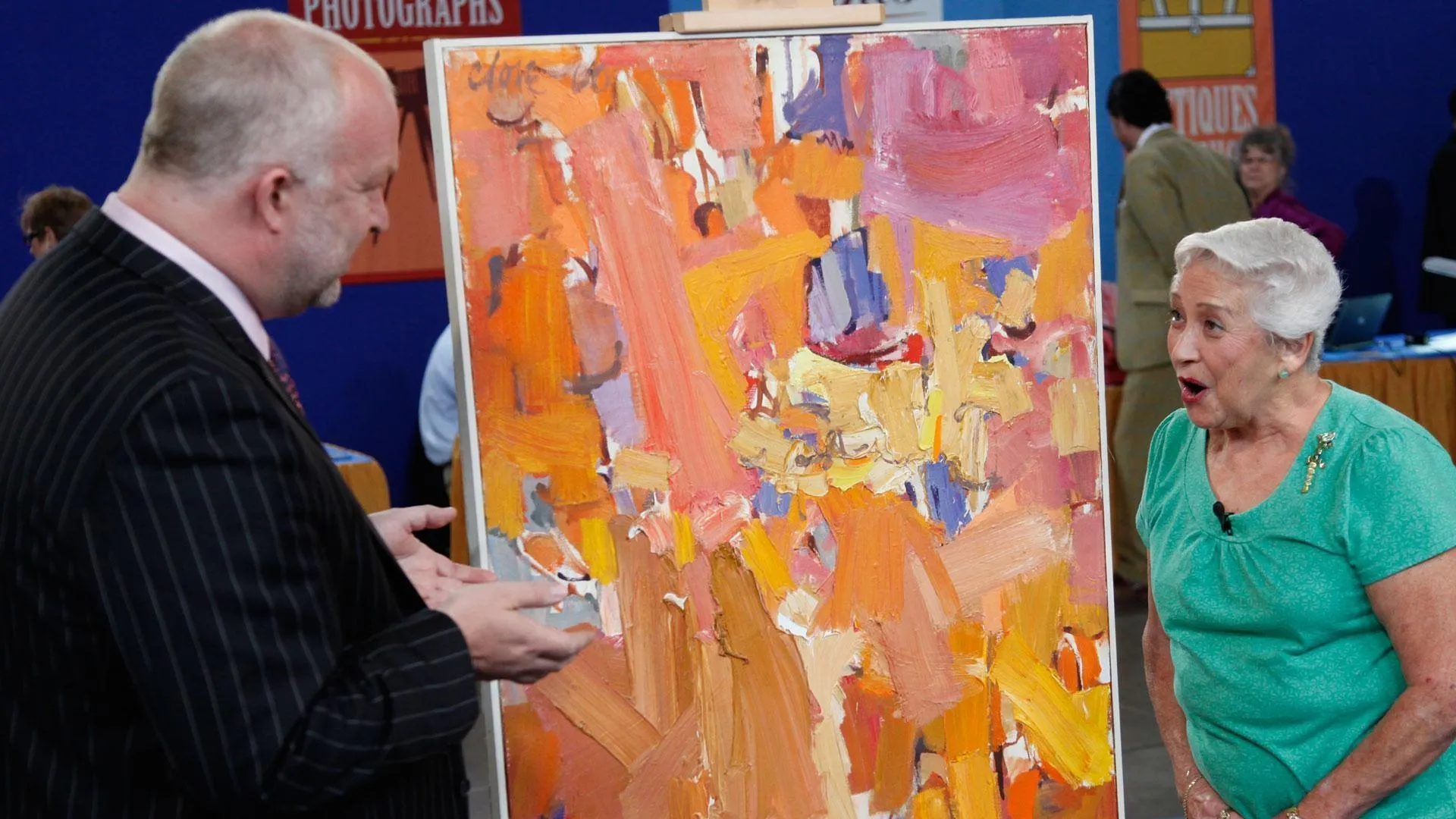
GUEST: This painting was painted by Chuck Close when he was a student at Everett Junior College. He was just a young man. My husband was a drama professor, and Chuck approached him, saying that, "Doc, I need eight dollars. I'm going to be evicted from my apartment tonight." And so my husband said, "But you have eight dollars worth of paint on it." And he said, "But I've got to have eight dollars, Doc." So, Boyd gave him eight dollars, and in 1960, that was... eight dollars was quite a bit, for us. And... brought it home. It's been hanging in my front room ever since. Well, it was a very kind thing for him to do.
APPRAISER: This is dated-- we can see it's signed here, "Close, 1960." So he would have been what-- around about 20 years old when he painted it?
GUEST: Well, I would say 18, 19. That's about the age of students in junior college. And he went from there to the University of Washington and Yale, and then he just, all of a sudden, he was famous.
APPRAISER: Yes, he certainly was.
GUEST: But none of it looked like this.
APPRAISER: That's absolutely right. But when he painted this, he was still very much in thrall to the influence of the abstract expressionists.
GUEST: Oh, yes, very much so.
APPRAISER: Jackson Pollock, Mark Rothko, and, clearly, in this particular case, Willem deKooning. I love this painting. I think it's a fantastic painting. Particularly for a young artist.
GUEST: Well, my husband asked him, "Well, what is it?"
APPRAISER: And what did he say? And he said, "It's 'Man Walking.'" And he said, "Well, how do you figure that?" And he said, "This is the way I feel "in the spring of the year "when I'm out stepping in the bright sunshine and the flowers and the spring of the year."
APPRAISER: Well, obviously this is very different to what he's better known for.
GUEST: Oh, yes-- portraits now.
APPRAISER: Indeed. He really became a prime mover within the photorealist type or realist movement.
GUEST: Definitely.
APPRAISER: And famous for doing the very large portrait heads. I believe he felt that he wasn't a good enough painter to follow on as an abstract expressionist, so he changed tack. I think on the evidence of this, he could have been.
GUEST: Oh, yes. I think it's a magnificent painting.
APPRAISER: This is an early work, work of a young man, but still, I think, a very impressive piece. Have you ever given any thought to what it may be worth?
GUEST: You know, I would expect it to have some value, but what it is, I really wouldn't... I couldn't fathom a guess. It must be in the thousands.
APPRAISER: I would say it was in the thousands. Would you be surprised if I said $100,000 to $150,000?
GUEST: How much?
APPRAISER: At auction, $100,000 to $150,000.
GUEST: Oh, wow. That is a... that is a great deal. It will make my son very happy, because it's in the will for him.
APPRAISER: This is an interesting painting in terms of his development. And who knows, it may even make a little bit more. And not a bad return on the eight dollars that saved him from being thrown out of his digs.
GUEST: Oh, I would say not. My daughter has been saying all day, she says, "And they'll tell you that it's worth eight dollars." But I think you've told me a lot more than that.
APPRAISER: Absolutely.
GUEST: Thank you so much.
APPRAISER: My pleasure.