1959 & 1961 Lynne Drexler Oil Paintings
GUEST: So my great-aunt was an artist, and she studied under Hans Hofmann and wound up becoming friends, uh, with several of the other artists that, that studied along with him. And one of them was a woman named Lynne Drexler. Lynne wound up leaving a, a number of pieces, uh, with my aunt, and when my aunt passed in 2009, uh, I inherited them. And so I've always loved them. About a year and a half ago, I saw a "New York Times" article that talked about Lynne Drexler, and how this artist, who had been in obscurity for decades, was all of a sudden getting interest. So I thought I would bring these and see if I could learn more about them.
APPRAISER: Sure-- where did your, uh, great-aunt live?
GUEST: Provincetown.
APPRAISER: So these are works by Lynne Drexler. Lynne Drexler was born in 1928 in Virginia, and then moved to New York in the, the mid-'50s to study with Hans Hofmann. Hans Hofmann was a very famous painter. He'd come from Germany, and he had an art school in New York City. He was a teacher, and also, later, he had a school in Provincetown, Massachusetts. And many, many important artists from the second half of the 20th century studied with Hans Hofmann.
GUEST: Mm.
APPRAISER: So he's considered one of the great teachers and abstract artists of the 20th century. Lynne Drexler passed away in 1999 on Monhegan Island in Maine, where she had moved for the last years of her life. Lynne Drexler was considered an Abstract Expressionist. These are great examples of her work. This piece is from 1959, and this piece, uh, is from 1961. Both of these paintings are oils paintings on canvas. Both paintings are signed and dated on the back. The smaller one's also titled "Redwood Time." The larger painting is dated 1961, but is not titled. And it was typical for her to sign her paintings on the back-- that way, it didn't disturb the, uh, composition. She was a, really, a brilliant colorist. Like Hofmann, sort of led her compositions with color more than form. A lot of these artists were really overlooked. The, the macho men of that movement were, are the ones that have really been celebrated. But in recent years, there have been several books written and there have been several exhibitions really focusing on the women abstract artists of that period. So your great-aunt was friends with the artist...
GUEST: Yes.
APPRAISER: ...and got these directly from the artist?
GUEST: Yes.
APPRAISER: So, she-- so, what did she pay for them?
GUEST: Uh, nothing. A lot of the artists that would stay with her and up in Provincetown would, you know, trade art, or they would work in each other's studios and leave things behind.
APPRAISER: Sure. The works from the '50s and the early '60s are the most desirable. These are small- and medium-sized paintings for her. The market has really shifted in the last few years. There have been a couple of major galleries in New York and in London and overseas that have done major shows. And so they've started moving into major collections. And they've also done very well at auction. If the smaller painting were to come to auction, I believe that value would be $50,000 to $70,000.
GUEST: Wow, wow. (stammering) Who would have known? I, just a small little painting that I've had on my wall for 15 years. That's amazing.
APPRAISER: And the larger painting, I believe if this painting were at auction, it would sell for between $300,000 and $500,000.
GUEST: Oh, my goodness. I... I'm spee, I'm speechless. Wow, I... I mean, I, I've always just liked them, but I would never have imagined. That's fantastic.
$350,000 - $570,000 Auction
Featured In

episode
Maryland Zoo, Hour 1
Watch astonishing treasures from ROADSHOW’s Baltimore stop! One is $350,000 - $570,000!
2D Art
appraisal

appraisal
Frank Zappa Painting, ca. 1960

appraisal
Edgar Alwin Payne Painting, ca. 1925
appraisal
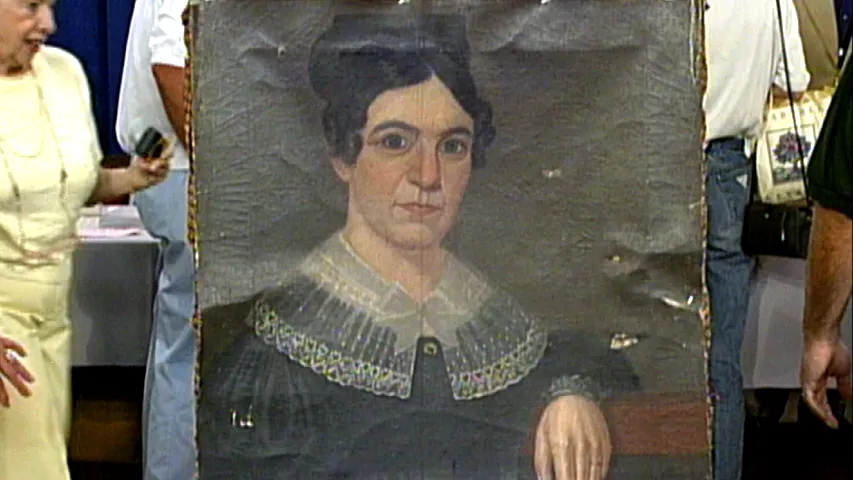
American School Portrait, ca. 1820
Understanding Our Appraisals
Executive producer Marsha Bemko shares her tips for getting the most out of ANTIQUES ROADSHOW.
Value can change: The value of an item is dependent upon many things, including the condition of the object itself, trends in the market for that kind of object, and the location where the item will be sold. These are just some of the reasons why the answer to the question "What's it worth?" is so often "It depends."
Note the date: Take note of the date the appraisal was recorded. This information appears in the upper left corner of the page, with the label "Appraised On." Values change over time according to market forces, so the current value of the item could be higher, lower, or the same as when our expert first appraised it.
Context is key: Listen carefully. Most of our experts will give appraisal values in context. For example, you'll often hear them say what an item is worth "at auction," or "retail," or "for insurance purposes" (replacement value). Retail prices are different from wholesale prices. Often an auctioneer will talk about what she knows best: the auction market. A shop owner will usually talk about what he knows best: the retail price he'd place on the object in his shop. And though there are no hard and fast rules, an object's auction price can often be half its retail value; yet for other objects, an auction price could be higher than retail. As a rule, however, retail and insurance/replacement values are about the same.
Verbal approximations: The values given by the experts on ANTIQUES ROADSHOW are considered "verbal approximations of value." Technically, an "appraisal" is a legal document, generally for insurance purposes, written by a qualified expert and paid for by the owner of the item. An appraisal usually involves an extensive amount of research to establish authenticity, provenance, composition, method of construction, and other important attributes of a particular object.
Opinion of value: As with all appraisals, the verbal approximations of value given at ROADSHOW events are our experts' opinions formed from their knowledge of antiques and collectibles, market trends, and other factors. Although our valuations are based on research and experience, opinions can, and sometimes do, vary among experts.
Appraiser affiliations: Finally, the affiliation of the appraiser may have changed since the appraisal was recorded. To see current contact information for an appraiser in the ROADSHOW Archive, click on the link below the appraiser's picture. Our Appraiser Index also contains a complete list of active ROADSHOW appraisers and their contact details and biographies.


